
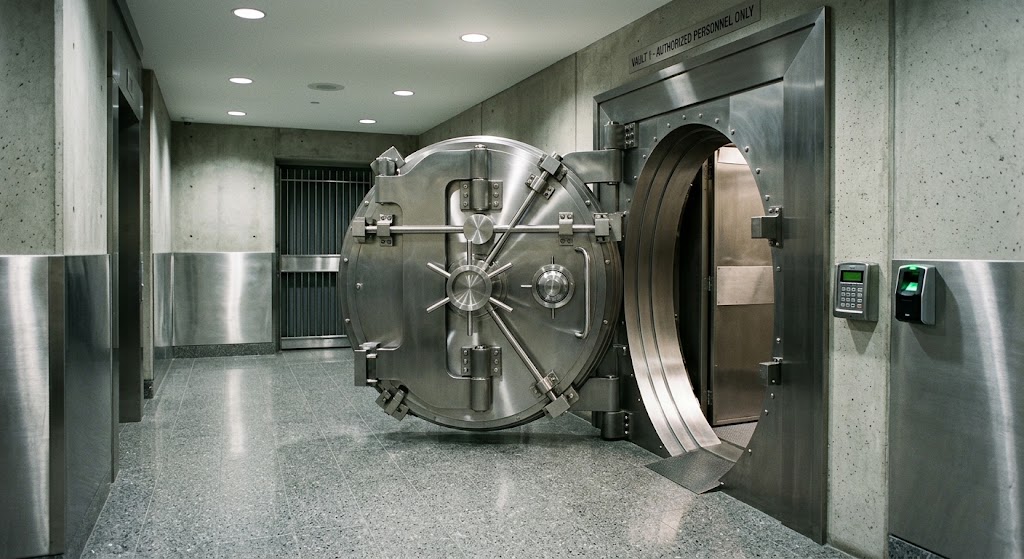
Your most valuable asset.
Your team can hand in their notice on a Friday. Your AI belongs to a company on the other side of the world. The software is rented and the terms change on a Tuesday. What’s left is how you do what you do.
No credit card · 14-day trial · Cancel anytime
Trusted by 100,000+ businesses worldwide
Run the list. It’s shorter than you think.
You’ve built something real. So let’s be precise about what you hold the title to.
- Your team. Good people. Not one of them is yours. Any of them can resign on a Friday afternoon and walk out with fifteen years of how-we-actually-do-it.
- Your AI. It feels like yours. It knows your business, remembers your preferences, answers the way you like. It belongs to Anthropic or OpenAI or Google. Everything it has learned about you sits on their balance sheet, not yours.
- Your software. All rented. Prices move, features get retired, terms get updated without asking.
- Your client relationships. Some are genuinely yours. Plenty live with whoever answers the phone. When a salesperson leaves and three accounts go with them, you find out which was which.
Some things are properly yours. Your brand. Your premises. The equipment. The trademark. Real assets and worth having.
But none of them are the thing that makes the business work.
The thing that makes it work is how you do what you do. The way a job gets quoted. The reason you call that supplier first, not second. The order the work has to happen in. That’s the business. And it’s the only item on the list that can’t resign, can’t reprice itself and can’t be acquired by somebody else.
Knowing how isn’t the same as owning how.
Here’s the thing. If that knowledge lives in people’s heads and a few private AI accounts, you don’t own it either. You’re renting it from your own team, one pay cycle at a time.
An asset is something you can hand to someone else. Sell it, borrow against it, pass it to your kids, show it to a buyer. If the only way to transfer how your business runs is a three-week handover and a lot of hoping, it isn’t an asset yet.
It’s a habit.
That’s the uncomfortable sentence and it’s also the good news, because habits can be written down.
Four things turn a habit into an asset.
None of them are complicated. It has to be:
- Written down. Plain English, one place. Not a drive full of files where nobody can tell which version is current, so the team stops looking and asks you instead.
- Owned by a name. One person accountable for each process. Not a committee and not “the team”.
- Dated. A review date, so you know whether you’re reading how the business runs or how it ran in 2023.
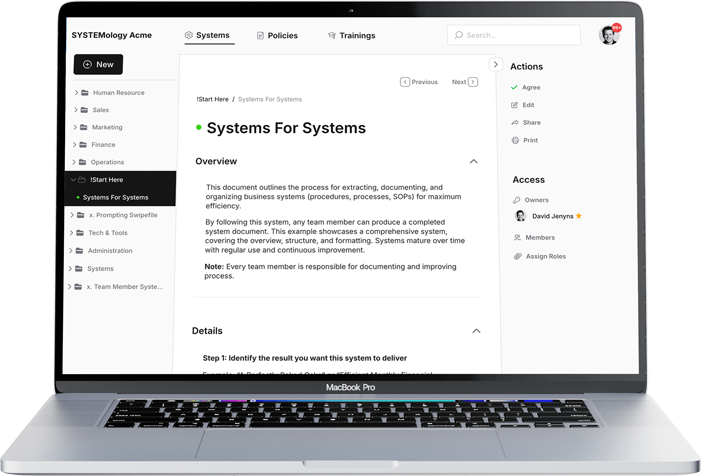
- Readable by both. Your new hire opens it and does the job. Your AI reads the same record and answers from it. One source, no second copy quietly drifting out of date in the background.
Do that and how-you-do-what-you-do stops being folklore. It becomes something with your name on it.
What it looks like when the asset is real.
The only cancellation email we’ve ever celebrated.
They exported it and left

The South Melbourne front office. The trophies on the counter came before the sale did.
In June 2019, PETstock bought DiggiddyDoggyDaycare. During the handover their team logged into systemHUB, exported every process Jeanette Farren had documented, walked the lot into their own enterprise platform and cancelled the subscription.
That one transaction is the whole argument. The software was a container. The asset was what was inside it. When a corporate buyer paid a high multiple of profit for a dog daycare that everybody told Jeanette was impossible to systemise, the operating manual was what they were buying. They took it with them. They didn’t need us any more.
“The first areas corporate buyers look at when valuing a business are its accounts and systems. The earlier people can educate themselves about systems, the better.”
Jeanette Farren, co-founder, DiggiddyDoggyDaycare
Jeanette would know. She was a financial controller before the daycare and she treated the business like a property build the whole way through: an asset under renovation that would one day go to market.
Twelve months of work with her team turned scattered procedures into one documented flow. Profit rose 25 percent along the way, because processes that had been quietly losing money finally got found and fixed.
12 months
to document the business, working alongside her own team
25%
profit lift, from processes that had been quietly losing money
~75%
of the buyer’s due diligence already sitting in the account
Then the part that matters most. By the time the deal closed she didn’t have to sell. She had stopped going into the office completely and the business ran without her. She could have held it under management, franchised it or run it quietly for another decade. She sold because after thirteen years she wanted to travel.

Jeanette & Nicole Farren
“A business that needs you is not an asset. It is a job with a logo on the door.”
You don’t have to sell it. You do want to be able to.
Most owners start this work after they’ve already decided to leave. Which means building the asset at the exact moment they’re most exhausted and least leveraged. A buyer can smell it.
The time to make a business ownable is while you still want to keep it.
Not because you’re planning an exit. Because the same work that makes a business sellable is the work that makes it survivable, hireable and possible to step away from for three weeks without your phone going off.
“Whether or not you sell is completely up to you, but at least you want to have the option, because you don’t know what’s going to get thrown at you.”
David Jenyns, founder, systemHUB
Start owning how you do what you do.
Document the first process today. It’s the one thing in this business nobody can resign from or reprice.
Start your free trialOn AI

Rent the AI. Own the brain.
The AIs are becoming interchangeable. Your business isn’t. So point whichever model is winning this month at your own documented processes, then swap it out when a better one ships. Nothing to migrate, nothing to re-teach, nothing lost. The engine is a rental. The driver is yours.
Other paths to the same destination.
Lose the person, keep the knowledge
Capture what walks out the door when somebody resigns, while everything is still calm.
Build to sell
Make the business worth buying and able to run without you when a buyer asks.
Stop being the operator
Stay the owner. Step out of running it. The Systems Champion model makes the handover stick.
Straight answers.
Fair question and the DigDog story is the honest answer. Your systems are plain readable documents. Export them, print them, hand them to a new hire or a buyer or a completely different platform. PETstock did exactly that and we were pleased about it.
Now ask an AI platform to hand over everything it has learned about your business and see what you get back.
You own the list. What you often don’t own is the relationship, or the reason that client stays. That tends to live with one person. Document how those relationships actually get handled and you own something a lot more durable than a spreadsheet of names.
No, it’s your best starting material. Pull out what it has learned, get it documented properly and it becomes permanent instead of trapped. Every AI you connect after that starts warm.
More, not less. With five of you, one person leaving takes a fifth of the operating knowledge out the door. Small is also the easiest time to capture it, because there’s less of it and no legacy to unpick.
Not everything, which is how most attempts die in the first fortnight. Start with the money path: how a customer goes from first contact to paid. That’s usually 10 to 15 processes and it covers most of what actually runs the business. Simple beats perfect.
Jeanette was told the same thing about a building full of 80 dogs and 1,500 owners. What you’re documenting isn’t the judgment, it’s everything around it: the sequence, the standards, the handoffs, the questions worth asking. That’s most of the job and it’s the part that keeps walking out the door.
Start with one.
You own how you do what you do. Right now it’s probably in your head, in your team’s heads and in a couple of private AI accounts. That isn’t ownership. It’s familiarity.
Pick the one process that would hurt most if the person who does it resigned tomorrow. Write that one down. You’ll own more of your business tonight than you did this morning.
Free trial · No credit card · Cancel anytime