
What Is a Business Playbook? How to Build One That Actually Gets Used
Not a slide deck. Not a mission statement. A working document your team can actually run the business from, starting with the flow it’s built on.
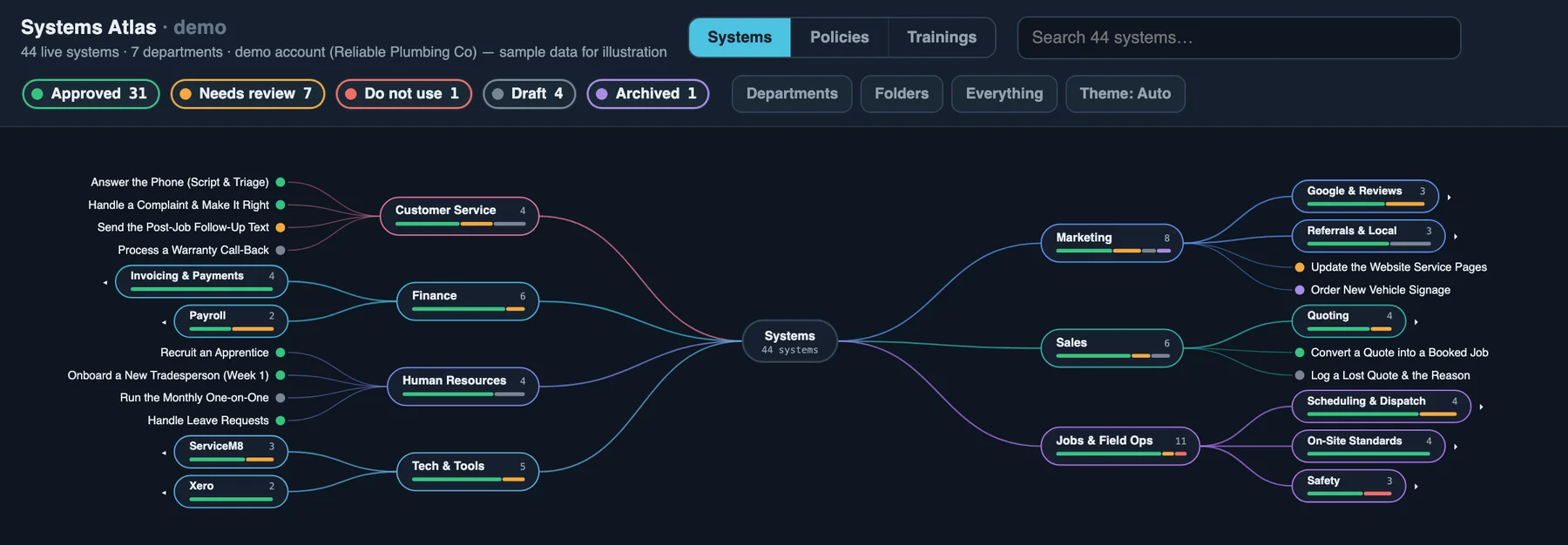
What a working playbook looks like: 44 systems across 7 departments, mapped from a systemHUB account (sample data).
Most business playbooks never get opened twice. Someone spends a weekend writing one, it gets a proud mention in a team meeting, and six months later nobody can find it, let alone follow it.
That’s not a discipline problem. It’s a structure problem. A playbook built from a generic template captures the sections everyone expects, an org chart, a mission statement, a list of policies, but it skips the one thing that makes a playbook worth having: the actual flow your business runs on, and the systems that keep it moving.
Here’s what a business playbook really is, what it needs to include, and how to build one starting from the part that matters.
What is a business playbook?
A business playbook is a documented, working version of how your business runs day to day. It holds the path a client moves through, the systems that support each stage of that path, and who owns what. Someone new to the business should be able to read it and understand how things actually get done, not how they’re supposed to get done in theory.
That’s the test worth applying to anything calling itself a playbook: if your best person left tomorrow, could someone else pick it up and run the business from what’s written down? A logo and a mission statement won’t get them there. The working detail will.
Playbook, SOP, or policy: what’s the difference?
An SOP (standard operating procedure) is the instructions for one task: how to onboard a client, how to process a refund, how to close out a job. It’s the smallest working unit.
A policy is a rule, not a process: what your leave entitlements are, what your data handling standard is, what’s acceptable and what isn’t.
A playbook is a collection of SOPs organised around how your business runs, usually the stages a client moves through. It shows which SOPs and policies sit under each stage and why. An SOP tells you how to do one thing well. A playbook tells you how all of it fits together.
Handbooks, process documents, and work instructions add a few more terms to the mix. Here’s how they all compare.
What a real business playbook should include
- Your Critical Client Flow. The seven to twelve stages a client moves through, from first contact to done, in your own words. This is the spine everything else hangs off.
- The systems that sit under each stage. Not every process you can think of, the handful that matter most at each stage of the flow.
- Clear ownership. Who runs each system, and who is the Systems Champion driving the documentation itself.
- Company foundation. Mission, values, and org chart are useful context, but they support the playbook. They aren’t the playbook.
- A review rhythm. A playbook that never changes is a playbook nobody trusts. Build in who checks it and when.
Notice what’s first on that list. Most templates start with the company foundation and treat the flow as an afterthought, if it appears at all. Start with the flow instead, and the rest of the playbook has something real to attach to.

A finished Critical Client Flow: the stages a client moves through, with the bottleneck circled.
How to build a business playbook, step by step
-
Map your Critical Client Flow
Pick one offer, the one that pays the bills, and map how a client moves through it today, not how you’d like it to work. Seven to twelve stages is the right range. Thirty means you’re describing tasks, not the flow. Our free generator does this in about ten minutes.
-
Find the bottleneck
Look at the finished flow and ask where things break down: where clients get stuck, where you personally get pulled in, where quality depends on who’s handling it. That’s where you start.
-
Identify the systems under each stage
You don’t need a hundred systems. You need the ten or so that matter most, one or two per stage. This is your Minimum Viable Systems, the priority list the rest of your documentation builds from.
-
Document the systems, starting with the bottleneck
Have the person who actually does the work write the steps, not the owner. A template removes the blank page so the writing itself isn’t the barrier.
-
Assign a Systems Champion and a review date
One person owns keeping the playbook current. Without an owner and a date, it drifts out of date within a year and nobody notices until it costs them.
A playbook in action

Gary McMahon,
Ecosystem Solutions
Ecosystem Solutions: from tribal knowledge to peer-reviewable standard
Gary McMahon runs Ecosystem Solutions, an ecological consulting firm where the work is scientific assessment and compliance reporting, the kind of output that has to hold up to outside scrutiny. Before the playbook, quality depended on who was doing the assessment that week.
Gary mapped his Critical Client Flow first, then built the systems underneath it: assessment methodologies, data collection standards, peer review checklists. The firm now onboards new consultants against a documented standard instead of tribal knowledge, delivers consistent quality across projects, and has substantially cut its compliance risk.
“Peer-reviewable methodology IS the product. systemHUB is where ours lives.”
Watch Gary’s story →Common mistakes when building a business playbook
- Starting with the org chart, not the flow. Structure is easy to write and doesn’t tell anyone how work actually moves. Start with the client flow instead.
- Writing it yourself. Owners are usually too close to the work to document it well, and the team won’t trust a version they didn’t help write.
- Documenting everything at once. Fifty processes at once means the effort stalls in week two. Start with the one stage causing the most pain.
- No owner, no review date. A playbook nobody’s responsible for is a playbook that goes stale, quietly, until someone relies on the wrong version.
Frequently asked questions
What is a business playbook, in one sentence?
A documented, working version of how your business runs day to day: the flow a client moves through, the systems behind each stage, and who is responsible for what.
What’s a good business playbook example?
A consulting firm whose playbook maps client onboarding through delivery to renewal, with documented assessment methods and peer review checklists under each stage, is a working example. Ecosystem Solutions above is a real one.
Is a business playbook the same as an employee handbook?
No. A handbook covers culture, conduct, and HR policy. A playbook covers how the business actually delivers its work. Most businesses need both, and they serve different readers. See the full comparison.
How long does it take to build a business playbook?
Mapping the Critical Client Flow takes about ten minutes with a guided tool. Documenting the systems underneath it properly is a bigger project, usually weeks, and depends on how much is already written down.
Do I need software to build a business playbook?
No, a playbook can live in a document. Software helps once it needs owners, review dates, and version history attached, so it stays current instead of becoming another forgotten file.
Start with your Critical Client Flow, free
Map the flow your playbook builds from in about ten minutes, no account needed. Or talk to us about building the whole thing properly.