
Playbook vs Handbook vs SOP vs Policy: What’s the Difference?
Four terms that get used interchangeably and shouldn’t be. Here’s what each one is, what people also call them, and how they fit together.
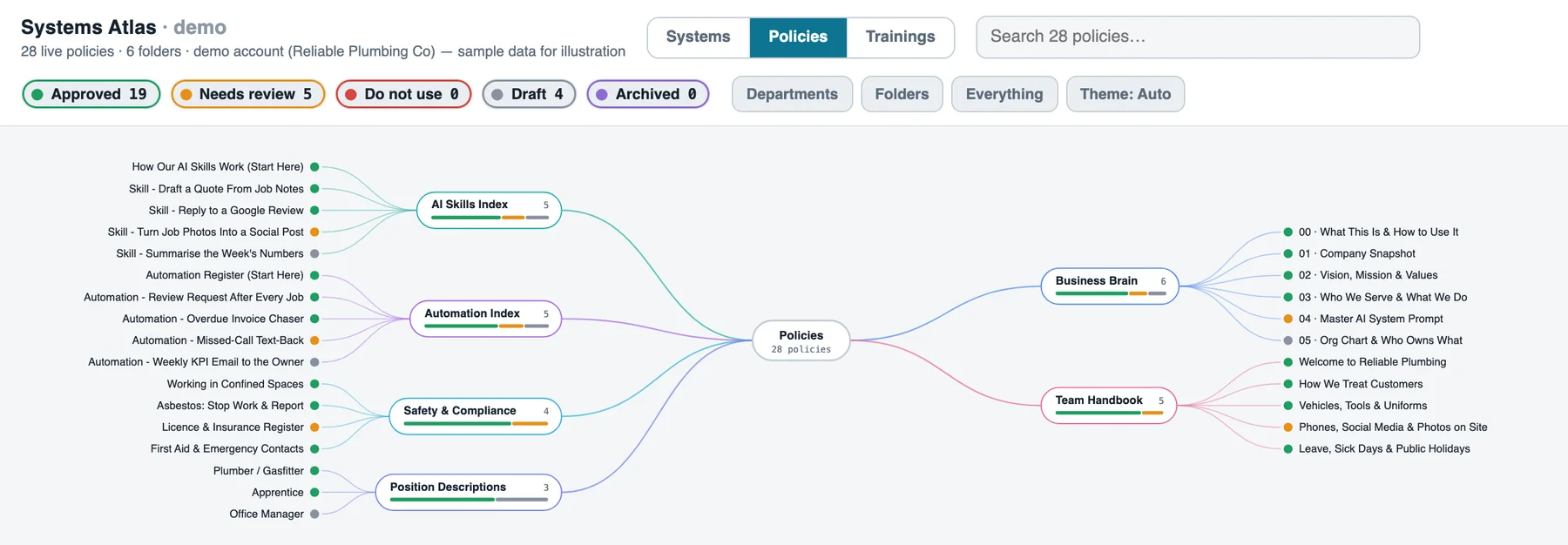
Where it all lives: policies, an AI skills index, automations and a team handbook mapped in one place (sample data).
The same document can be called three different things depending on who’s in the room. One team’s “process doc” is another team’s SOP, and a third team calls it a how-to. That’s fine day to day, but it causes real confusion when you’re deciding what to build first and where each thing should live.
Here’s the short version.
A policy is a rule.
An SOP is how to do one thing.
A playbook is a collection of SOPs organised around how your business runs.
A handbook is what your team reads: culture, policies, and the key procedures they need.
A skill is a newer term: an SOP written for an AI instead of a person.
The four terms side by side
| Term | What it is | Who it’s for | Example | Also called |
|---|---|---|---|---|
| SOP | Step-by-step instructions for one task or process | Whoever does the task | How to onboard a new client | Procedure, process document, how-to, work instruction, checklist |
| Policy | A rule or standard: what is required, allowed, or expected | Everyone, enforced by managers | Leave policy, data handling policy | Standard, guideline, code of conduct |
| Playbook | A collection of SOPs organised around how the business runs, usually your client flow | Owners, managers, and anyone learning how the business works | A business playbook from first enquiry to repeat client | Operations manual, business manual |
| Handbook | The document every team member reads: culture, policies, conduct, and key procedures | The whole team, especially new starters | A team handbook | Employee handbook, staff handbook |
SOP, process document, how-to, work instruction: are they the same thing?
For most small businesses, yes. Teams use “process document”, “how-to”, “procedure”, and “SOP” to mean the same thing: written steps someone can follow to get a task done the right way.
There is a technical difference. A process is what happens, the flow of work from start to finish. A procedure is the written instructions for carrying it out. In manufacturing and quality-managed environments, a work instruction usually means the detailed steps for a single task, while an SOP covers the wider procedure around it. Most businesses don’t need that distinction.
What matters is picking one word and using it everywhere, so your team knows what to look for. If you want the full definition, see what an SOP is and the five things every one needs.
How they fit together
Each one has a different job, and they stack.
- Policies set the rule. For example: refunds are approved within 30 days, by a manager.
- SOPs explain how. The steps to actually process that refund, in order.
- The playbook organises the SOPs. The refund SOP sits under the “after the sale” stage of your client flow, next to the other systems that stage relies on.
- The handbook gives the team what they need. The refund policy is in it, with a pointer to the SOP for anyone who handles refunds.
Same refund, four documents, four different jobs. None of them replaces the others.
A newer term: skills, or SOPs for AI
If you’ve been using AI tools, you may have seen the word skill. It’s the same idea as an SOP with a different reader. A skill is a written set of instructions an AI can follow, so it does a task the way you want it done, every time. Tools like Claude and ChatGPT now support them: you write the instructions once, and the AI uses them whenever that task comes up.
A skill looks a lot like an SOP. It says when to use it, lists the steps in order, describes what good looks like, and usually includes an example or two. The difference is who’s reading. An SOP is written for a person. A skill is written for an AI.
That’s one more reason documented SOPs matter. A well-written SOP is most of the work of a skill already, because the steps are written down. A business with its processes documented can turn them into skills quickly. A business without them is asking the AI to guess.
The same logic applies as with SOPs. One skill helps one person. A collection of skills, kept in one place, shared with the team, and reviewed as things change, starts to look like part of the business’s intellectual property: the way your business does things, written down in a form an AI can use.
If you already have SOPs, you can turn one into a skill in a few minutes with our free Claude skill creator.
Which one do you need first?
- Your team keeps asking the same questions. Start with SOPs, beginning with the one causing the most pain. The template library removes the blank page.
- Nobody can see how it all fits together. Start with a playbook, built from your Critical Client Flow. Here’s how to build one.
- You’re hiring and need to set expectations. Start with a team handbook.
- You use AI for the same task again and again. Turn the SOP behind that task into a skill, so the AI does it your way.
- You have a legal or compliance requirement. Start with the specific policies that requirement calls for.
Most businesses end up with all four. The order matters less than starting with the one that’s costing you time right now.
Frequently asked questions
Is a playbook the same as an SOP?
No. An SOP covers one procedure. A playbook is a collection of SOPs organised around how your business runs, so you can see how the pieces connect.
Is a business playbook the same as an employee handbook?
No. A handbook is written for the team and covers culture, conduct, and HR policy. A playbook covers how the business delivers its work. Most businesses need both, for different readers.
What’s the difference between a process and a procedure?
A process is the flow of work: what happens, in what order. A procedure is the written instructions for carrying that process out. In everyday use the two are often swapped, and that’s usually fine.
Is a work instruction the same as an SOP?
Often, in practice. In manufacturing and quality systems, a work instruction is usually the detailed steps for one task, while an SOP covers the wider procedure. Most small businesses use the terms interchangeably.
What is an AI skill?
A written set of instructions an AI follows to do a specific task the way your business does it. Think of it as an SOP written for an AI instead of a person.
Are skills replacing SOPs?
No. Skills are built from SOPs. Your team still needs procedures they can follow, and the AI needs the same steps in a form it can use.
Do I need all of them?
Not at once. Start with the one solving your biggest problem right now, usually SOPs, and build outward from there.
Start with one system
Pick the task your team asks about most and document it. Or map the flow your whole playbook builds from.