
The invisible business
Your business is running on things you can’t see.
Every business runs on knowledge. The real question is where that knowledge lives, and whether anyone but its owner can get to it.
Where it lives
How you do things lives in three places.
For 20 years the answer was “in the owner’s head.” That problem is well understood and we know how to fix it. There’s a new one, and most owners haven’t noticed it yet.
Nobody wrote it down
The way your best estimator prices a job. The reason you always call that supplier first. It works, right up until that person takes a holiday or hands in their notice.
Nobody knows what’s current
A drive full of files. Some current, some three years old. Nobody can tell which from the outside, so the team stops looking and asks you instead.
Nobody knows it exists
A prompt someone built for quoting. A custom GPT that scopes jobs. An automation that chases invoices while everybody sleeps.
Here’s the thing: only one of those three is visible to anyone other than the person who built it. And it isn’t the third one.
Works with



The new problem
AI is quietly making your knowledge invisible again.
We spent 20 years getting knowledge out of the owner’s head and into something a team could follow. That was the entire job.
AI is reversing it. Not because AI is bad, but because of where the work ends up.
When someone builds a prompt that prices a job, they have documented a process. A real one. Often better than the version sitting in your drive. But it lives in their private account, under their login, with no owner, no review date, and no way for anybody else to know it exists.
That is a system. It’s just an invisible one.
It’s worse than knowledge in someone’s head, because you can at least ask a person how they do it. You can’t interview an automation. When it breaks, or the person leaves, or the model gets retired, nobody knows what it was doing or why.
None of this shows up as a problem. That’s what makes it a problem. It shows up 18 months later as a job priced wrong, an onboarding that takes three months, or a buyer walking away because you can’t show them how your business runs.
Do this first
Where does your knowledge actually live?
Take 10 minutes. Write down the five things your business does most often. Quoting, onboarding a client, ordering stock, whatever yours are. Then ask three questions of each.
Could someone else do it?
Without calling you. If the answer is “they’d figure it out”, that’s a no.
Is it written down, and current?
Not “is there a document somewhere”. Would you hand it to a new hire on Monday?
Is any of it running through an AI?
A prompt, a custom GPT, an automation. If yes, who else knows it exists?
Most owners can’t get clean answers on more than one or two. That’s the point of the exercise. You don’t need us to do this and you might not need us afterwards. But you can’t fix what you can’t see, and this is the cheapest way to see it.
What visible looks like
One place humans and AI read the same thing.

The record of how your business runs. Plain English, owned by a real person, with a date on it. That single record does two jobs at once.
Your team runs off it
A new hire opens the process and does the job. No guessing, no asking you, no digging through a drive.
Your AI reads off it
Connect systemHUB to Claude or ChatGPT and the AI answers from your live processes, not from a copy somebody pasted in six months ago and forgot about.
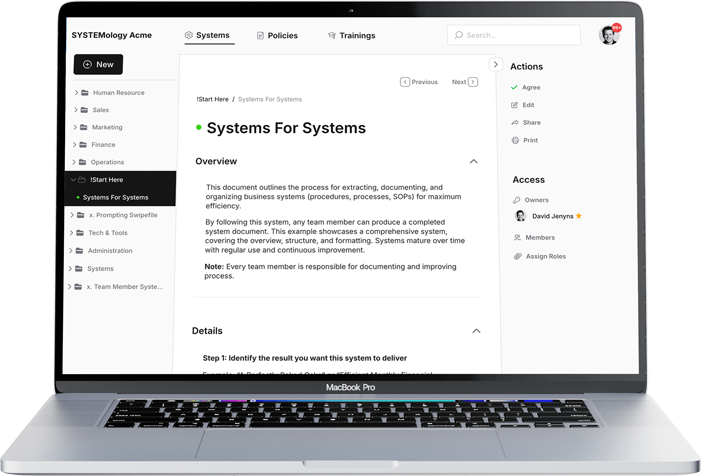
Same source. One version. Nothing drifting apart in the background while you’re not looking. The connection is called MCP, and it’s what turns an AI that guesses how your business works into one that knows.
See how the connection works →
Stop guessing where your knowledge lives.
Pick the one process causing the most pain this week and get it out of the invisible layer. That’s the whole first step.
Free trial · The SYSTEMology method is built in, so you’re not starting from a blank page
Proof
“We documented first. Then the AI was worth 1,000 hours.”
Shannon Smit was the bottleneck in her own accounting firm. 70-hour weeks, and the critical knowledge sat in her head where nobody else could reach it.
They mapped the client flow, documented the core systems, and put them in systemHUB. Then her son Ryan took the Systems and AI Champion seat and automated file-noting across three separate systems. Over 1,000 hours a year, from the first bot.
The order matters. The AI was worth that much because the process was already written down and somebody owned it.

Shannon Smit & Ryan · SMART Business Solutions
2024 Australian Accounting Awards — Multiservice Firm of the Year
Control and proof
Visible doesn’t mean visible to everyone.
Your AI shouldn’t know everything
Once you point an AI at your business you have a question nobody had to answer before: what is it allowed to see?
Your team needs the install process. They don’t need your margins. Your AI needs to understand how you quote. It doesn’t need the salary review.
In systemHUB you control access document by document, for people and for the AI. Roles, individuals, or a single link for a contractor who needs one process and nothing else.
You can see who has signed off
Documenting a process is the easy half. Knowing it’s been taken on board is the half that matters.
systemHUB shows you who has signed off on each process and who has completed the training attached to it. Not a guess. A record, with a name and a date against it.
No AI brain can do that. Neither can a folder of documents. It’s the difference between hoping your team is aligned and being able to prove it.
Agnostic by design
Don’t build your business inside one tool.
Models get retired. Providers change their terms. The AI you’re using today is not guaranteed to be the AI you’re using in two years, and that decision won’t be yours to make.
This isn’t doomsday planning. It’s the same thinking you’d apply to a key supplier or a key staff member. Lock-in is key person dependency wearing a different hat.
Because systemHUB holds your processes in plain, human-readable form, you’re never locked in. Point a different AI at it tomorrow and nothing is lost. Turn the AI off completely and your team can still open the page and do the job.
One record, read by your team and read by your AI. That’s what keeps you current, and what keeps you standing if the tools change.
Related Outcomes
Other paths to the same destination.
Systems Insurance
Pay the premium before the event. You can’t buy cover during the fire.
Learn more → OwnershipYour Most Valuable Asset
You don’t own your staff or your AI. Only how you do what you do.
Learn more → Key PersonLose the Person, Keep the Knowledge
Capture it while things are calm, not during a notice period.
Learn more →Make it visible.
Do the 10 minute stock-take first. Five processes, three questions each. It tells you where your knowledge is really sitting.
Then start with one. The process causing the most pain this week. Get it out of the invisible layer and into a place your team and your AI can both read.
That’s the whole thing. It was never about where you keep your SOPs. It’s about whether anybody other than you can see how your business actually runs.
Weighing up your options? See how the five places knowledge can live compare →
Or see how systemHUB connects to your AI →
Built on SYSTEMology®, the framework behind the book