
What Is a Business Brain? The Most Important Asset You Own
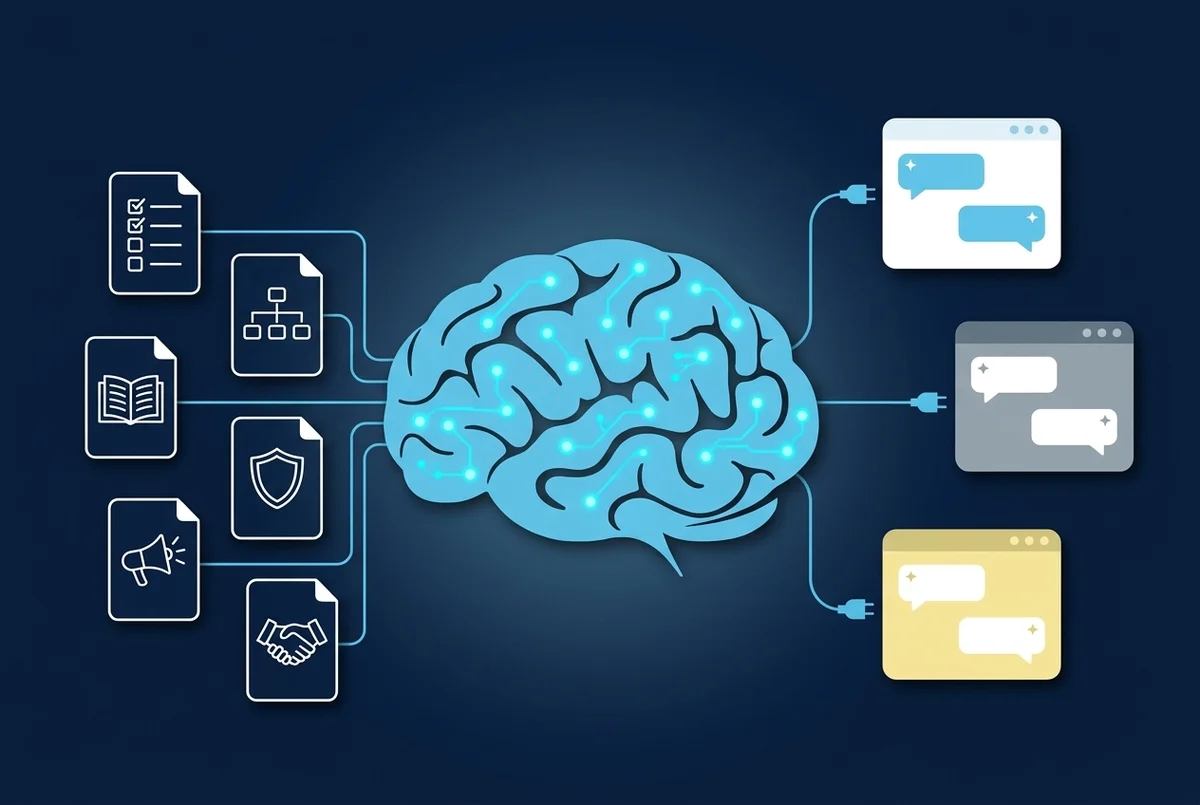
A business brain is one central place that explains how your business works. Written down, owned by you and readable by your team and any AI you choose to connect.
By David Jenyns, founder of SYSTEMology and systemHUB
A business brain is your whole business, written down in one place
A business brain is the single place where how your business works is written down: who you are, who you serve, what you sell, how you sound, how the work gets done and who owns what.
It is plain English. It lives in a system you control. Your team reads it. So does any AI you decide to connect.
You will hear it called a company brain, a business playbook or an operating manual. The words change and the idea doesn’t. Instead of living in your head, your best person’s head and a Drive folder nobody opens, the way your business runs lives in one record that anyone can find.
I have spent years helping owners get their business out of their heads and onto the page. The ones who do it properly all end up in the same place. The business runs without them and they get to decide what happens next.
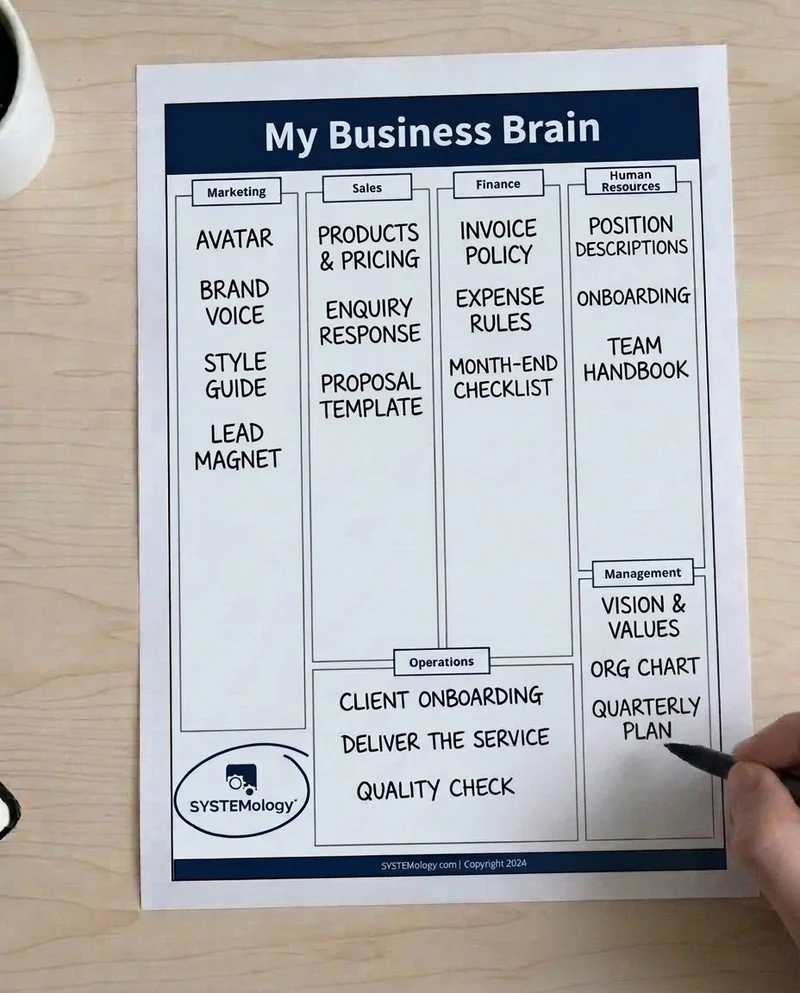
Where does your business actually live today?
Be honest about it. Some of it is in your head. A lot of it is in the heads of two or three people you would hate to lose. The rest is scattered across a Drive folder, half a handbook, a dozen email threads, a pile of software and, more and more, the chat history of whichever AI you have been teaching.
That works until someone resigns, takes three weeks of leave or gets sick. Then you find out how much was never written down.
It is also expensive. According to Payscale, SHRM puts the cost of replacing an employee at 90 to 200 percent of their annual salary. One of the hidden costs it lists is the loss of “tribal knowledge”. That is everything the person knew that nobody else did.
An asset is something you can hand to someone else. If handing over your business means a long handover and a lot of hoping, you don’t have an asset yet. You have a habit. Habits can be written down. That is what a business brain is.
Eight things every business brain holds
You don’t need all eight on day one. This is the full picture of what you are building towards.
Who you are
Your vision, mission, values and goals, plus the non-negotiables. See our guide to company core values.
Who you serve
Your ideal client, what keeps them up at night, the words they use and who you are not for.
What you sell
Products and services, pricing, guarantees and the proof that it works.
How you sound
Brand voice, style guide, the phrases you use and the ones you would never use.
The rules
Policies, compliance, delegation limits and what to do when something goes wrong.
If you have read our guide to the playbook, the handbook and the SOP, think of those as rooms. The business brain is the house.
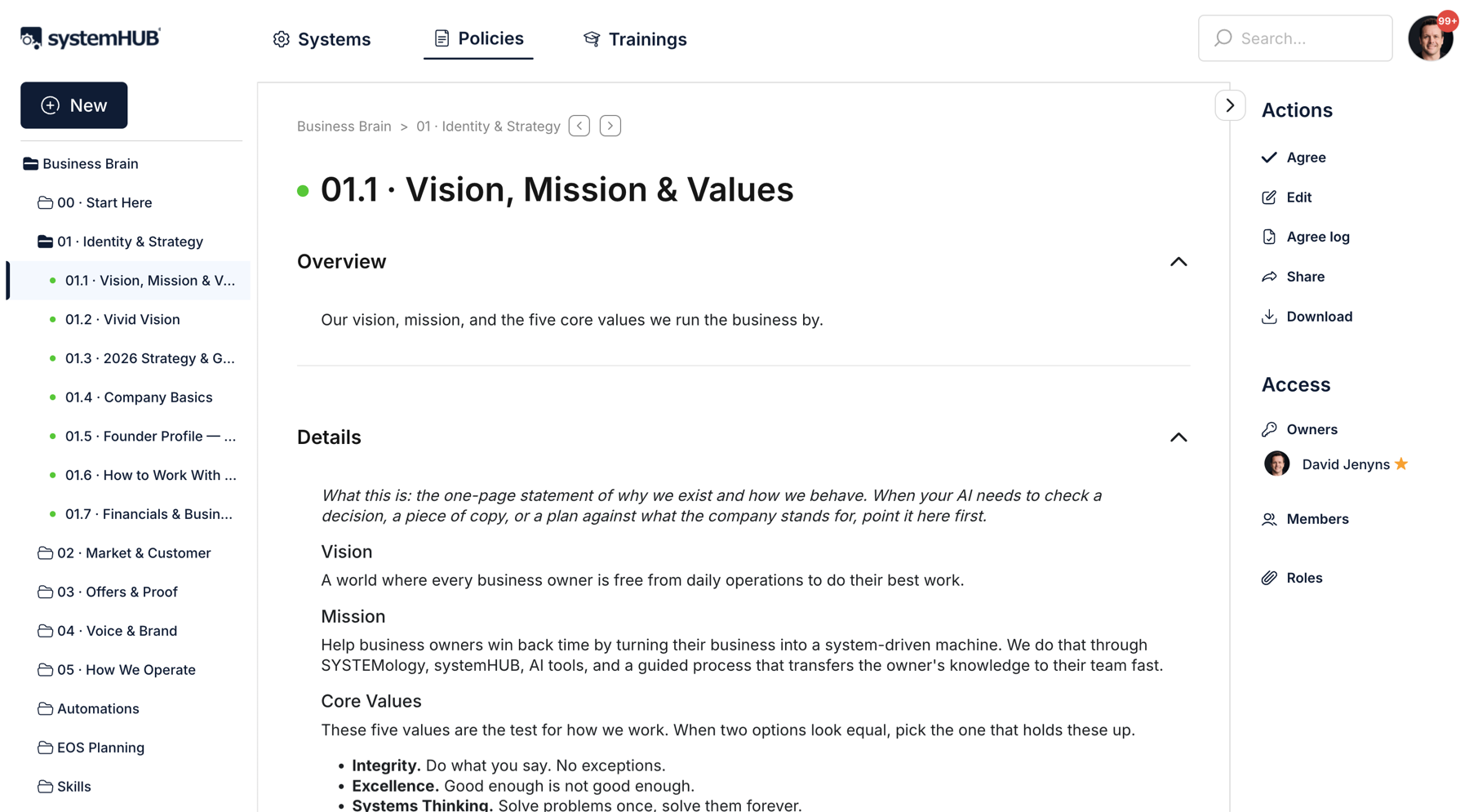
The detail lives in your systems, policies and trainings. The brain links to all of it.
In systemHUB, the Business Brain is the front door: six sections covering Start Here, Identity & Strategy, Market & Customer, Offers & Proof, Voice & Brand and How We Operate. They link out to your systems, policies and trainings, which hold the detail.
Short on time? Here is the 8-minute version: how I turn rough recorded notes into a living business manual with systemHUB’s AI tools.
Want to see one built? Here is the replay of my free live training, where I build a business brain in systemHUB and plug it into AI.
Systemise Your Business with AI, live training replay (56 min). It starts at the business brain section. Scrub back to the beginning for the full session.
A business brain vs everything it gets mistaken for
People use these words for different things. Here is how a business brain differs. It doesn’t replace the others. Your handbook, your SOPs and your policies become rooms inside it.
| Thing | Made for | Owned by | Any AI can use it | Covers how the work gets done |
|---|---|---|---|---|
| A business brain | The whole team and any AI | The business | Yes | Yes. SOPs, policies, roles and onboarding live inside it. |
| A wiki or knowledge base | Staff looking things up | The business | Depends on the tool | In part. Often notes and answers and not owned processes. |
| AI memory and chat history | You, in one AI tool | The AI platform | No. One platform only | No. Scattered preferences and past chats. |
| An employee handbook | New hires | The business | Only if it is stored where an AI can read it | In part. Rules and culture more than the how-to. |
| A “second brain” | One person | That person | Depends on the tool | No. Personal notes, ideas and reading. |
Your business brain is your moat
Every big AI can write, summarise and brainstorm. The gap between them shrinks with every release. The one that is best this month will not be best next quarter. Your competitors can sign up for exactly the same tools tomorrow.
What they cannot get is your business. The way a job gets quoted. The reason you call that supplier first. The promises you make to clients and the order the work has to happen in. Years of working out what actually works and what doesn’t.
That is the one thing no AI model and no competitor can copy. It only counts as a moat if it is written down. Until then it is just a strong opinion held by whoever is in the room.
It is the most important asset in your business. It is also the one thing every AI needs before it can do useful work for you. We unpack the second half of that in Own the Brain, Rent the AI.
Own it. Don’t rent it.
Here is the part most people miss. You can build your business brain inside an AI tool and it will feel like progress. Months of chats, saved instructions and a model that finally gets you. But it belongs to the platform. It only works in the platform.
Taught to one AI
- Lives in chat history and “memory”
- Only works inside that one platform
- Your team can’t see what you taught it
- Disappears when you switch tools
- Terms and features change without asking
A business brain you own
- Plain written documents in a system you control
- Works with any AI, today’s and the next one
- Your whole team reads the same record
- Export it as Markdown, PDF or XML any time
- You decide who sees it and who can change it
Control is the point. Roles and permissions decide who can read and edit what. You can share a single process with a contractor or an auditor without opening the rest of the business. And you can connect an AI to exactly the parts you choose.

When PETstock bought a dog daycare business in 2019, their team exported every process the owner had documented and took the lot into their own platform. The software was only the container. The business brain was what they were really buying. Read that story here.
What happens when your business has a brain
- New people get up to speed without you. The rule is simple: check the business brain first, then ask your supervisor, then ask the owner. Nobody is afraid of asking a silly question, because the answer is already written down.
- Sick days and holidays stop being emergencies. There is a default way every job gets done and whoever covers knows where to look.
- Delegation gets easier. You hand over a documented process, not a favour and a hope.
- Quality stays consistent. Ten people follow one version, not ten half-remembered ones.
- A buyer, lender or investor can see how the business runs. That is a big part of due diligence and it is already done.
- You get your head back. You stop being the answer machine. You get the space to see opportunities instead of being buried in the work.
It also changes what you get out of AI. Ask a generic AI how your business onboards a client and it guesses. Connect it to your business brain and it answers from your real process.
A generic AI
“Typically you would send a welcome email, schedule a kickoff call and set expectations for the first 30 days…”
Best-practice guesswork.
AI connected to your brain
“Per your Client Onboarding SOP, the welcome pack goes out within 24 hours and the kickoff call is booked from the intake form…”
Your actual process.
An illustration of the difference, not a real client conversation.
How to build your business brain without a six-month project
Don’t try to document everything. An 80 percent version in a few weeks beats a perfect one that never gets finished. Build it in this order.
- Map how a customer moves through your business. This is your Critical Client Flow. It tells you which systems matter most. Our Critical Client Flow guide walks you through it.
- Write your Start Here page. One page covering who you are, who you serve and what you sell. It doubles as the master prompt you can paste into any AI.
- Document your top ten systems. Pick the ones that move a customer through the flow. Record yourself or your best person doing each one once, then write the steps. Here is how to document a business process.
- Add the rules and the roles. Policies, position descriptions and onboarding. People then know what is expected and what is theirs.
- Give everything an owner and a review date. One person is accountable for each document. Each one says when it was last checked.
- Connect your AI. The systemHUB MCP server lets Claude, ChatGPT and Copilot read your business brain directly. No copy and paste and no re-explaining.
That is the short version. The full method is in our guide on how to systemise your business.
A Start Here template you can paste today
Step two above says to write your Start Here page. Here is a template for it. The five blocks match the five sections after Start Here in systemHUB’s Business Brain folder, and the last block is the instruction that turns the page into a master prompt for any AI. Fill in what you know. Leave the rest blank. A half-filled page is still a start.
START HERE: [Your business name]

WHO WE ARE
In one sentence, what we do and who for:
Our vision, mission and values:
Our goals for the next 12 months:
What we never do:

WHO WE SERVE
Our ideal client:
What keeps them up at night, in their own words:
Who we are not for:

WHAT WE SELL
Our products and services, with prices:
Our guarantee:
The proof that it works:

HOW WE SOUND
Three words that describe our voice:
Phrases we use:
Phrases we would never use:

HOW WE WORK
Our client journey in 7 to 12 steps:
Our top ten systems and who owns each one:
Rules that apply to everyone:

HOW TO USE THIS PAGE (instruction for any AI)
You are a member of our team. Use this page first. If the answer is not here, say so and ask me before you guess.
See a filled-in example (a made-up bookkeeping firm)
START HERE: Harbour Bookkeeping

WHO WE ARE
We keep the books for small health clinics so the owner stops doing paperwork on Sundays.
Our values: accurate, on time, no jargon.
Our goal this year: 40 clinics and a two-day month-end close.
We never: give tax advice outside our licence.

WHO WE SERVE
Owners of clinics with 3 to 15 staff.
They worry about cash flow and surprise tax bills.
Not for: businesses that want one-off catch-up work only.

WHAT WE SELL
Monthly bookkeeping from $490 and a quarterly review.
Guarantee: books closed by the 5th or the month is free.

HOW WE SOUND
Calm, plain, direct. We say "money in and money out", not "revenue streams".

HOW WE WORK
Client journey: enquiry, discovery call, proposal, onboarding, monthly close, quarterly review, renewal.
Top systems: onboarding a client, month-end close, chasing late invoices.
Rule for everyone: never email bank details.

HOW TO USE THIS PAGE
You are a member of our team. Use this page first. If the answer is not here, say so and ask me before you guess.
Paste your finished page into your AI’s custom instructions and you get most of the benefit from day one. When you are ready to move it somewhere your whole team can use it, the Business Brain in systemHUB gives it a home.
Where this started: the master prompt
Before the business brain there was the master prompt. This 8-minute video shows how to build a reusable master prompt from your business context, such as your avatar, your style and your goals. It then compares the result with a generic prompt. It is version one of the idea. The Start Here page is the grown-up version.
A brain that goes stale is worse than none
The risk with any written record is that it drifts out of date until nobody trusts it. Then the team stops looking and goes back to asking you.
Three habits stop that. Every document has one named owner. Every document carries a review date. And the brain lives in the same place your team works every day. Fixing a step takes a minute and not a project. When your automations change, document the change too. Here is how.
Done properly, it also does something quietly important. It means the business does not live in one person’s head. It does not walk out the door when they do. That is what we call systems insurance.

1,000+ hours
saved every year at SMART Business Solutions
Shannon Smit was working 70-hour weeks because the critical knowledge sat in her head. Once the core systems were documented in systemHUB, her son Ryan pointed AI at them and automated file-noting across three systems. The AI did not get smarter. It finally had something real to work from.
“We documented first. Then the AI was worth 1,000 hours.”
How ready is your business brain?
Tick what is true today. Be honest. “Mostly” is a no.
0 of 8
Early days. Start with the template above and write your Start Here page this week.
Business brain FAQ
What is a business brain?
A business brain is a single, central place where how your business works is written down: who you are, who you serve, what you sell, how you sound, how the work gets done and who owns what. It is written in plain English, owned by you and readable by your team and by any AI you connect.
Is a business brain the same as a company brain?
Yes. Company brain, business brain and operating manual all describe the same idea: one shared record of how the business runs. A “second brain” is usually a personal note-taking system. A business brain is shared, owned by the business and written so that anyone in the team can use it.
What should go in a business brain?
Start with who you are (vision, mission, values), who you serve, what you sell and how you sound. Then add how the work gets done (SOPs and your Critical Client Flow), your policies, your org chart and position descriptions and your onboarding and training. Begin with a Start Here page and your top ten systems, then build out from there.
Why not just keep this knowledge inside ChatGPT or Claude?
Because it stays inside that one platform. Chat history and memory don’t transfer. Your team can’t see them. You are stuck if you want to switch to a better model. A business brain keeps the knowledge in a place you own. You can connect any AI to it and swap AIs whenever you like.
How long does it take to build a business brain?
You can have a useful first version in a few weeks if you start small. Write a Start Here page, map your Critical Client Flow and document your top ten systems. Aim for 80 percent right, then improve it as you use it. The brain gets better every time someone follows a process and fixes a step.
How do I connect an AI to my business brain?
The systemHUB MCP server, included on the Accelerator plan, lets Claude, ChatGPT and Copilot read your business brain directly. If you are not using MCP yet, paste your Start Here page into your AI’s custom instructions and you get most of the benefit from day one.
Can I take my business brain with me if I leave?
Yes. It is your content. You can export your library as Markdown, PDF or XML at any time. You are never locked in to any software, including ours.
Build the asset only you can build
Start documenting how your business really runs. Every AI you ever connect starts with the real thing. So does every new hire.
14-day free trial. No credit card required.