You are probably good at relationships. Most business owners are, because that is how you won your first clients and it is how you keep the good ones. The trouble starts when you try to do it for a thousand people instead of thirty. You cannot ring a hundred contacts a week, so everyone you are not actively selling to goes quiet, and a year later they have forgotten what you do.
Brad Banyas has spent more than twenty years in sales and CRM software, and his social selling system is his answer to that problem. It is not really a tool. It is five to 10 minutes every morning, a short list of things worth noticing in your network and a bit of simple automation sitting behind it so nothing slips. If your pipeline depends on being remembered, press play.
Key Takeaways
- Social selling is an old idea with new tools. Brad’s version is the way people have always sold, building a relationship over years. What changed is that the information you need is now sitting in front of you for free.
- Engagement is a daily discipline, not a campaign. He spends five to 10 minutes every morning on birthdays, job changes and new businesses in his network, then lets his cadences do the follow-up.
- Listening starts at zero dollars. Google Alerts and LinkedIn will tell you most of what you need before you pay for anything.
- Be a connector, not a connection. The business Brad refers away comes back to him tenfold, because people remember who did the right thing by them.
- The sales process is not linear. Someone who will never buy from you today can be your best client in three years, which is the whole argument for staying in touch.
- Sort the message before you buy the software. Working out who you are targeting and what you will say is the hard part. Brad puts the technology at under $150 a month.
In This Episode
- 02:30 The gap between what marketing is doing and what the sales team can see
- 04:45 Why “social selling” is a very old idea wearing new tools
- 06:15 Step one, engage: the small touches almost every owner skips
- 08:30 The insurance agent who sent birthday cards for twenty years
- 10:15 How Brad runs his own five to 10 minutes every morning
- 13:45 Step two, listen: Google Alerts, social listening and what to do with it
- 16:30 Being a connector instead of a connection, and Harvey Mackay’s 66 points
- 17:45 Step three, be savvy: knowing exactly who you are talking to
- 21:15 Step four, be personal: across email, print and everything else
- 24:15 Step five, stay flexible: why none of this runs in a straight line
- 28:30 Step six, build the action plan before you buy any software
- 31:15 What happened when Brad finally committed to LinkedIn
👤 Today’s Guest, Brad Banyas
Brad Banyas is the CEO of Outsource Management Inc., which he founded in 1999, right in the middle of the tech bubble. Unlike most of the companies that started alongside it, OMI is still going. It works with mid-size companies on CRM, marketing automation and sales enablement platforms.
In 2016 he co-founded 366 Degrees with Paul Sciandra. It started as a side project born out of frustration with the platforms his own team was using, then turned into a commercial product. It pulls contacts straight out of a CRM like Nimble or Salesforce, runs the outreach and writes every bit of engagement back onto the contact record, so sales and marketing stop arguing about which leads are qualified.
Website: 366degrees.co
📋 The Six-Part Social Selling System
Based on the interview with Brad Banyas, CEO of OMI and co-founder of 366 Degrees.
The problem Brad set out to solve was a familiar one. Marketing was running campaigns the sales team could not see, salespeople had no idea what a client had already received and both sides argued about what counted as a qualified lead. His fix was to put every interaction back on the contact record, where the person doing the selling could actually read it.
The social selling system that came out of it has almost nothing to do with software, though. Brad is blunt about the term itself: it has been overused to the point of being misleading. What he means by it is the way people have always sold, which is building a relationship slowly, learning about the person and being useful long before there is a deal on the table. The only thing that has changed is that the information you once had to dig for is now sitting in front of you for nothing.
“We all think people are engaged and know what we do. They don’t. It takes time and repetitive interaction”
Brad Banyas, 09:30
1 Engage
Step one is the one everybody nods at and nobody does. Your network is constantly telling you when something has happened: a birthday, a new job, a new business, an anniversary. LinkedIn will hand you most of it free. Brad’s rule is simply to never let one of those moments go past without saying something.
It sounds almost too small to matter. It is not. Joe Girard held the world record for car sales for years and his method was not clever selling, it was a card in the post at every anniversary that mattered to the buyer. Brad tells a version of the same story from one of his partners in the gifting business, about an agent who sent his kids a birthday card every year for twenty years. The man never bought a policy from him. Then his son turned old enough to need life insurance and car insurance, and there was only ever going to be one phone call.
The discipline is the daily part. Brad spends five to 10 minutes every morning doing this by hand, and he has wished thousands of people a happy birthday over the years. What comes back is not a sale that week. It is somebody a year later saying they had no idea he was in the CRM business.
Then the tools take over the repetition. He touches the person on LinkedIn, a cadence in 366 sends a short email, and two days later a printed card lands at their house. Three touches, one of which took him fifteen seconds. If you want to see what that kind of sequencing looks like set up properly, we have a walkthrough of choosing marketing automation software that covers the same ground.
“You can’t call 100 friends or your network every week to keep up with them.”
Brad Banyas, 12:45
2 Listen
Engaging tells you when something happened. Listening tells you what to say about it. At the cheap end, Google Alerts will email you when a client or a prospect gets mentioned anywhere, and that costs nothing to set up. Brad runs his listening through Nimble, which pulls what is being said on LinkedIn and Twitter into one stream he reads for five or 10 minutes a day.
The point is not to collect information. It is to have something specific to say. If a client is quoted in a trade publication, you can mention it. If an article turns up that is useful to them, you send it, even when it has nothing to do with what you sell. That is the bit people get wrong: sharing something genuinely relevant to the other person is what breaks through, not another note about your product.
“social selling is really about being a connector, right? Not just a connection, right?”
Brad Banyas, 16:30
Brad reaches for Harvey Mackay here, the author of Swim With The Sharks, whose sales team had to fill in a 66-point profile on every customer. No Twitter, no LinkedIn, fifty years ago, and they were still expected to know the person. Mackay’s own warning is the one worth pinning up: even if you follow every one of those connection points, if you do not care, it is all irrelevant.
3 Be savvy
Being savvy means knowing exactly who you are talking to and sending them only what fits. Brad is direct about the fastest way to lose someone: open with your product. Talk about yourself, send material they have no reason to care about and you are done.
What he does instead is tag people by what they are actually interested in, then let only that material reach them. If he has just had a conversation with you about a particular CRM, he can highlight your name in his browser and drop you straight into the sequence that educates you on it. Nothing else goes near you.
Most of us have been on the wrong end of the alternative. You buy the thing, and the pitch for the thing you just bought keeps arriving, because nobody told the marketing system you had become a customer. That is the sales and marketing split showing up in the inbox.
4 Be personal
Pulling a first name out of a database is not personalisation, it is the bare minimum. Brad treats being personal as something that has to hold across every channel, which is why he still rates the phone and video alongside anything automated.
Where it gets interesting is the physical end. The same database that sends the email can send a card, a mug with someone’s name on it, a gift card or a pack of brownies, straight from the contact record. His own team built that into OMI with Rocket Notes, and the obvious moments to use it are not only new leads: renewals, re-signing a contract, a client’s first anniversary with you. None of it is expensive any more.
The warning attached is simple. Pressing the canned “happy birthday” button and moving on is worse than doing nothing, because it is visibly automatic. Add the one line only you could have written.
Want the follow-up to happen without you remembering it?
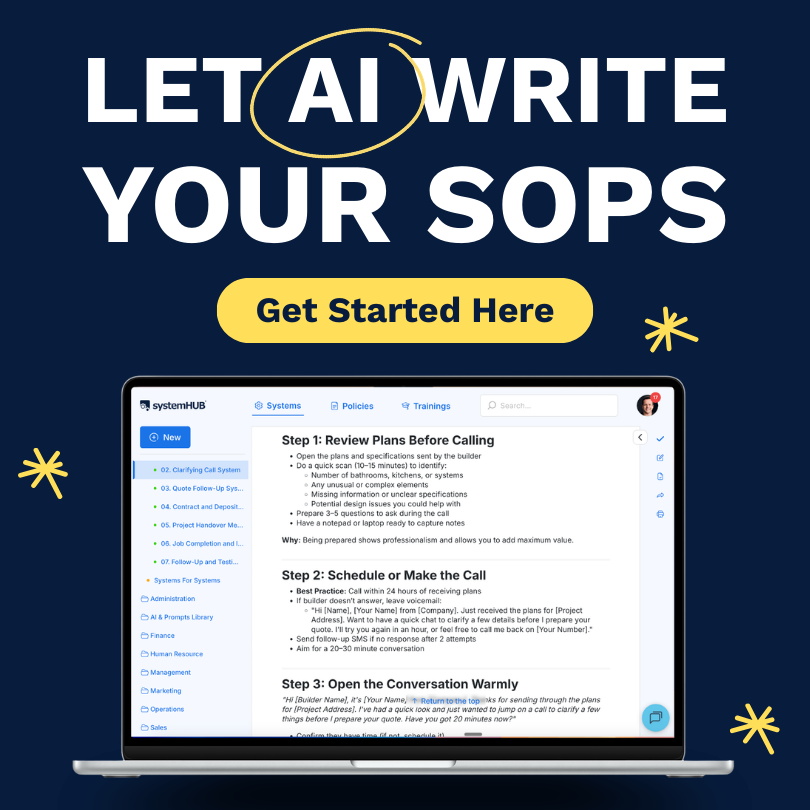
Try systemHUB for a dollar and document the touches you keep meaning to make, so the daily five minutes survives a busy week.
5 Stay flexible
Very few of us are in genuinely transactional businesses. Sales cycles run long, trust has to be earned and the thing you are really selling is your judgement rather than the software. Brad’s point about flexibility is that the pipeline will not behave, so stop expecting it to.
The practical version is referring work away. When a lead comes to his team and it is not a fit, they send it to someone who can help. He says it comes back tenfold, because the person remembers who was straight with them, and when they do need a CRM consultant they already know one.
“Someone may not do business with you today, but they are a prospect in the future.”
Brad Banyas, 26:30
6 Build the action plan
The last step is the one Dave pushed for on air, and Brad agreed it belongs: before any of this becomes software, write the plan. Who are you targeting. What are you trying to accomplish. What content or message actually moves that person. Then go looking for the tool.
“So where you start is before you buy any technology, before you invest in it, think about who you’re trying to target, what you’re trying to accomplish”
Brad Banyas, 30:15
Brad says the defining what to say part is where businesses get stuck, every time. Everyone believes they can describe their target customer in a sentence until they have to write it down. The delivery is the easy half, and he puts the whole technology stack for a small business at under $150 a month.
So do it by hand first. Human automation, as Dave calls it, is how you find out whether the sequence is worth paying to run. Once it works, the software is just you, repeated.
Five minutes a day, compounded
Brad is upfront that he did not always practise this. A couple of years before the interview he had a few hundred LinkedIn followers because he had never bothered with it. A friend pushed him. He committed to the daily habit, connecting and thanking people by hand, and by the time of this conversation he was at around 6,000.
The business benefited before any of it was automated, which is the part worth noticing. The automation came second, and all it did was hold the position he had already earned. The same logic sits behind the LinkedIn lead generation system we covered in an earlier episode.
Where your systems fit
Here is the systems angle, and it is the whole reason this episode belongs on this show. Every part of what Brad describes is a repeatable action with a trigger attached. Birthday turns up, do this. Client mentioned in the press, do that. New customer signs, move them out of the prospect sequence. That is a system, whether you have written it down or not.
Write it down and two things happen. It survives the week you are flat out, and it survives you. Somebody else on your team can run the daily 10 minutes to the same standard, which is the only way it ever becomes more than a habit you personally maintain. The same thinking applies to the sequences themselves, and the benefits of email marketing are mostly a function of whether anyone has documented what gets sent, to whom and when.
You do not need more tools, you need to be remembered
The temptation with an episode like this is to go shopping. Resist it for a week. Pick the ten people whose business you would most like in three years and do the small, unscalable thing for each of them every morning.
Then write down what you did, hand it to someone else and see if it still runs. Your business is not short of software. It is short of the systems that make the good intentions happen on a Tuesday when everything is on fire.
Frequently Asked Questions
What is a social selling system?
It is a documented, repeatable way of staying in front of the people in your network so you are the one they call when they are finally ready. Brad Banyas breaks it into six parts: engage, listen, be savvy, be personal, stay flexible and build the action plan. The tools matter far less than doing it every day.
How much time does social selling actually take?
Brad spends five to 10 minutes each morning on the manual side, wishing people happy birthday and congratulating job changes, then another five or 10 reading what his network is saying. Everything past that is automated follow-up that runs whether he is at his desk or not.
Can I do this without paying for software?
Yes, and Brad recommends starting that way. LinkedIn will surface birthdays, new roles and new businesses for free, and Google Alerts will tell you when a client or prospect is mentioned anywhere. Do it by hand until you know the sequence is worth automating.
What does the technology cost once you do automate it?
In this episode Brad puts a small business stack of a CRM plus an outreach platform at under $150 a month, which is why he built 366 Degrees for that market in the first place. The same capability used to cost a larger company tens of thousands a month.
Why do sales and marketing keep disagreeing about qualified leads?
Usually because the engagement data lives in the marketing platform and never reaches the contact record the salesperson is looking at. Brad’s fix is to write every interaction back to the CRM, so both sides are reading the same history instead of arguing from different screens.
Does sending a birthday card really win business?
Not on its own and not quickly. Brad tells the story of an insurance agent who sent a man’s children a birthday card every year for twenty years without ever making a sale, and then got the business the moment the son needed cover. The sales process is not linear, which is the whole argument for staying in touch.
Ready to get started?
systemHUB gives you 100+ ready-made SOP templates across Sales, Marketing, Operations, HR and Finance. Customise them for your business and start building a business that runs without you.
Thank you for listening!
Thanks for joining us for this episode. Do you have any questions or feedback you'd like to share? We'd love to hear it! Let us know in the comments section below.
If you enjoy listening to this podcast, please share it on Facebook and leave an honest review on iTunes. We'd love to know what you think.
Remember, the next system we share could be just the one you’ve been looking for, so subscribe on iTunes so you can get the latest episodes as soon as they’re published.
About The Show
Business Processes Simplified
We interview industry experts and have them share their best small business systems and processes. This is the quickest, easiest and most efficient way to build a systems centered business.