What if your best salesperson’s approach could be cloned across your entire team?
Most business owners hit the same wall. Sales grow to a point, then plateau. Revenue depends on one or two key people. When those people are busy, sick, or on holiday, deals stall. New hires take months to get up to speed. And the owner is still the one closing the biggest deals.
The problem isn’t a lack of talent or effort. It’s a lack of system.
When you systemise your sales process, you capture what already works and make it repeatable. Your best performer’s method becomes the standard. New salespeople ramp up faster. Follow-up happens consistently. And revenue grows without depending on any single person.
This guide shows you exactly how to increase sales by building a systemised sales process. You’ll learn why sales plateau in growing businesses, how to extract your top performer’s method, and how to document a repeatable process your whole team can follow.
In this guide:
Why sales plateau in growing businesses
Sales don’t plateau because of the market. They plateau because of how the business is structured. When revenue depends on one person’s effort, knowledge, or relationships, there’s a hard ceiling on growth. You can only make so many calls, attend so many meetings, and close so many deals in a day.
This is the owner-dependency trap. And it’s the single biggest reason small businesses stall between $1 million and $5 million in revenue.
Here are the five patterns I see most often.
1. The owner is still the top salesperson
In many businesses, the owner closes the majority of deals. Prospects want to talk to “the boss.” The owner knows the product better than anyone. They’ve built relationships over years that no one else can replicate, or so they think. But as long as the owner is the sales engine, the business can only grow as fast as the owner can work. And that’s not a scalable model.
2. Your best performer’s method lives in their head
Every sales team has a top performer. They consistently close more deals, handle objections better, and follow up more reliably than everyone else. But ask them to explain exactly what they do differently, and they’ll struggle. Their method is instinct. It’s muscle memory. It’s not written down anywhere.
In SYSTEMology, we call this person the “knower.” They have the knowledge your business needs. The problem is, that knowledge is trapped in their head. If they leave, their method leaves with them. And the rest of the team never gets the benefit of what they’ve figured out.
3. Follow-up is inconsistent (or nonexistent)
Studies consistently show that most sales happen after the fifth to twelfth contact. But most salespeople give up after one or two. Without a documented follow-up system, leads fall through the cracks. Some prospects get three follow-ups. Others get none. It depends entirely on who’s handling the lead and how busy they are that week.
4. New salespeople take months to ramp up
When there’s no documented sales process, every new hire learns by trial and error. They shadow someone for a week, get handed a phone, and figure it out. Some make it. Many don’t. Either way, the ramp-up period is long, expensive, and inconsistent. The business loses revenue during every transition.
5. There’s no defined sales process to follow
This is the root cause behind all the others. Without a documented, step-by-step sales process, everyone does things their own way. There’s no standard for how enquiries get handled, how proposals get sent, how objections get addressed, or how handoffs happen between sales and operations. The result is inconsistency, and inconsistency kills growth.

The old way: every sale depends on the owner or one key person.
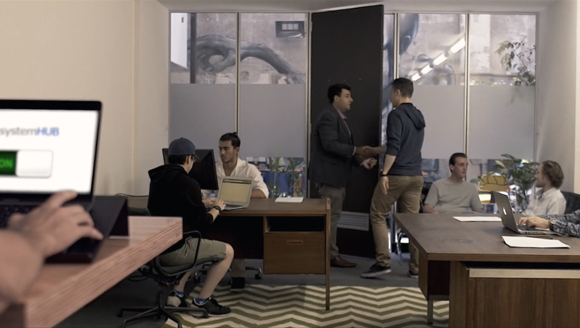
The SYSTEMology way: your team runs the sales system. You run the business.
The shift from the old way to a systemised approach is what separates businesses that stall from businesses that scale. It’s not about working harder. It’s about capturing what works and making it repeatable.
Is your sales process systemised — or stuck in someone’s head?
Take the free Systems Strength Test and find out exactly where your business is leaking revenue and momentum.
What a systemised sales process looks like
A systemised sales process isn’t a rigid script that turns your team into robots. It’s a documented, repeatable workflow that captures the best way to move a prospect from enquiry to closed deal. It gives your team a clear path to follow while still leaving room for personality and judgement.
In SYSTEMology, sales is one of the six core departments every business needs to systemise. Along with marketing, operations, finance, human resources, and management, it forms part of your complete business systems framework.
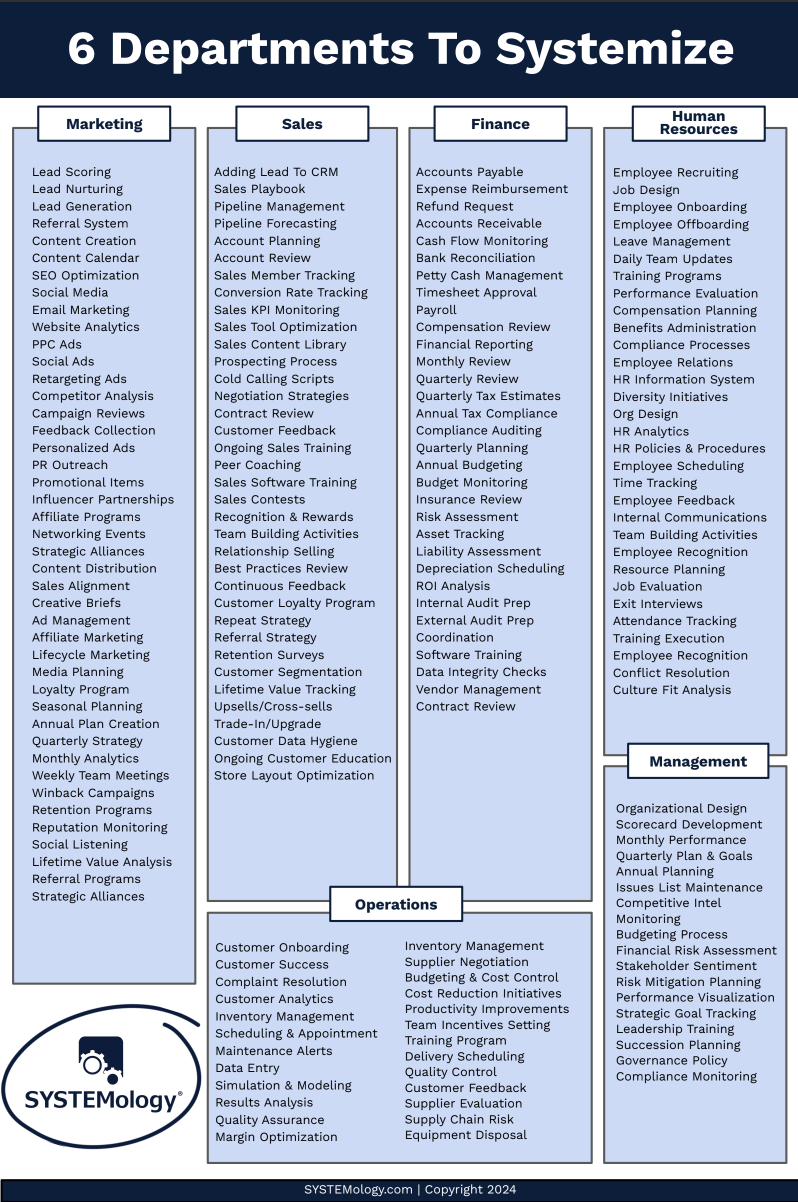
Sales is one of the six core departments to systemise. It covers everything related to converting prospects into clients.
Sales also sits at the heart of your Critical Client Flow (CCF), the linear map of how your business takes a prospect from first contact through to repeat business. The CCF identifies 10 to 15 critical systems across your entire client journey. The sales stage covers what happens after a prospect shows interest and before they become a paying client.
Here’s what a systemised sales process typically includes.
1. A documented step-by-step sales workflow
From the moment a lead comes in to the moment the deal is closed, every step is mapped out. Who contacts the prospect first? What information do they gather? How do they qualify the lead? What’s the next step after the initial call? When does a proposal go out? Each step has a defined owner, a timeline, and a clear outcome.
2. Scripts and talk tracks based on your best performer
Your top salesperson already knows what to say. They know which questions to ask, how to handle the most common objections, and how to guide a prospect toward a decision. A systemised process captures those talk tracks and makes them available to everyone. Not as rigid scripts to read word-for-word, but as proven frameworks the whole team can adapt.
3. Clear handoff points between marketing, sales, and operations
One of the biggest sources of dropped revenue is the gap between departments. Marketing generates a lead, but nobody follows up for three days. Sales closes a deal, but operations doesn’t get the details they need to deliver. A systemised process defines exactly when and how handoffs happen, who is responsible, and what information needs to transfer at each stage.
4. A defined follow-up cadence with triggers and timelines
Follow-up shouldn’t depend on memory or motivation. A systemised sales process includes a specific follow-up schedule: when to call, when to email, what to say at each touchpoint, and when to stop. It also defines triggers. For example, if a prospect opens a proposal but doesn’t respond within 48 hours, that triggers a follow-up call. Nothing falls through the cracks because the system catches it.
5. A training pathway for new salespeople
When the sales process is documented, onboarding a new salesperson goes from months to weeks. They don’t need to shadow someone indefinitely or figure things out on their own. They have a clear playbook to follow, recorded examples to study, and defined milestones to hit. The system becomes their training program.
Tip: You don’t need to document every possible sales scenario on day one. Start with your single most common sales pathway, the one that represents 80% of your revenue. Systemise that first. Then expand to edge cases and secondary products later.
How to systemise your sales process (step-by-step)
The good news is you don’t need to invent a sales process from scratch. The knowledge already exists inside your business. You just need to extract it, document it, and share it with the team. Here’s how, following the SYSTEMology method.
1. Identify your best salesperson (the “knower”)
Look at your team and find the person who consistently delivers above-average sales results. They close more deals, handle objections more smoothly, or maintain better client relationships. This is the person whose method you want to capture.
In SYSTEMology, we call this person the knowledgeable worker, or simply the “knower.” They may not realise they have a system. But they do. It’s in the way they open a conversation, the questions they ask, the timing of their follow-ups, the way they present pricing. Your job is to make that invisible system visible.
Where possible, avoid using the business owner as the knower. Yes, you probably can do it better than anyone. But the goal is to build a sales process that works without you. If another team member delivers strong results, start with them.
2. Map your Critical Client Flow (CCF) for sales
Before you document individual steps, zoom out. Map the full journey a prospect takes from first contact to becoming a paying client. In SYSTEMology, this is called the Critical Client Flow.
For the sales stage specifically, your CCF might look like this: Enquiry received, initial response, qualification call, proposal sent, follow-up, deal closed, handoff to operations. Keep it simple. Two to three words per step. You’re not writing the detail yet, you’re mapping the flow.
3. Record your top performer in action
This is where the magic happens. Rather than sitting down to write a sales manual from scratch, you record your knower doing the actual work. For a phone-based sales role, use a Dictaphone app or call recording software. For a face-to-face role, use a camera. For screen-based work like sending proposals or updating a CRM, use screen-recording software.
Ask them to talk through what they’re doing as they do it. Why do they ask that question? Why do they send the proposal at that point? What’s their reasoning for the follow-up timing? The goal is to capture both the steps AND the thinking behind them.
Tip: Don’t aim for perfection in the recording. You want to capture how things are done right now, not an idealised version. Optimisation comes later. The first goal is simply to get the process out of someone’s head and into a format the team can learn from.
4. Document the sales process as an SOP
Once you have the recording, hand it to a systems champion or team member (not the knower) and have them turn it into a written standard operating procedure. This keeps the knower free to keep selling while someone else handles the documentation.
The SOP should include: the trigger (what kicks off this process), the step-by-step workflow, any scripts or templates used, the tools involved, and the endpoint (how you know the process is complete). Keep the language simple. Write it so a new hire could follow it on their first day.
5. Train the team on the new standard
A documented process that nobody follows is just a document. The real value comes when your entire sales team adopts the system as the new standard. Run a training session where the knower walks the team through the process. Have team members practise with role-plays. Then assign the SOP as required reading for all new hires.
The key insight from SYSTEMology is this: you’re not asking everyone to be as good as your best performer overnight. You’re raising the floor. If your top performer closes at 30% and the rest of the team is at 15%, getting everyone to 22% through a documented process is a massive revenue increase, with no extra marketing spend.
6. Measure, review, and refine
A sales system isn’t “set and forget.” Track your key metrics: conversion rate at each stage, average deal cycle time, follow-up completion rate, revenue per salesperson. Review the numbers monthly. When something isn’t working, update the system. When a team member discovers a better approach, capture it and roll it out.
This is how great sales teams continuously improve. The system creates the baseline. The team’s feedback makes it better over time.
Example: Inbound sales enquiry system
Trigger: A new enquiry is received via phone, web form, or email.
- Acknowledge the enquiry within 2 hours (phone) or 4 hours (email/web).
- Log the prospect’s details in the CRM with source, contact info, and initial notes.
- Run through the qualification checklist: budget range, timeline, decision-maker, and fit with your core offering.
- If qualified, schedule a discovery call within 48 hours and send a calendar invite with an agenda.
- Conduct the discovery call using the standard talk track. Identify the prospect’s core problem, desired outcome, and urgency.
- Send a tailored proposal within 24 hours of the discovery call, using the approved proposal template.
- Follow up at day 2, day 5, and day 10 using the follow-up email sequence.
- If the deal closes, complete the client handoff checklist and pass all details to the operations team.
Endpoint: The prospect is either converted to a client (with a signed agreement and handoff complete) or moved to the nurture sequence for future follow-up.
Training new salespeople faster with documented sales systems
One of the biggest hidden costs in any growing business is the time it takes to bring a new salesperson up to speed. Without a documented system, training is informal, inconsistent, and slow. The new hire shadows someone for a few days, absorbs what they can, and then figures out the rest through trial and error.
The result? It can take three to six months before a new salesperson is fully productive. During that time, you’re paying their salary while they’re still learning. Deals get missed. Prospects get a subpar experience. And the person doing the training loses their own selling time.
A systemised sales process changes this completely.
When your sales system is documented as an SOP, with recorded examples, talk tracks, and a clear step-by-step workflow, a new hire has everything they need from day one. They can watch recordings of your best performer handling a real sales call. They can follow the documented process step by step. They can reference scripts when they’re unsure what to say.
Instead of shadowing someone for weeks, they study the system, practise with role-plays, and start taking real calls within days. The ramp-up period drops from months to weeks. And the quality of their early interactions is dramatically higher because they’re following a proven process, not winging it.
This is exactly how smart businesses hire and retain A-players. They don’t rely on finding natural-born salespeople. They build systems that make good people great.
What a sales training system includes.
A complete sales training pathway typically covers: the company’s sales philosophy and values, recorded examples of successful sales calls, the documented sales process (SOP), objection-handling frameworks, product knowledge materials, role-play exercises with feedback criteria, and 30/60/90-day performance milestones. Store all of these in one place so new hires can access them independently.
The businesses that scale their sales teams fastest aren’t the ones with the biggest recruitment budgets. They’re the ones with the best systems. When you can delegate effectively by handing someone a playbook instead of just a phone, growth stops being limited by your personal capacity.
Ready to document your sales systems in one place?
systemHUB gives your team a single source of truth for every sales process, template, and training resource. Stop losing knowledge when people leave.
Common mistakes when systemising sales
Systemising your sales process is one of the highest-leverage moves you can make. But there are a few traps that catch business owners early on. Here’s what to watch for.
Trying to document everything at once. You don’t need to systemise every sales scenario on day one. Start with your most common sales pathway. The one that handles 80% of your enquiries. Get that right first, then expand. Trying to capture everything leads to overwhelm and nothing getting finished.
Writing the system yourself instead of extracting it. The business owner sitting alone at a desk writing a sales manual is one of the most common (and least effective) approaches. Instead, record your best performer doing the work. Extract what they already do. The system should reflect reality, not theory. This is the core principle behind the SYSTEMology extraction method.
Making the process too rigid. A sales system should be a framework, not a cage. Leave room for personality, judgement, and genuine conversation. The goal is consistency in the process, not uniformity in the delivery. Your salespeople still need to be human.
Skipping the follow-up system. Most businesses document the front end of the sales process (enquiry handling, proposals) and forget the follow-up. But follow-up is where the real revenue lives. If you’re not systemising when, how, and how often your team follows up, you’re leaving money on the table.
Not measuring conversion at each stage. A system without metrics is just a suggestion. Track conversion rates between each step of your sales process. Where are prospects dropping off? Which stage has the longest delay? Without this data, you can’t improve. With it, you can make targeted business process improvements that directly increase revenue.
Frequently asked questions
How do I increase sales without spending more on marketing?
The fastest way to increase sales without extra marketing spend is to improve your conversion rate. Systemise your follow-up process, document your best salesperson’s method, and make sure no leads fall through the cracks. Most businesses have plenty of leads. They just don’t have a consistent process for converting them. A documented sales system fixes that.
What is a systemised sales process?
A systemised sales process is a documented, repeatable workflow that describes exactly how your business converts a prospect into a paying client. It includes the steps, the scripts, the follow-up cadence, and the handoff points. When it’s documented as a standard operating procedure, anyone on your team can follow it and deliver a consistent result.
How long does it take to systemise a sales process?
You can document your core sales process in one to two weeks. The SYSTEMology method involves recording your best performer doing the work (a few hours), then having someone else document it as an SOP (a day or two). The initial version doesn’t need to be perfect. Get it documented, start using it, and refine it over time.
Can I systemise sales if I’m the only salesperson?
Yes, and you should. Documenting your sales process now means you’re ready to delegate it when you hire. Record yourself handling a few typical sales interactions. Write up the steps, the scripts, and the follow-up sequence. When your first salesperson starts, they’ll have a complete playbook instead of starting from scratch.
What tools do I need to document my sales process?
You don’t need complicated software. A screen recorder (like Loom), a simple document tool, and a place to store your SOPs are enough to get started. A dedicated platform like systemHUB makes it easier to organise, share, and update your sales systems as your team grows.
How do I get my sales team to follow a new process?
Start by involving them in creating it. When you extract the process from your best performer, the rest of the team sees it as a peer-developed best practice, not a top-down mandate. Run a training session where the knower walks through the system. Then make the documented process the default standard. Over time, compliance becomes culture.
What’s the difference between a sales script and a sales system?
A sales script is a single component, a talk track for a specific conversation. A sales system is the full end-to-end process: how leads are received, qualified, followed up, proposed to, closed, and handed off. Scripts sit inside the system. The system is the complete workflow that ensures every prospect gets a consistent, professional experience.
How do sales systems help with scaling a business?
Sales systems remove the bottleneck of individual performance. When your process is documented, you can hire new salespeople and get them productive quickly. You can delegate without losing quality. You can open new territories or add products without starting from zero each time. Systems make growth repeatable, not just possible.
Your best salesperson’s method shouldn’t leave when they do. Document it, train your team, and watch your sales grow.
The path to increasing sales isn’t always more leads or more marketing. Often, it’s simply capturing what already works and making it available to everyone on the team. A systemised sales process turns individual talent into team capability, and that’s how businesses scale.
If you’re ready to start documenting your sales systems, explore systemHUB and see how other businesses organise their processes, templates, and training in one place.