You started your business for freedom. So why does it feel like a trap?
You built something real. You took the risk, hired the team, found the clients. But somewhere along the way, the business stopped working for you and started depending on you. Every decision, every question, every problem runs through you. And the freedom you imagined? It feels further away than ever.
Systemising your business is how you get it back. Not by working harder. Not by hiring more people. By building a business that runs on systems instead of running on you.
In this guide, I’ll share why systemising your business is the single most important shift you can make, what held me back for years, and how I went from 70-hour weeks to stepping away from my business in just twelve months.
In this guide:
- What systemising your business actually means
- Why business owners resist systemisation
- The real cost of staying unsystemised
- David’s story: from 70-hour weeks to freedom
- The four stages of business systemisation
- How SYSTEMology makes systemisation achievable
- Getting started with systemising your business
- Common mistakes when systemising
- Frequently asked questions
What systemising your business actually means
Let’s start with a simple definition. A system is a series of steps that, when followed, produces a predictable outcome. That’s it. Nothing fancy. A system might be a detailed step-by-step instruction for onboarding a new client. Or it might be a high-level overview showing how your entire delivery process fits together.
Systemising your business means seeing your entire operation as a collection of these interconnected systems. Sales is a system. Delivery is a system. Hiring, onboarding, invoicing, quality control: all systems. Whether you’ve documented them or not, they already exist. The question is whether they’re running well or running you into the ground.
Here’s what systemising is NOT:
It’s not turning your business into a rigid, soulless machine. It’s not writing hundreds of boring manuals nobody reads. And it’s not trying to become McDonald’s. Systemising means capturing how your business works at its best, so your team can deliver that standard consistently, without everything depending on you.
Think of it this way. Poor recruiting systems lead to staffing issues. Poor financial systems lead to cash flow problems. Poor marketing systems lead to inconsistent lead flow. All problems in business are, ultimately, caused by poorly performing systems. The first step to fixing them is recognising they exist.
When you systemise your business, you create the foundation for consistency, scalability, and eventually freedom. You move from being the person who does everything to being the person who designs how things get done. That’s a fundamentally different role, and a far more powerful one.
Why business owners resist systemising their business
If systemisation is so valuable, why do so many business owners put it off? I know the answer because I lived it. For years, I believed many of the same myths that might be holding you back right now.
There’s an old story about a fully grown elephant held in place by a tiny stake in the ground. The elephant could escape with minimal effort. But she doesn’t try because that same stake held her in place when she was a calf. She pulled and pulled back then, failed, and eventually gave up. She remains in captivity not because she’s incapable, but because previous attempts discouraged her.
The same thing happens to business owners. Here are the stakes that hold most of us back.
1. “I’ve tried to systemise before and it didn’t work”
Maybe you bought a course, tried creating some SOPs, or hired a consultant. It felt clunky, nobody used the documents, and the whole initiative faded within weeks. But the problem wasn’t systemisation itself. It was the method. Most approaches to standard operating procedures were designed for large corporates, not small businesses with limited time and margin for error.
2. “Systems will kill the creativity in my business”
This is one of the most common objections I hear. The fear is that documenting how things work will make everything rigid and mechanical. The reality is the opposite. Systems handle the repetitive work so your team has more bandwidth for creative problem-solving. You don’t systemise the thinking. You systemise the doing.
3. “It’s too time-consuming”
Yes, systemising takes time upfront. But the cost of NOT systemising is paid every single day in rework, inconsistency, and firefighting. The real question isn’t whether you can afford to invest the time. It’s whether you can afford not to. As I like to say, you need to slow down in order to speed up.
4. “I need to be the one to create all the systems”
This belief traps more business owners than any other. The truth is, the knowledge of how to do most tasks already exists within your team. Your best people are doing great work every day. The SYSTEMology approach captures that knowledge from them, rather than expecting you to write everything yourself. In fact, the business owner is usually the worst person to create the systems.
5. “Even if I create systems, my team won’t follow them”
Fair concern. But team buy-in is a process, not a switch you flip. When you involve your team in creating the systems (not just following them), compliance goes up dramatically. People support what they help create.
6. “We’d need to systemise everything like McDonald’s”
McDonald’s is an elite athlete competing at an Olympic level in business systemisation. You don’t need to be there. You just need to prioritise the right systems that drive 80% of your results. For most businesses, that’s 10 to 15 core systems. Not hundreds.
Tip: Don’t let previous failed attempts fool you into thinking systemisation won’t work for you. The methods may have been wrong, but the principle is sound. Every business that has achieved lasting success runs on systems.
What’s the chaos costing your business?
Use the free Cost of Chaos Calculator to put a dollar figure on your unsystemised operations.
The real cost of staying unsystemised
Every business pays for systemisation. You either invest proactively by building systems, or you pay reactively through chaos. The question isn’t whether you’ll pay. It’s how.
Here’s what an unsystemised business looks like from the inside. And if you’re honest with yourself, some of this might sound painfully familiar.
1. You are the bottleneck
When every decision runs through you, your business can only move as fast as you can think, respond, and approve. Your team waits on you. Projects stall. Growth hits a ceiling because there are only so many hours in your day. The business owner is quite often the biggest bottleneck, and there’s no real insight that they (not systems) are the problem.
2. Your team makes things up as they go
Without documented processes, every team member does things their own way. One person handles a client enquiry one way. Another takes a completely different approach. The result is inconsistent quality, missed steps, and processes that aren’t repeatable.
3. Your knowledge walks out the door
When a key team member leaves, everything they know goes with them. Training their replacement starts from scratch. The cost of not systemising compounds every time someone walks out.
4. You can’t step away
Want to take a holiday? Good luck. The thought of leaving your business for even a week fills you with dread. What if something goes wrong? What if a client calls and nobody knows what to say? An unsystemised business holds its owner hostage.
5. Your business is unsaleable
If your business can’t run without you, nobody wants to buy it. Buyers and investors look for businesses with documented systems, clear processes, and teams that operate independently. An owner-dependent business isn’t an asset. It’s a job.

The old way: everything runs through the owner.
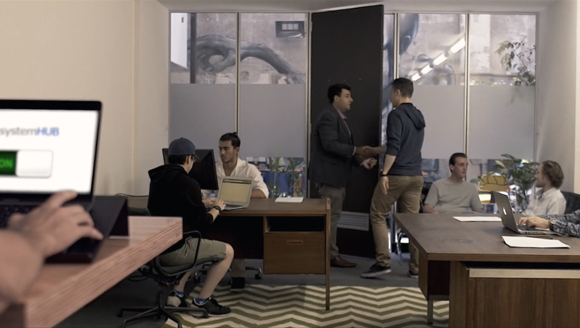
The SYSTEMology way: your team runs the systems, you run the business.
David’s story: from 70-hour weeks to freedom
I want to share my own story because I think it illustrates why systemising your business matters more than any statistic ever could.
I was running a digital agency called Melbourne SEO Services. We helped businesses with their online presence through SEO, paid advertising, and content marketing. Like most agencies, we worked with lots of different clients in many industries. I’d been at it for over ten years.
And I was working at least 60 to 70 hours a week. I was trapped on the hamster wheel of finding clients, delivering for clients, maintaining relationships, and then circling back to getting new clients again. Each part of my job was critical and required my constant attention.
I had plenty of great employees doing fantastic work. But I was the cog in the middle that kept everything connected and moving. The business literally couldn’t work without me.
Then my wife and I discovered we were going to have a baby.
Everything changed. I didn’t want to be one of those dads who’s always too busy. Too busy to walk my son to school. Too busy to watch his footy games. Too busy to help him with homework. Even if I worked from home, the number of hours wouldn’t change. I’d be physically present but mentally absent.
So I had to find a way to build a business that worked without me.
The turning point: I couldn’t sell the business even if I wanted to. No one would buy a company entirely dependent on the person who’s leaving. I had to restructure it so it could function without me at the helm. Which, as it turned out, would solve my problem anyway.
As it turned out, it took around twelve months. By that time, I’d systemised almost all the key elements of my business and hired a CEO to replace me. My involvement became minimal. I work from home on my new ventures. If one of my kids (yes, I have two of them now) wants to knock on my office door and tell me about their day, that’s absolutely fine.
I freely admit that I’m a recovering micromanager. In my old business, I learned to put good people in charge and let go. The right motivation is a powerful factor. But what really made the difference wasn’t just motivation. It was having a system for systemising. That’s what became SYSTEMology.
David Jenyns — a recovering micromanager who built a system for systemising.
The four stages of business systemisation
Having worked with hundreds of businesses, I’ve found they typically fall into one of four stages. Understanding where you are right now will help you see where you need to go.
1
Survival
Chasing work, doing work, getting work. Endless loop. No systems, no clarity.
2
Stationary
More consistent but at capacity. Knowledge trapped in people’s heads.
3
Scalable
Core systems documented. Culture shifting. Team starting to follow process.
4
Saleable
Complete business reliability. Systems run the business. You run your life.
Survival is where most owners start. You’re figuring out product/market fit, spending 80% of your time problem-solving, and hustling through. Your team (if you have one) makes things up as they go. The business owner is the bottleneck, and there’s no real insight that systems are the way forward.
Stationary is where things get dangerous. The ups and downs have smoothed out. You have a loose way of doing things, but it’s trapped in the heads of your best people. It often feels like you’re running an adult daycare centre, constantly assigning tasks, circling back, and rarely finding time for your own work. You’ve reached capacity and can’t break through to the next level.
Scalable is where it gets interesting. You’ve documented your core systems. Your business model is proven. But a funny thing happens here: people think “good enough” is good enough. They stop. The truth is, “good enough” traps you. The biggest wins come when you push through to the final stage.
Saleable is the goal. Whether you plan to sell or not, a saleable business operates at a different level. Your operations run with precision. Your team upholds the culture. No longer are you dependent on specific team members for things to work. The systems work, and the people work the system. This is what we call complete business reliability.
Most people reading this are in the Stationary stage with one foot still in Survival. That’s not a judgement. It just is what it is. The important thing is knowing where you want to go.
How SYSTEMology makes systemising your business achievable
Here’s the good news. Systemising your business doesn’t have to be the overwhelming, time-consuming nightmare you might imagine. SYSTEMology is a seven-stage process designed specifically for small businesses. It identifies the critical systems, captures them efficiently, and gets your team following them.
Here are the seven stages at a glance.
1. Define
Reduce the overwhelm. Instead of trying to document everything, you identify only the 10 to 15 most critical systems using the Critical Client Flow (CCF). The CCF maps the journey from getting a client’s attention through to delivering your product and turning them into a repeat customer. It takes about twenty minutes to complete and provides laser-like focus.
2. Assign
Recognise that the knowledge already exists within your team. Identify your key departments, assign department heads, and locate the “knowledgeable workers” who already do each task to a great standard. The critical shift: take the business owner out of the equation.
3. Extract
This is where SYSTEMology changes the game. Creating systems is always a two-person job. One person (the knowledgeable worker) shares their knowledge. Another person (your systems champion) documents it. This removes the biggest objection. Your best people don’t need to stop what they’re doing to write long, boring documents. They just do their job while someone captures it.
4. Organise
Store and structure your systems so your team can actually find and use them. A system nobody can find is a system nobody follows. This stage is about organising your business systems in a way that makes compliance effortless.
5. Integrate
Get your team’s buy-in. This stage focuses on shifting your culture from “we have to follow process” to “this is how we do things here.” When your team embraces the systems, everything accelerates.
6. Scale
Expand beyond your core delivery systems into HR, finance, management, and other departments. This is where you build the capacity to grow without adding complexity.
7. Optimise
Continuously improve your systems. This isn’t about becoming perfect on day one. It’s about building a culture of constant, incremental improvement. Each system saves a little time here and a little extra efficiency there. Layer those wins and the breakthroughs are unparalleled.
Key insight: You don’t need hundreds of systems to systemise a business. You simply need to pick one target audience, one central product, and define the Critical Client Flow. Over the years of helping hundreds of people perform this exercise, I’ve never found a business where I couldn’t identify their CCF.
Ready to start systemising your business?
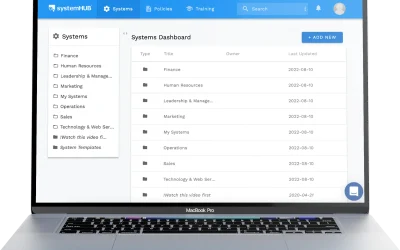
systemHUB gives you the platform, templates, and AI tools to document your systems and get your team following them.
Getting started with systemising your business
You don’t need to overhaul your entire business this week. Systemisation is a journey, and the best way to start is with three focused steps.
1
Map your CCF
One client, one product, one journey. 20 minutes.
2
Find your champion
Identify the organised, detail-oriented person on your team.
3
Extract your first system
Record your best person doing the task. Document it. Review it.
Step 1: Map your Critical Client Flow. Grab the CCF template and map the journey your business goes through to deliver your core product. Start from how you get a client’s attention, through to delivering the product and turning them into a repeat customer. Keep it high-level. Two or three words per step. Only include what you’re currently doing, not what you’d like to be doing.
Step 2: Identify your systems champion. Is there someone on your team who loves organising things? The person who creates to-do lists for fun and gets satisfaction from seeing things run smoothly? That’s your systems champion. They’ll play a key role in interviewing knowledgeable workers and turning those conversations into documented systems.
Step 3: Extract your first system. Pick the most critical system from your CCF and use the two-person method. Your knowledgeable worker does the task while your systems champion records it. Then the champion turns that recording into a documented system. The knowledgeable worker reviews and edits it. Done. Your first system is live.
Example: a simple CCF for a service business
Client: Small business owner looking for bookkeeping services
Product: Monthly bookkeeping package
- Attention: Google Ads, referrals, LinkedIn content
- Lead capture: Website enquiry form, phone call
- Qualification: Discovery call to assess fit
- Proposal: Scope and pricing document sent
- Onboarding: Software access, document collection, intro meeting
- Delivery: Monthly reconciliation, reporting, review
- Retention: Quarterly check-in, upsell advisory services
Result: Seven systems identified in under twenty minutes. That’s your starting point.
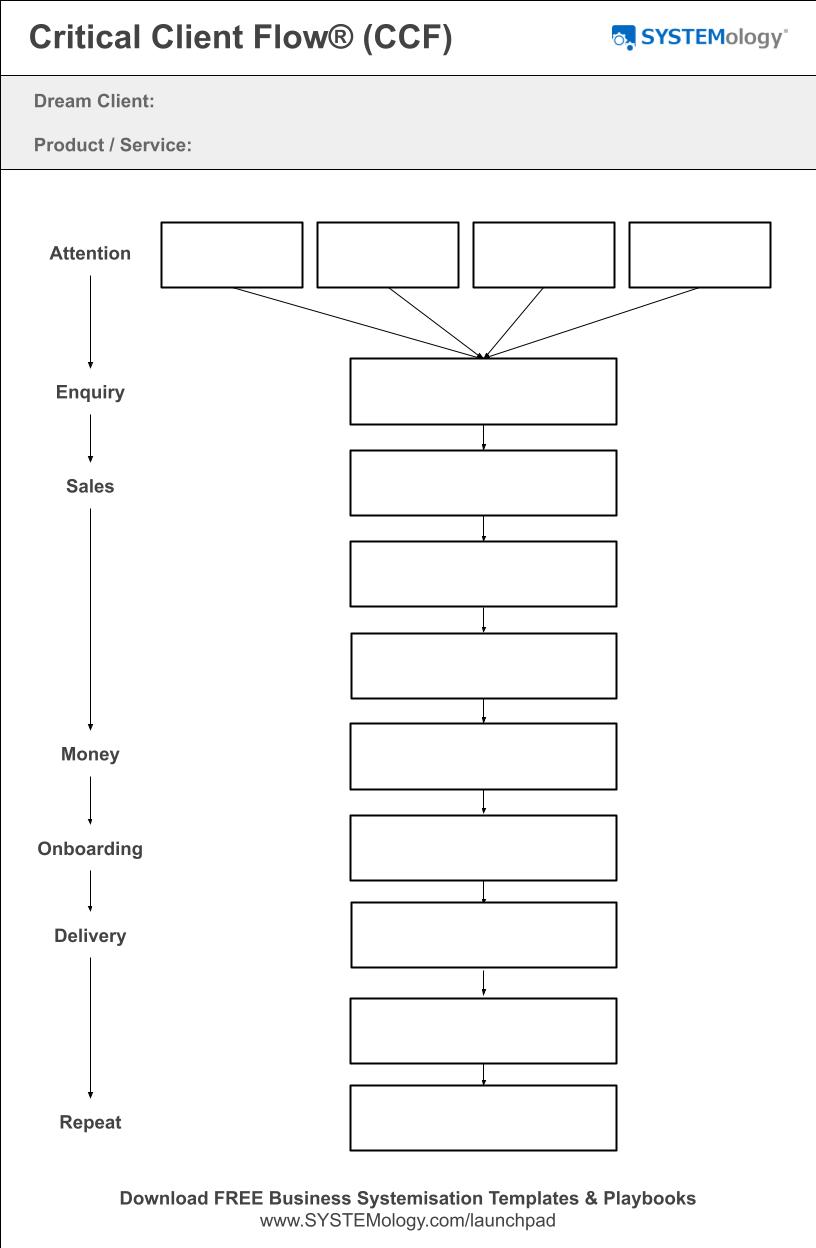
The Critical Client Flow (CCF) maps your entire delivery process in a single, simple overview.
What systemisation looks like in practice
Gary McMahon, Ecosystem Solutions
Gary McMahon founded Ecosystem Solutions in 2005, a specialised ecological consulting firm. Demand grew quickly, and so did the chaos.
Years of working 100 to 110 hours per week jeopardised his health, his family relationships, and the quality of his work. He hired staff and tried to expand, but he was still the bottleneck. Every tool he tried didn’t solve the problem.
“This is my only hope,” he said when he came across SYSTEMology. He began implementing the steps one by one. The CCF was a “game changer,” allowing him and his team to visualise the bottlenecks. He used it to onboard new team members and create a cohesive brand identity.
Through implementing SYSTEMology, profitability increased approximately 80 per cent. But his greatest win? A three-week holiday with his family, for the first time in his entire working life.
When asked what it means to have a systemised business, Gary said: “Peace of mind. It’s like I’ve lost fifty kilos! And I’ve got a life.”
Common mistakes when systemising your business
Trying to document everything at once. The biggest trap is believing you need hundreds of systems. Start with the 10 to 15 systems in your Critical Client Flow. That’s enough to create massive momentum. You can expand later.
The owner doing all the documenting. If you try to write every system yourself, you’ll burn out and nothing will get finished. Use the two-person extraction method. Let your team’s knowledge do the heavy lifting. Your role is to guide and review, not to write.
Making systems too complex. Long documents with roman numeral sub-lists and hundreds of screenshots will never get read. Keep your systems simple. Capture the overview first. You can add detail later as needed.
Not getting team buy-in early. If you spring systemisation on your team as a top-down mandate, expect resistance. Involve them from the start. Explain the why. Make it a two-person job. People are far more likely to follow systems they helped build.
Waiting for the “right time.” There is no perfect time to start systemising. The best time was five years ago. The second best time is today. Your ego might tell you the business needs you in the weeds. But the business needs you working ON it, not just IN it.
Frequently asked questions
What does systemising your business mean?
Systemising your business means documenting the key processes that make your business work, so your team can deliver consistent results without depending on you. It’s about building a business that runs on systems rather than running on the owner. A system is simply a series of steps that produces a predictable outcome.
How long does it take to systemise a business?
It varies depending on your starting point and commitment. David Jenyns systemised his digital agency and hired a replacement CEO in approximately twelve months. Most businesses can document their Critical Client Flow (10 to 15 core systems) within the first few weeks. The full transformation from Survival to Saleable is an ongoing journey, but meaningful progress happens quickly.
Do I need to create hundreds of systems?
No. This is one of the biggest myths about systemisation. In SYSTEMology, you start by identifying just 10 to 15 critical systems through the Critical Client Flow. These are the systems that drive 80% of your business results. You don’t need McDonald’s-level documentation to see dramatic improvements.
Can I systemise my business if I’m the only one who knows how things work?
Yes, though the SYSTEMology approach specifically addresses this. In most businesses, the knowledge of how to do tasks to a great standard already exists within the team, not just the owner. The Assign stage helps you identify “knowledgeable workers” who already do excellent work. The Extract stage captures their knowledge using a two-person method, so no one person has to both explain and document.
What’s the difference between systemising and creating SOPs?
Creating standard operating procedures is one part of systemising, but systemisation is broader. It includes identifying which systems matter most, assigning the right people to document them, organising them so your team can find and follow them, and building a culture where systems are embraced rather than ignored.
Will systemising my business remove creativity?
No. Systems handle the repetitive, operational work so your team has more mental bandwidth for creative problem-solving and innovation. Think of systems as the foundation that frees people up to do their best thinking. The goal is to systemise the doing, not the thinking.
Where should I start if I want to systemise my business?
Start with the Critical Client Flow (CCF). Pick one target client and one core product, then map the journey from attracting that client through to delivering your product. This takes about twenty minutes and identifies 10 to 15 systems as your starting point. From there, assign a systems champion and begin extracting your first system using the two-person method. For a detailed walkthrough, read our guide on how to systemise your business.
Systemising your business isn’t about control. It’s about freedom.
You built your business to create a better life. Systems are how you actually get there. They free you from the daily grind, protect your business from key person dependency, and create an asset that’s worth something beyond your own effort.
The journey from Survival to Saleable isn’t always fast. It requires patience and the discipline to stay the course. But every business owner who has made the commitment will tell you the same thing: it was worth it.
Ready to take the first step? Explore systemHUB and start building a business that works without you.