What if you could decode what your best people do differently and teach it to everyone?
That’s the core promise of NLP in business. Neuro linguistic programming started as a way to model excellence: study what high performers do, break it down into repeatable patterns, and transfer those patterns to others.
Sound familiar? If you’ve ever tried to get what’s in your best employee’s head into a process that others can follow, you already understand why NLP matters in business. It’s the communication layer that makes systems, delegation, and team development actually work.
In this guide, you’ll learn what NLP is (without the jargon), six practical benefits for business owners, and how NLP techniques connect directly to building better business systems.
In this guide:
What is NLP?
NLP stands for neuro linguistic programming. It’s a set of communication and behaviour-modelling techniques developed in the 1970s by Richard Bandler and John Grinder. The original idea was simple: study people who are exceptionally good at something, identify the specific patterns they use, and teach those patterns to others.
In a business context, NLP isn’t about manipulation or mind tricks. It’s about understanding how people process information, make decisions, and communicate. When you understand these patterns, you can lead more effectively, resolve conflicts faster, sell more naturally, and build teams that actually function.
NLP in one sentence:
It’s the study of how language and behaviour patterns drive results, and how to replicate the patterns that work.
6 key benefits of NLP in business
NLP techniques aren’t just for coaches and therapists. Business owners who apply even basic NLP principles see measurable improvements across leadership, communication, sales, and team performance.
1. Better communication across your team
Most communication breakdowns in business happen because people process information differently. Some team members are visual thinkers. Others need to hear things explained verbally. Some need to do something hands-on before it clicks.
NLP teaches you to recognise these communication preferences and adapt your message accordingly. When you explain a new process to a visual thinker, you use diagrams and flowcharts. With an auditory processor, you walk them through it verbally. With someone kinesthetic, you let them practise.
This isn’t about being everything to everyone. It’s about removing the friction that causes misunderstandings, rework, and frustration. Clear communication is the foundation of every effective process and procedure in your business.
2. Stronger leadership and influence
Leadership isn’t about authority. It’s about influence. NLP gives you tools to build rapport quickly, communicate with clarity, and inspire action without relying on positional power.
Techniques like matching and mirroring help you connect with team members on a deeper level. Reframing lets you turn problems into opportunities during team discussions. Anchoring helps you create positive emotional states in high-pressure situations like board meetings or client presentations.
The best leaders don’t just tell people what to do. They communicate in a way that makes people want to follow. NLP is the toolbox that makes that possible.
3. Improved sales conversations
Sales resistance often comes down to a communication mismatch. The prospect is thinking one way, and the salesperson is talking another way. NLP bridges that gap.
By paying attention to a prospect’s language patterns, you can mirror their communication style and speak in terms that resonate with them. If they talk about how something “looks,” use visual language. If they ask how something “sounds,” match that auditory preference.
This isn’t manipulation. It’s meeting people where they are. When prospects feel understood, trust builds faster and buying decisions happen more naturally.
4. More effective team management and delegation
One of the biggest challenges business owners face with delegation is communicating expectations clearly enough that the task gets done right. NLP helps you become precise with your language and aware of the assumptions you’re making.
The NLP meta-model, for example, teaches you to ask specific questions that uncover missing information. Instead of assuming your team understood a vague instruction, you learn to check for clarity before work begins. Instead of saying “handle this,” you specify the outcome, the timeline, and the quality standard.
Better delegation starts with better communication. And NLP gives you the framework to communicate expectations in a way that sticks.
5. Smoother conflict resolution
Every business has conflict. What separates functional teams from dysfunctional ones is how quickly and effectively that conflict gets resolved.
NLP teaches you to separate the person from the behaviour, understand different perspectives (through a technique called perceptual positions), and reframe disagreements into productive conversations.
Instead of reacting emotionally when a team member pushes back on a new system, you learn to step into their perspective, understand their concern, and address the real issue. This is particularly valuable when you’re encouraging your team to love systems and adopt new ways of working.
6. Easier change management
Introducing new systems into a business is a change management challenge. People resist change. Not because they’re lazy, but because their brains are wired to prefer the familiar.
NLP provides tools for managing that resistance. Reframing helps you present change as an opportunity rather than a threat. Anchoring lets you create positive associations with new processes. Future pacing (a visualisation technique) helps team members see themselves successfully using the new system before they even start.
If you’ve ever rolled out a new process and watched your team quietly ignore it, NLP techniques can help you understand why it happened and prevent it next time.
How strong are your business systems?
NLP improves communication. Systems make that communication permanent. Take the free Systems Strength Test and see where you stand.
How NLP supports better business systems
Here’s the connection most people miss: NLP and business systemisation are solving the same problem from different angles.
NLP is about modelling what works. You study your best performer, identify the patterns, and replicate them. Business systemisation does the same thing. You take your best processes, document them, and make them repeatable.
The overlap is significant:
- Modelling excellence: NLP models behaviour. SYSTEMology models processes. Both aim to capture what works and make it teachable.
- Clear documentation: NLP teaches precise language. Good SOPs require precise language. The meta-model questions that NLP practitioners use are exactly the questions you should ask when documenting a standard operating procedure.
- Change adoption: NLP gives you tools to help your team embrace new systems. Without these communication skills, even the best systems collect dust.
- Delegation confidence: NLP helps you communicate expectations clearly. Clear expectations make delegation of authority less stressful for both you and your team.
In David Jenyns’ book SYSTEMology, the first challenge every business owner faces is extracting what’s in their head. NLP techniques make that extraction process smoother because they teach you to articulate tacit knowledge: the things you do instinctively but struggle to explain.
Document what your best people do
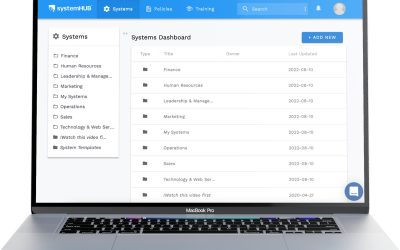
systemHUB gives you a central place to store the processes, checklists, and SOPs that capture your team’s best practices.
Practical NLP techniques for business owners
You don’t need an NLP certification to start applying these techniques. Here are five practical NLP tools you can use in your business this week.
Rapport building
Match the other person’s pace, tone, and energy. If a team member speaks slowly and deliberately, slow down. If a client is enthusiastic and fast-paced, match that energy. People trust others who feel familiar, and rapport is the quickest path to trust.
Reframing
When a team member says “this new system is too complicated,” reframe it: “It feels complicated because it’s new. Once you’ve done it three times, it’ll feel automatic.” Reframing doesn’t dismiss the concern. It shifts the perspective from permanent problem to temporary challenge.
Meta-model questions
These are precision questions that cut through vague language. When someone says “the project isn’t going well,” ask: “Which specific part isn’t going well? What would ‘going well’ look like?” These questions force clarity and prevent misunderstandings before they snowball.
Anchoring
Anchoring connects a specific state (confidence, focus, calm) to a physical trigger. Before a big presentation, recall a time you felt completely confident and anchor that feeling to a physical gesture. It sounds simple. It works surprisingly well under pressure.
Modelling
This is the core of NLP. Find someone who does something brilliantly, study exactly how they do it (their mindset, their language, their specific steps), and break it into a teachable sequence. In business, this is essentially what you do when you create a system: you model the best way, document it, and teach it to your team.
Common mistakes with NLP in business
Treating NLP as a magic trick. NLP techniques are practical tools, not secret weapons. They improve communication over time through consistent practice. Expecting instant transformation leads to disappointment and abandonment.
Using NLP to manipulate rather than communicate. The moment your team senses manipulation, trust evaporates. Use NLP to understand people better and communicate more clearly, not to control or deceive.
Learning NLP without applying it to systems. Attending a weekend NLP workshop and then returning to the same chaotic business changes nothing. The real value of NLP comes when you apply it to how you document processes, train team members, and manage change.
Overcomplicating things. You don’t need to master every NLP technique. Start with rapport building and meta-model questions. Those two skills alone will transform how you lead your team and delegate tasks.
Frequently asked questions
What does NLP stand for?
NLP stands for neuro linguistic programming. “Neuro” refers to how we process information through our senses. “Linguistic” refers to how language shapes our thinking. “Programming” refers to the behavioural patterns we can identify and change. In business, it’s about using these insights to communicate better and lead more effectively.
Is NLP scientifically proven?
NLP has a mixed relationship with academic research. Some techniques (like rapport building and reframing) are well-supported by psychology and communication research. Others have less empirical backing. In business, the practical question isn’t whether NLP passes a peer review. It’s whether the techniques improve your communication and leadership. For many business owners, they demonstrably do.
Do I need NLP certification to use these techniques?
No. While formal NLP training can be valuable, the basic techniques like rapport building, reframing, and meta-model questions can be learned from books and applied immediately. Start using them in your next team meeting or client conversation and see what changes.
How does NLP help with delegation?
NLP teaches you to communicate with precision and empathy. When you delegate a task, NLP techniques help you give clear instructions (using the meta-model), build trust with the person you’re delegating to (through rapport), and handle pushback constructively (through reframing). This leads to better outcomes and less micromanagement.
Can NLP improve how I document business processes?
Absolutely. The NLP meta-model is essentially a toolkit for asking precise questions. When you’re documenting a process, these questions help you capture the specific details that make the difference between a vague SOP and one your team can actually follow. It turns “handle the customer complaint” into a clear, step-by-step sequence.
What’s the connection between NLP and business systems?
Both NLP and business systemisation are about modelling what works and making it repeatable. NLP models behaviour and communication. Business systemisation models processes and workflows. When you combine both, you get systems that are clearly documented (NLP precision), readily adopted (NLP change management), and consistently executed (systems thinking).
Where should I start with NLP in my business?
Start with two things: rapport building (match the communication style of the person you’re talking to) and meta-model questions (ask specific, clarifying questions instead of accepting vague answers). Use these in your next team meeting, performance review, or client conversation. The impact is often immediate.
NLP gives you the communication tools. Systems give you the structure. Together, they build a business that runs on clarity, not chaos.
Ready to capture what your best people do and turn it into systems anyone can follow? Start documenting your processes in systemHUB.