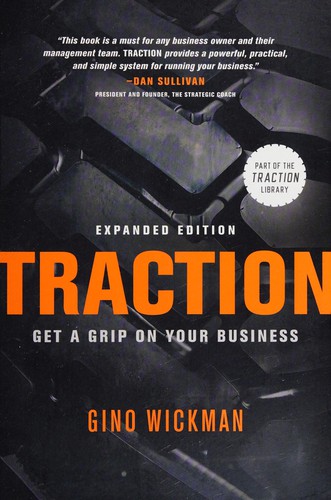
The Level 10 meeting comes from Gino Wickman’s Traction — the book that introduced the EOS framework. If you’ve seen the orange cover on a leader’s desk, this is the meeting structure they’re running every week.
On this page
EOS Implementer Daniel Davis walks through the Traction system and the weekly Level 10 meeting.
Short answer: A Level 10 meeting (L10) is the weekly 90-minute leadership meeting from Gino Wickman’s Traction / EOS. It runs a fixed 7-part agenda: segue, scorecard review, rock review, headlines, to-dos, IDS, then conclude. Everyone rates the meeting a 10. If yours scores lower, the structure tells you what to fix. This guide walks through each section, shows you how IDS works, and gives you a template you can copy tomorrow.
What is a Level 10 meeting?
A Level 10 meeting is a weekly leadership meeting introduced by Gino Wickman in Traction and formalised as the central rhythm of the Entrepreneurial Operating System (EOS). It always runs 90 minutes. It always follows the same 7-part agenda. Everyone at the table rates the meeting out of 10 at the end, so the name doubles as a quality check and a weekly target.
The point is rhythm. Most business owners I talk to have “weekly meetings” that drift, overrun, and leave people unsure what was decided. The L10 solves this with a fixed agenda, a fixed clock, and a fixed method for working through issues. When you install it properly, the meeting becomes the single most productive 90 minutes of your leadership team’s week.
It sits inside EOS alongside the Vision Traction Organiser (VTO), the Accountability Chart, the People Analyzer and the Scorecard. If you want the broader framework, start with our EOS people analyzer and management system guide. This page is the deep-dive on the meeting itself.
Who should run a Level 10 meeting?
In an EOS business, every leadership team runs an L10 once a week, plus every department-level team (sales, ops, service) runs one of their own. Attendees are the people accountable for the function of the team. Same time, same day, same 90 minutes.
“When they love their Level 10, they are happier, live longer, make more money, have better relationships, and frankly, I think they have fewer cavities.”
Gino Wickman, author of Traction
The 7-part L10 agenda
Every L10 follows the same seven sections in the same order. The timing targets below are EOS standard. Feel free to shave them for a smaller team, but do not add sections or reorder. The structure is the structure.
Good news
Each person shares one piece of personal good news and one piece of business good news. It sounds like fluff. It is not. Segue resets the team from whatever was happening 5 minutes ago and reconnects people to the human side of the business. Skip this and the meeting starts cold every week.
Review last week’s numbers
Walk through the weekly scorecard. Every metric is either on track or off track. Do not discuss or debate the numbers here. If a metric is off, drop it into the Issues List. The scorecard review is a scan, not a conversation.
Check 90-day priorities
A Rock is a single 90-day priority owned by one person. Each owner says “on track” or “off track” against their Rock. Again, no discussion. Anything off track goes straight into the Issues List.
The front-page news of the business
Short headlines only. Customer headlines: a great piece of feedback, a big complaint, a new client signed. Employee headlines: a resignation, a great hire, a team concern. The point is awareness, not problem solving. If a headline needs action, it goes to the Issues List.
Close last week’s commitments
Review every to-do agreed in last week’s L10. Each one is either done or rolled forward. Target 90% completion week on week. If a to-do has been carried for three weeks, it is an issue: push it into IDS.
Identify, discuss, solve
The engine of the meeting. Your Issues List now has everything the scorecard, Rocks, headlines and to-dos flagged above, plus anything else people dropped in during the week. Prioritise the top 3 issues. Work them one at a time using the IDS method (next section). Solve or park each one before moving on.
Recap and rate
Three things: recap the new to-dos owners walked away with, confirm any messages going out to the wider team, and rate the meeting out of 10. If anyone scores below an 8, ask one question: what would have made it a 10? Log the answer, fix it next week.
Watch: an actual L10 in practice
Above is the theory from EOS Implementer Daniel Davis. For the practitioner view, here’s Ben Stickland walking through exactly how his leadership team runs the weekly meeting — 8:55am every Wednesday, good-news round-robin, rapid-fire numbers, rock review with on-track / off-track calls, then IDS. The rock review mechanics kick in at ~38:39.
Business Systems Summit: Ben Stickland on formalising the leadership team, core values, and the weekly meeting rhythm.
IDS: the issues-solving method
Most of the meeting’s 90 minutes are spent on IDS, so the method matters. The three letters stand for Identify, Discuss, Solve. It looks simple and takes practice to run well.
Identify the real issue
Almost every issue that gets raised in a weekly meeting is a symptom, not a cause. “We lost a client this week” is a symptom. The real issue might be that onboarding is inconsistent, or that the account manager is overloaded, or that the product does not match the promise. The first 2 to 3 minutes of IDS is spent asking “what is the real issue here?” until the team agrees on the root cause.
Discuss with the whole team
Once everyone agrees on the real issue, everyone gets to weigh in. This is the only place in the meeting where open discussion is allowed, so use it properly. The facilitator’s job is to keep it on the single issue being worked, not let it wander into adjacent problems.
Solve, or park with a clear next step
You are not done with an issue until there is a decision and an owner. Sometimes the decision is “we need more information, Jamie will gather it by next Tuesday”. That is still a solve, because it has an owner and a date. What is not a solve: “let’s keep thinking about it”. Kick issues like that back to the list and work the next one.
One at a time. That is the rule. Tackling three issues in parallel always ends with all three half-solved.
Scorecard integration
The scorecard is a weekly dashboard of 5 to 15 numbers. Each number has one owner and one target. Each number gets a green tick or a red cross every week. No averaging, no colour gradients. Either you hit the target or you didn’t.
Typical scorecard metrics for a leadership team: weekly revenue, number of sales calls, cash in bank, customer satisfaction score, hires closed, churn count. Departmental scorecards use operational metrics: tickets resolved, SLA hit rate, jobs completed on time, utilisation.
The scorecard does two things for the L10. First, it catches problems early. A target missed 2 weeks in a row tells you something 6 weeks before the P&L will. Second, it keeps the meeting objective. Instead of debating feelings about how sales is going, you look at the number and route the shortfall into IDS.
If you do not have a scorecard yet, pick 5 metrics your leadership team can reasonably influence week to week. Start there. Add measurables as the team matures.
Where the L10 fits in the EOS system
The L10 is one of six components of the EOS operating system. Running a great meeting without the rest of the machinery will burn people out because the team will not know what to measure or who owns what.
The short version of the other components:
- Vision / VTO: the one-page document that answers core values, core focus, 10-year target, marketing strategy, 3-year picture, 1-year plan, quarterly Rocks, and the current issues list. The VTO feeds the Rock review.
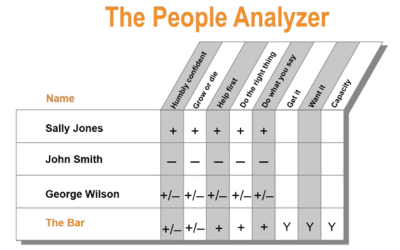
- People Analyzer: a 2×3 grid that scores each team member against core values (right people) and against GWC (Get it, Want it, have the Capacity for it — right seat). The Analyzer surfaces hiring and firing issues that get worked in IDS.
- Accountability Chart: not an org chart. It lists the seats the business needs, the functions each seat owns, and the 5 top responsibilities of each role. One name per seat.
- Data / Scorecard: covered above. The measurables for each seat.
- Issues / IDS: the method used in the L10 and in quarterly planning.
- Process: the documented core processes of the business. This is where EOS gets light and where SYSTEMology picks up (more on that below).
For a deeper walkthrough of the Vision, People and Data sides of EOS, including the People Analyzer template, see our EOS people analyzer and management system guide.
L10 vs a traditional weekly meeting
If you have never run a structured leadership meeting, the L10 feels over-engineered. It isn’t. It is simply prescriptive enough to survive a busy week. Here is the contrast.
| Dimension | Traditional weekly meeting | Level 10 meeting |
|---|---|---|
| Agenda | Varies, often written the morning of | Same 7-part agenda every week |
| Duration | Whatever it takes, usually overruns | Fixed 90 minutes, start and finish on the clock |
| Decision method | Open discussion, consensus, often inconclusive | IDS, one issue at a time, owner and date on every solve |
| Measurement | Verbal updates, sometimes slides | Scorecard: red or green, no ambiguity |
| Priorities tracked | “Whatever is on fire” this week | Weekly Rocks tied to quarterly Rocks tied to the VTO |
| Quality feedback | Nobody knows if it was a good meeting | Everyone rates 1 to 10 at the end, feedback loop closes |
| Installation time | Whenever | 6 to 8 weeks to land properly, faster with an EOS Implementer |
Where SYSTEMology fits with EOS
If you already run EOS and you are on this page because your meetings are working but your operations are not, you are in the right spot.
EOS is a leadership operating system. It tells you who does what and how decisions are made. It is deliberately light on the “how the work actually gets done” side. Step 5 of the EOS system, Process, is one paragraph: “document your core processes, make sure everyone follows them.” That is a huge project wrapped in a single sentence.
SYSTEMology picks up exactly there. It is a process operating system for small businesses. The 7-stage framework walks you through identifying the Critical Client Flow, building Minimum Viable Systems, documenting SOPs with AI, then scaling the business off the founder. Teams running EOS and SYSTEMology together usually describe the two as complementary, not competitive. EOS runs the cadence. SYSTEMology runs the process library.
If this is new, a good starting point is our side-by-side comparison of SYSTEMology and EOS or SYSTEMology the book.
Systemise Your Business In Weeks, Not Years.
Run tight Level 10 meetings, then use systemHUB to document and standardise the processes behind them. 100+ plug-and-play templates, AI-assisted SOP creation, full audit trail. Free trial, no credit card.
Level 10 meeting FAQ
What is a Level 10 meeting?
A Level 10 meeting is a weekly 90-minute leadership meeting from Gino Wickman’s Traction / EOS. It follows a fixed 7-part agenda: segue, scorecard, Rock review, headlines, to-dos, IDS, conclude. Everyone rates the meeting out of 10 at the end, which is where the name comes from.
How long does a Level 10 meeting take?
Ninety minutes, every week, same time, same day. Start on time, finish on time. Shorter meetings rarely work because IDS needs room to breathe. Longer meetings almost always mean the team has drifted off the agenda.
Who should attend the L10?
The leadership team: the people accountable for the major functions of the business, usually 5 to 7 people. Departmental teams run their own L10 with their department head plus 3 to 5 direct reports.
How often should we run one?
Weekly, without exception. Skipping a week does not save 90 minutes, it costs you a month because issues pile up and nothing gets cleanly worked.
What is IDS in a Level 10 meeting?
IDS is the issues-solving method used in the L10. Identify the real issue (not the symptom), discuss it with the full team, then solve it with a decision, an owner, and a date. Work one issue at a time.
What is a Rock in EOS?
A Rock is a single priority owned by one person for the current 90-day period. A company typically has 3 to 7 company Rocks. Each leader also has their own 1 to 3 personal Rocks that roll up to the company Rocks.
Why is it called a Level 10 meeting?
Because the target is a meeting that everyone rates 10 out of 10. Rating at the end of every meeting creates a continuous feedback loop. If someone rates it a 7, ask what would make it a 10, then fix that thing next week.
Where can I download a Level 10 meeting template?
The canonical free L10 template is at eosworldwide.com/eos-toolbox. For the broader EOS system, including the People Analyzer template and the Accountability Chart, the fastest path is to start a free systemHUB trial. The canonical EOS templates (L10, People Analyzer, VTO, scorecard) are free from Gino Wickman’s EOS Toolbox. systemHUB is what you use underneath — to document and store the SOPs behind every seat on your Accountability Chart, so the business stops depending on the people in it.
Key takeaways
- The L10 is a fixed 7-part, 90-minute weekly leadership meeting. Same agenda, same clock, every week.
- IDS is the engine. Identify the real issue, discuss with the team, solve with an owner and a date. One at a time.
- The scorecard makes the meeting objective. Numbers either hit target or they don’t. Misses route into IDS.
- Rate every meeting 1 to 10. Below an 8 means something broke. Fix it the next week.
- The L10 is one of six EOS components. It is most powerful when the VTO, People Analyzer, Accountability Chart and Scorecard are also in place, and when the process side is handled by a dedicated system like SYSTEMology.