You know your product solves a real problem, but your pipeline is dry and networking only gets you so far. Scaling through referrals alone eventually hits a ceiling, and most businesses stall right there. The missing piece is often a repeatable cold outreach strategy that targets the right people with the right message at the right time.
In this episode, David Jenyns sits down with Sawyer Paul, founder of Launch Pal and the Concrete agency, to unpack his five-layer framework for cold outbound that consistently delivers 10–15% reply rates (well above the 1–3% industry average). If you’ve been avoiding outbound because you’re afraid of spam folders, this conversation will change the way you think about building scalable sales systems. Hit play and take notes.
PODCAST SEASON 4: EP 11


Episode Chapters
- 00:47 Cutting Through the Noise
- 02:06 The Five-Layer Outreach Framework
- 05:33 Testing Your ICP Across Different Industries
- 06:46 LinkedIn First, Email Second
- 12:12 Speed to Lead and Follow-Up
- 14:50 Systemise Before You Automate
- 18:51 Do the Hard Work Before You Automate
- 21:22 Find Sawyer and LaunchPal
👤 Today’s Guest, Sawyer Paul
Sawyer Paul is a sales and marketing strategist with over seven years of experience in B2B outbound and cold outreach. He is the founder of Concrete (cnct.co), a marketing, design, and automation agency, and the creator of Launch Pal (launchpal.io), a software platform built to help fast-moving consumer goods (FMCG) brands validate product-market fit through automated personalised outreach.
Based in New Zealand, Sawyer specialises in helping emerging brands land retail distribution by connecting them directly with buyers at liquor stores, supermarkets, and hospitality groups. His campaigns consistently deliver reply rates of 10–15%, well above the industry average.
Website: launchpal.io | cnct.co
“You’ve gotta do the legit human element of it first before you can accelerate that. I wouldn’t want to 10x something that I’m bad at.”
— Sawyer Paul, Founder of Launch Pal & Concrete
📋 Sawyer Paul’s Five-Layer Cold Outreach Framework
Based on the interview with Sawyer Paul, Founder of Launch Pal & Concrete
Sawyer breaks effective cold outreach into five interconnected layers. Skip any one of them and the whole system underperforms. Here is the framework he uses to generate consistent results for FMCG brands and service-based businesses alike.
Step 1: ICP Clarity
Everything starts with knowing exactly who your ideal client is: what they do, where they spend their time, and what problems keep them up at night. Sawyer recommends testing three to four different ICP segments with small campaigns of 100–300 prospects each. After a month or two of data, you will have clear evidence of which segments respond and which ones to drop entirely.
This kind of upfront testing prevents you from wasting months sending messages to the wrong audience.
Step 2: Data Quality
Bad data kills campaigns before they start. Sawyer’s team works with 39 different data points per prospect to ensure accuracy. Old lead lists, incorrect phone numbers, and outdated email addresses all drag down reply rates and damage your sender reputation. Investing in clean, verified data is not optional if you want your outreach to land.
Step 3: Deliverability
Your email can be perfectly written, but if it lands in spam, nobody will ever see it. Deliverability covers the technical infrastructure behind your campaigns: warming up multiple domains, configuring DNS text records, and stripping out HTML-heavy signatures that trigger spam filters.
Sawyer notes that sending 2,500 emails in a month might require ten separate domains, each properly warmed. Skipping this step is one of the fastest ways to end up on a blacklist.
How much is it costing you to run your business without a system?
Sawyer’s framework proves that every layer of cold outreach needs its own process. Without clear systems, you’re burning leads and budget. Use our free Cost of Chaos Calculator to put a real dollar figure on it.
Step 4: Message Relevance
Once your technical foundation is solid, the message itself needs to earn the open and the reply. Generic, one-size-fits-all copy does not cut it. Sawyer tailors every email and LinkedIn message to the specific ICP segment, referencing their industry, their pain points, and their goals. This personalisation is a core reason his team sees 10–15% reply rates on cold outreach, compared to the 1–3% industry standard.
Step 5: Structured Follow-Up
The sale is almost never made on the first touch. Sawyer’s team uses five to six touch points per prospect and sees a 60% increase in replies after the first follow-up. The key is persistence without being annoying: each follow-up adds value or shifts the angle rather than simply repeating the same ask.
When a prospect does reply, the team calls within 150–240 seconds. That speed-to-lead moment builds immediate trust and sets the tone for the entire relationship.
Bonus: Turning Cold Outreach Into a Repeatable SOP
David and Sawyer both emphasised a critical point: do not automate what you have not yet proven by hand. The first step is to scrape a list of prospects (using tools like Browse AI), then call every one of them manually. You will hear the objections, refine your offer, and sharpen your messaging.
Only once you know what works should you codify the process into an SOP and layer automation on top.
As David noted, the businesses getting the best results with AI are the ones that already documented their SOPs and understood what was working before they tried to scale it.
Choosing Your Channel: LinkedIn First, Then Email
For businesses new to cold outbound, Sawyer and David agree that LinkedIn is the safer starting point. You avoid the deliverability complexity of email, and the connection-request mechanic gives you an implied permission layer. Personalised voice messages on LinkedIn are particularly effective at breaking through the noise.
Once your messaging is dialled in and converting on LinkedIn, you can expand to cold email, armed with proven copy and a clear ICP. For established businesses, the easiest first win is reactivating past clients and dormant leads before going fully cold.
How strong are your business systems right now?
Sawyer’s framework only works when every layer is systemised. Take our free System Strength Test, a 2-minute assessment that scores your business across 9 dimensions and shows you exactly where to focus.
Sawyer’s five-layer framework makes it clear that cold outreach is not about blasting a thousand strangers with the same generic pitch. It is a system with moving parts: clean data feeding personalised messages, sent from properly warmed domains, to a precisely defined audience, followed up with speed and intention.
The most useful takeaway from this conversation might be the simplest one: pick up the phone and call your first list of prospects manually. Hear the objections yourself. Once you understand why people say yes (and why they say no), you will have the foundation to build an outbound engine that scales.
Ready to put this into practice?
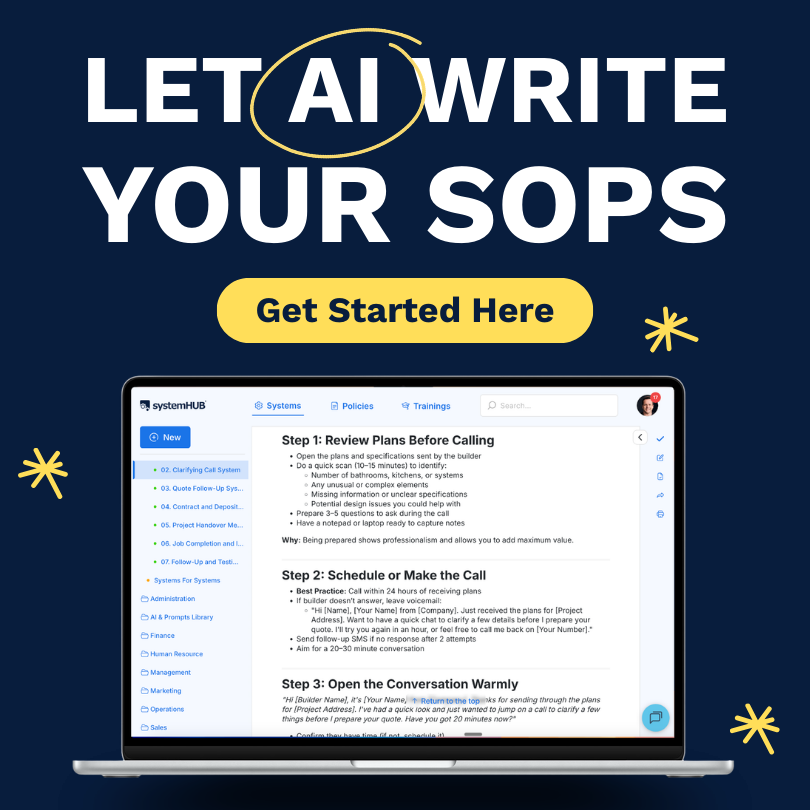
systemHUB gives you 100+ ready-made process templates across Sales, Operations, HR, Finance, and Marketing, so you can start building a business that runs without you, today.
Want to see business systemisation in action? Watch Dave walk through how to document your first business process step by step.
Ready to get started?
systemHUB gives you 100+ ready-made SOP templates across Sales, Marketing, Operations, HR, and Finance. Customise them for your business and start building a business that runs without you.
Thank you for listening!
Thanks for joining us for this episode. Do you have any questions or feedback you'd like to share? We'd love to hear it! Let us know in the comments section below.
If you enjoy listening to this podcast, please share it on Facebook and leave an honest review on iTunes. We'd love to know what you think.
Remember, the next system we share could be just the one you’ve been looking for, so subscribe on iTunes so you can get the latest episodes as soon as they’re published.
About The Show
Business Processes Simplified
We interview industry experts and have them share their best small business systems and processes. This is the quickest, easiest and most efficient way to build a systems centered business.