“Nobody can do it like I can.”
I’ve said that sentence more times than I’d like to admit. And every time I said it, I was right. Nobody could do it exactly like me. The problem was, that was the very thing keeping my business stuck.
Business ego is the silent bottleneck that most owners don’t recognise until they’re burned out, revenue has plateaued, and their team has stopped trying. It’s not arrogance in the traditional sense. It’s the deeply held belief that you need to be involved in everything for it to be done properly.
I’m a recovering micromanager. And building the SYSTEMology framework was, in many ways, the process of learning to let go. In this article, I want to share what business ego actually looks like, what it’s costing you, and the practical steps I used to get out of my own way.
In this guide:

What is business ego?
Business ego isn’t about being arrogant or having a big personality. It’s the ingrained belief that the business needs you for every decision, every task, and every customer interaction. It shows up in subtle ways that feel like dedication but actually function as control.
You check your team’s work before it goes out. You answer customer calls because “they expect to speak to the owner.” You redo tasks your team completed because they weren’t done your way. You carry your phone on holiday and check emails before breakfast.
These behaviours feel responsible. They feel like high standards. But they’re actually symptoms of a business ego that won’t let go.
The honest truth: Your business ego tells you the business will fall apart without you. But the reality is the business can’t grow because of you. You’ve become the ceiling.
Signs your business ego is holding you back
Business ego is hard to spot in yourself because it disguises itself as quality control, customer care, and dedication. Here are six warning signs.
1. You are the answer to every question
Your team comes to you for everything. Not because they’re incapable, but because you’ve trained them to. Every time you jumped in with the answer instead of pointing them to a process, you reinforced the message: “Don’t think for yourself. Ask me.”
If your inbox is full of questions your team should be able to answer on their own, that’s your ego’s fingerprint on the business. The fix isn’t more availability. It’s documented processes that give your team the answers without needing you. Knowing when to delegate starts with recognising this pattern.
2. You redo your team’s work
They complete a task. You review it. Then you quietly redo half of it because it’s “not quite right.” This cycle destroys team confidence and teaches people to give you their B-effort (since you’re going to change it anyway).
The cost isn’t just your time. It’s the message you’re sending: your team’s effort doesn’t matter. Over time, your best people leave and you’re left wondering why you can’t retain talent.
3. You cannot take a week off
The ultimate test. If you can’t take seven consecutive days away from the business without things deteriorating, you don’t have a business. You have a job that you own.
This isn’t a lifestyle gripe. It’s a valuation issue. A business that depends on the owner being present every day is worth significantly less than one that runs independently. Potential buyers see an owner-dependent business as a liability, not an asset.
4. Your team waits for your approval on everything
If nothing moves without your sign-off, you’ve created a bottleneck disguised as quality control. Your team sits idle while you’re in meetings. Decisions pile up. Projects stall.
The irony is that you feel indispensable, but what you’ve actually created is a culture of learned helplessness. Your team has stopped making decisions because every decision gets overridden anyway.
5. You hire people but won’t let them do their job
You hire talented people because you know you need help. Then you hover, micromanage, and second-guess their every move. The talent you hired at a premium either leaves or downgrades to simply following orders.
This is business ego at its most expensive. You’re paying for expertise and then not letting it work.
6. Revenue has plateaued because you’re maxed out
There are only so many hours in a day. If your revenue is directly proportional to your personal output, you’ve hit a ceiling that no amount of hustle will break through. The business can’t grow beyond your individual capacity.
This is the hidden cost of avoiding systemisation. Without systems, growth requires more of you. With systems, growth happens through your team.
What is your ego costing you?
Use the free Cost Calculator to estimate the real financial impact of owner-dependency in your business.
The real cost of being the bottleneck
Business ego doesn’t just slow things down. It has measurable, compounding costs that affect every part of your business.
Revenue ceiling. When growth requires you personally, it stops when you run out of hours. Most owner-dependent businesses plateau at $1-3M because that’s the maximum one person can drive.
Team disengagement. Talented people don’t stay in environments where their contribution is constantly overridden. You lose your best people first because they have options. The ones who stay learn to wait for instructions instead of taking initiative.
Burnout. Carrying everything leads to physical and mental exhaustion. And when you burn out, the business burns with you because there’s no one else who knows how to run it.
Lower business valuation. Buyers and investors assess key-person risk. An owner-dependent business is harder to sell and commands a lower multiple. The difference between a business valued at 3x earnings and one valued at 5-7x often comes down to whether the business can run without the founder.
Inability to scale. Scaling requires leverage. You need people, processes, and systems that multiply output beyond what one person can do. If everything runs through you, there is nothing to scale.

The old way: everything runs through the owner.

The SYSTEMology way: your team runs the systems, you run the business.
How systems help you let go
Here’s what I discovered when I started systemising my business: the reason I couldn’t let go wasn’t stubbornness. It was trust. I didn’t trust that things would get done properly without me because there was no documented way to do them properly.
When you build systems, you’re not just creating processes. You’re creating trust. The trust comes from knowing there’s a verified, documented way to handle every critical task. Your ego has less to hold onto because the system holds the standard, not you.
In my digital agency, the turning point came when I documented our client onboarding process. It was the one thing I was sure nobody could do as well as me. But once it was written down, step by step, Melissa (my operations manager) started running it. Then she improved it. Within three months, the process was better than when I ran it personally.
That’s the beautiful irony of letting go: the business often improves when you step back because your team brings fresh perspective and dedicated attention that you, spread across a hundred responsibilities, simply can’t match.
Key insight from SYSTEMology: Systems create trust because you’re verifying the process, not the person. When a system is documented and tested, you can trust the outcome regardless of who executes it.
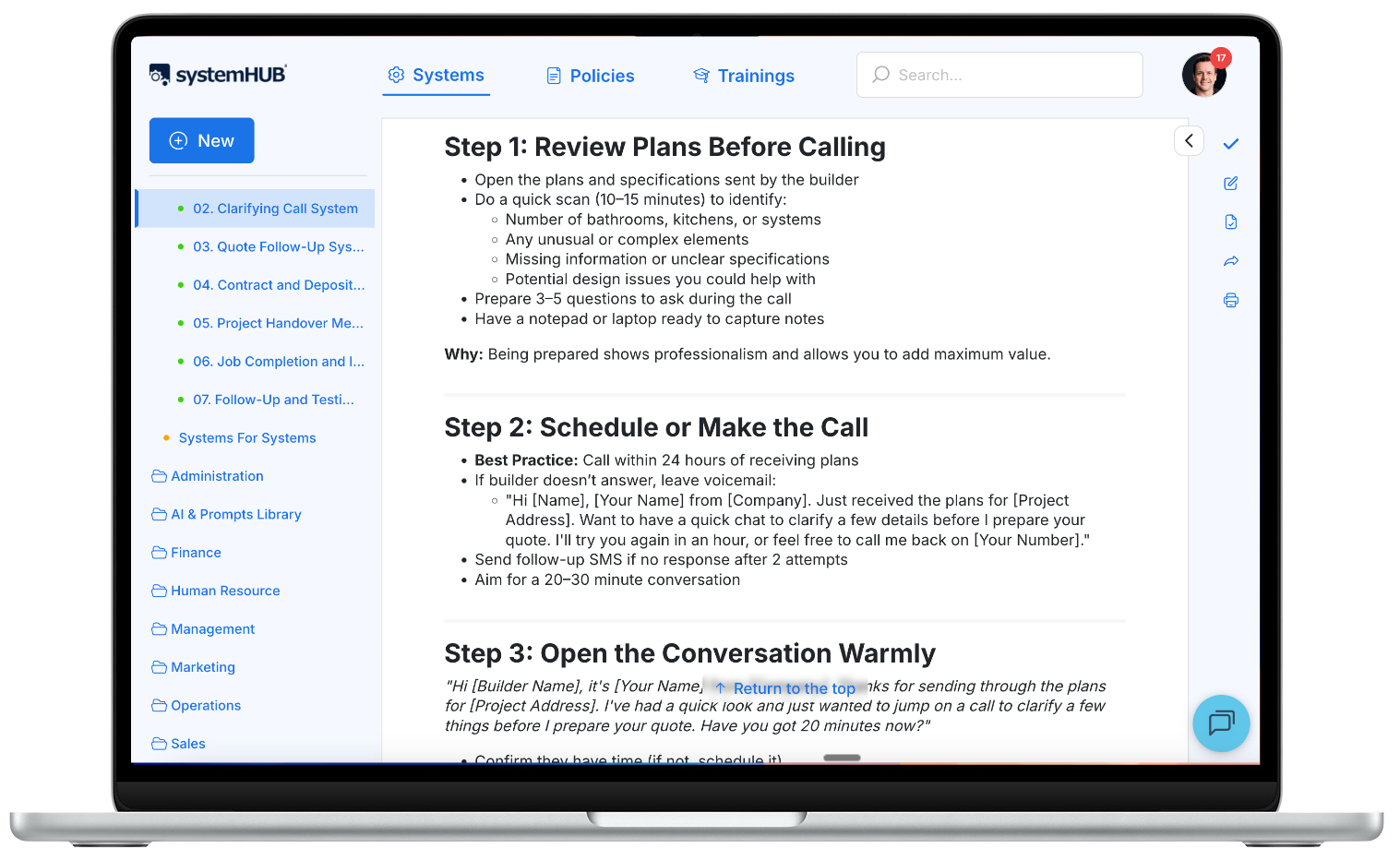
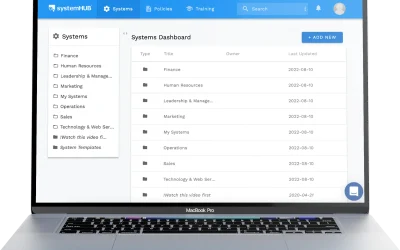
Store your documented processes in systemHUB so your team can access them without asking you.
Ready to stop being the bottleneck?
systemHUB gives you the platform to document your processes, delegate with confidence, and build a business that doesn’t depend on you for every decision.
Practical steps to overcome business ego
Awareness is the first step. Here are six practical actions you can take to start letting go.
1. Acknowledge you are the bottleneck
This is the hardest step and the most important one. Until you admit that your involvement is the constraint, not the solution, nothing changes. Say it out loud: “I am the bottleneck in my business.” It stings. It’s also the truth that sets you free.
2. Identify your Critical Client Flow
The Critical Client Flow (CCF) is the sequence of steps that takes a prospect from first contact to a happy, paying customer. Map it out. This is where your business systems have the highest impact, and where your personal involvement is most likely holding things back.
3. Extract your knowledge (don’t document it yourself)
Here’s a counterintuitive tip: don’t write the SOPs yourself. Have a team member watch you perform the task, then have them document what they observed. This extracts your knowledge without requiring you to spend hours writing documentation. It also reveals the gaps in your process that you’ve been covering with intuition.
4. Start with one system, not everything at once
The temptation is to systemise everything overnight. Resist it. Pick the one process that causes the most pain or generates the most revenue. Document it. Delegate it. Get it running smoothly. Then move to the next one.
5. Assign a systems champion
A systems champion is someone on your team who owns the systemisation process. They’re responsible for keeping documentation updated, ensuring processes are followed, and driving the culture of continuous improvement. This person takes the load off you and gives the initiative momentum even when you’re focused elsewhere.
6. Trust the process (and the person following it)
When you delegate authority and someone follows the documented process, let the result speak for itself. It might not be identical to how you’d do it. That’s okay. “Good enough” executed consistently beats “perfect” executed sporadically every time.
Common mistakes when letting go
Documenting everything at once. Overwhelm kills momentum. Start with one high-impact process and build from there. You can systemise your whole business over time, but trying to do it in a weekend guarantees failure.
Hovering over your team after delegating. Delegation isn’t delegation if you’re watching over someone’s shoulder. Set clear expectations, define checkpoints, then step away. Checking in at agreed milestones is fine. Micromanaging the execution defeats the purpose.
Taking back tasks at the first mistake. Mistakes will happen. That’s how people learn. If you snatch a task back after one error, you’ve taught your team that trying is risky and asking the boss is safe. Instead, use mistakes to improve the standard operating procedure.
Writing SOPs yourself instead of extracting them. The owner writing every SOP is just another form of ego. Have your team document the process while you perform it. Or better yet, have your best person perform it while someone else documents. You don’t need to be in the loop at all.
Not appointing a systems champion. Without someone driving the systemisation effort, it dies the moment you get busy. A dedicated systems champion keeps the momentum going and takes the burden off you.
Frequently asked questions
What is business ego?
Business ego is the deeply held belief that you, as the business owner, need to be personally involved in every decision, task, and customer interaction for the business to function properly. It’s not arrogance; it’s a control pattern that keeps the business dependent on you and prevents it from scaling.
How do I know if my ego is holding my business back?
The clearest test: can you take a week off without the business suffering? If the answer is no, your personal involvement has become a bottleneck. Other signs include redoing your team’s work, being the answer to every question, and revenue plateauing at the limits of your personal capacity.
What is the difference between high standards and micromanagement?
High standards define the outcome: “The proposal must include pricing, timeline, and scope.” Micromanagement controls the process: “Use this font, format it this way, and let me review every draft.” Systems let you maintain high standards by documenting the expected outcome and quality criteria, then trusting the process rather than managing every step.
How do I start letting go of control in my business?
Start by identifying one process you currently own that someone else could handle. Document that process step by step. Hand it to a team member with the documentation. Resist the urge to take it back. When it works (and it will, after some iteration), repeat with the next process.
What is a systems champion?
A systems champion is a team member who takes ownership of your business systemisation efforts. They coordinate documentation, ensure processes are followed, update SOPs when things change, and drive the culture of continuous improvement. They don’t need to be a manager; they need to be organised, detail-oriented, and committed to the process.
Can I systemise my business without losing quality?
Yes. In fact, quality often improves when you systemise. A documented process is a consistent process. Instead of quality depending on the owner’s mood, energy, or availability, it depends on a tested, verified system that delivers the same result every time. Systems don’t lower the bar; they make the bar consistently achievable.
How long does it take to remove yourself as the bottleneck?
It depends on your business complexity, but most business owners can systemise their Critical Client Flow within 90 days. Removing yourself from day-to-day operations entirely can take 6-12 months of consistent effort. The key is starting with high-impact processes and building momentum, not trying to do everything at once.
What if my team isn’t ready to take over?
Often the team is more ready than you think. The barrier isn’t their capability; it’s the lack of documented processes and clear expectations. Give them the system, the training, and the authority to execute. If genuine skill gaps exist, address them with training or hiring. But don’t assume your team can’t handle it until you’ve actually given them the chance.
Your business ego is not your enemy. But it is a pattern you need to outgrow.
The businesses that thrive long-term are the ones where the owner builds the systems, empowers the team, and then steps into the role of leader rather than doer. You started this business for freedom, not for a more demanding job. Start building the systems that give you that freedom in systemHUB.