You know the cycle: you finish a coaching program fired up with a new strategy, then Monday arrives and nothing gets implemented. The ideas were great, but there was no system to carry them forward. In this episode, SYSTEMology founder David Jenyns sits down with Allan Dib, bestselling author of The 1-Page Marketing Plan and Lean Marketing, to unpack how business systems and AI work together for owners who are short on time but long on ambition.
They cover why in-person events are making a comeback, how to empower an integrator to run daily operations, and how to feed your business processes into AI tools so they actually understand your context. If you have ever wondered where to start with AI without abandoning the human touch, hit play.
PODCAST SEASON 4: EP 4



Episode Chapters
- 2:54 Zoom fatigue and showing up
- 5:03 What coaching undervalues most
- 9:36 Keeping time-poor owners engaged
- 12:40 Doing the work for your clients
- 15:35 AI tools every owner should know
- 17:15 Building an AI context folder
- 21:11 Vibe coding internal tools
- 24:38 Where to start if you’re not a geek
- 30:09 Framework + context + AI = superpower
- 33:41 Where AI still falls short
- 39:00 Drunk business ideas
- 40:28 The locals card for residents
- 44:24 Surge pricing for restaurants
👤Today’s Guest, Allan Dib
Allan Dib is a serial entrepreneur, marketing strategist, and the author of the international bestseller The 1-Page Marketing Plan, which has been translated into over 40 languages and transformed how more than a million businesses approach their marketing. His follow-up, Lean Marketing, takes the framework further into tactical implementation.
Allan has founded, scaled, and exited multiple businesses across industries including telecommunications, where his company earned a place on BRW’s Fast 100 list. He is the founder of Successwise, a marketing accelerator that helps entrepreneurs build lean, systemised marketing departments.
Website: successwise.com
“The quality of AI output is completely dependent on the context you feed it. If you give it everything, your systems, your goals, your writing style, it’s like handing a consultant your entire filing cabinet instead of one sticky note.”
— Allan Dib, Author of The 1-Page Marketing Plan & Lean Marketing
📋 8 Ways to Combine Systems and AI Without Losing the Human Touch
Based on the interview with Allan Dib, Author & Founder of Successwise
David Jenyns and Allan Dib covered a wide arc in this conversation, from the resurgence of in-person events through to terminal-based AI workflows. Below are eight practical takeaways, grouped into three phases: building the foundation, layering in AI, and keeping things human.
Phase 1: Build the Foundation
Before you touch a single AI tool, you need the right infrastructure and people in place.
Step 1: Use In-Person Events as a Competitive Advantage
After years of everything moving online, real-world gatherings now stand out. Allan and David both run in-person client events and agree the connection they create is difficult to replicate on a screen. The energy starts building in the lead-up, peaks during the event itself, and carries momentum into the weeks that follow. For high-ticket coaching or consulting offers, an in-person experience can be the differentiator that keeps clients engaged and paying attention when everyone else is defaulting to another Zoom call.
Step 2: Invest in Community to Drive Retention
The most underappreciated part of a coaching program is not the curriculum; it is the peer group. Allan highlights that entrepreneurs on the same journey sharing their struggles and small wins create a support network that no amount of course content can match. Clients who feel connected to the community stay longer, and clients who stay longer get the benefit of compound results. If you run any form of group program, designing for peer interaction is one of the highest-leverage moves you can make. Think shared channels, accountability pods, and regular touchpoints that keep the group tight.
Step 3: Balance Quick Wins with Long-Term System Building
Time-poor owners need to see progress early. Allan recommends targeting quick wins in the first 90 days so clients feel validated in their decision to invest. At the same time, you need to map out longer sprints that build the repeatable processes and assets your business will rely on for years. David draws the analogy that building proper infrastructure takes time, just like a pregnancy cannot be rushed. The trick is layering visible progress on top of foundational work so neither the owner nor their team loses faith in the process.
Step 4: Empower Your Integrator to Execute
Visionary entrepreneurs typically have ten new ideas before breakfast. That energy is valuable, but it is not the energy that builds documented systems. Allan stresses the need for an integrator: someone who takes the daily, weekly, and monthly processes and owns them. These operational rhythms are where compound interest shows up in a business, but they sit outside most founders’ genius zone. Without an integrator handling execution, the common pattern is a founder agreeing to a strategy in a coaching session and then failing to do the work once they leave the room.
How much is it costing you to run your business without a system?
Allan and David agree that visionary founders often skip implementation. But skipped systems have a real dollar cost: rework, missed revenue, and team churn. Use our free Cost of Chaos Calculator to put a real dollar figure on it.
Phase 2: Layer in AI with Context
Once your systems exist, AI becomes dramatically more useful because it finally has something meaningful to work with.
Step 5: Feed AI Your Full Business Context
The single biggest factor in AI output quality is the context you provide. Allan compares it to hiring a consultant: if you hand them one sticky note, you get a generic answer; if you hand them your financials, client data, org chart, goals, and brand guidelines, you get a tailored recommendation. Building a business AI Strategy means collating all of your business assets, including your documented systems, writing style guides, personality assessments, policies, and goals, and feeding them to AI tools as persistent context. The owners who do this first will have a significant edge over those who keep prompting from scratch.
Step 6: Maximise the AI Tools You Already Pay For
Before jumping to advanced tools, Allan recommends squeezing value from what you already have. Google Gemini is built into Google Workspace. Microsoft Copilot is embedded in the Office suite. Both platforms are improving rapidly and already have access to your existing data, which means they can start delivering useful results with minimal setup.
For most business owners, the ROI from mastering these integrated tools is far greater than the ROI from experimenting with specialist platforms they do not yet have the context or workflow to support.
Step 7: Use Terminal Mode for Deep-Context Analysis
For advanced users ready to go further, Allan highlights tools like Claude Code Terminal. Originally designed for developers, terminal-based AI can ingest large volumes of data from a single directory: think 165 blood test results, a folder of legal documents, or an entire library of standard operating procedures. It then provides deep-context analysis, identifies trends, and offers recommendations that surface-level chatbots simply cannot match.
Allan also describes building “agents” within the terminal to automate multi-step workflows, such as scripting and producing a YouTube video from research through to final draft.
Phase 3: Stay Human
AI amplifies what you put in. If every business puts in the same generic prompts, the output becomes indistinguishable. Here is how to break that pattern.
Step 8: Use Analog Touchpoints to Differentiate
Allan warns that AI risks a “flattening effect” where content, outreach, and communication all start looking and sounding the same. The antidote is deliberate human connection. He gives the example of a team member who sends personalised voicemail memos and authentic social media posts that break the polished, templated pattern.
In contrast, automation done wrong, like firing the same generic birthday text to every client year after year, erodes trust rather than building it. The businesses that win will use AI to handle the repeatable work and reserve human energy for the moments that require genuine presence and personality.
How strong are your business systems right now?
Allan’s framework only works if you know where the gaps are. Take our free System Strength Test, a 2-minute assessment that scores your business across 9 dimensions and shows you exactly where to focus.
This conversation keeps circling back to a core tension most owners feel: the pull toward shiny new AI tools and the reality that those tools are only as useful as the systems underneath them.
Allan’s insight about context is the thread that ties the entire episode together. You would not hand a consultant one sticky note and expect a masterpiece strategy; do not do the same with your AI. Start by documenting the processes your integrator already runs, feed those into the AI tools you already pay for, and save the advanced terminal workflows for when your foundation is solid. The human touch is not a nice-to-have; it is the thing that makes your business recognisable when every competitor’s content starts to sound the same.
Ready to put this into practice?
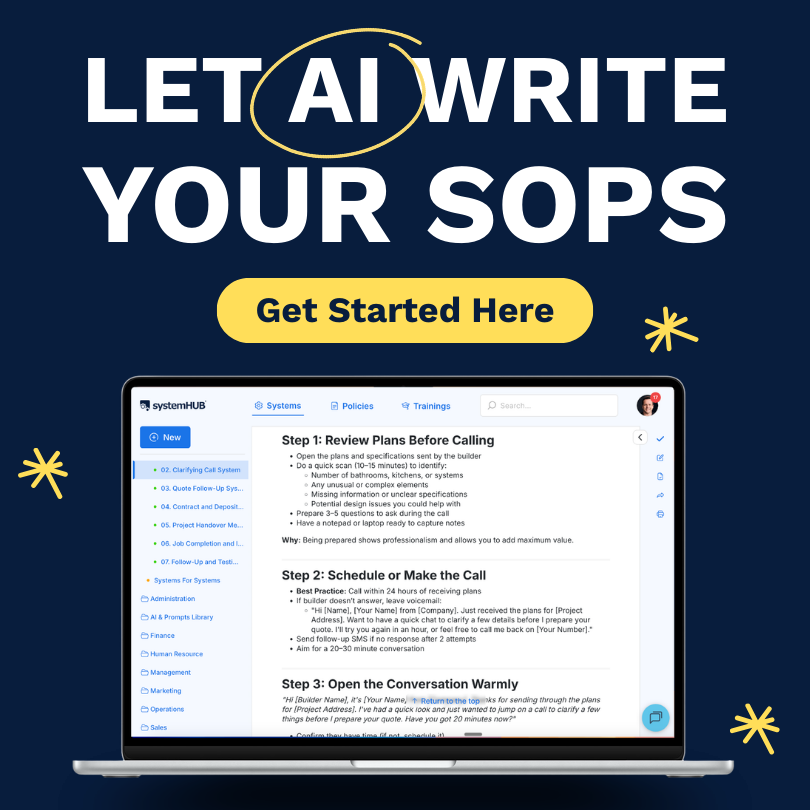
systemHUB gives you 100+ ready-made process templates across Sales, Operations, HR, Finance, and Marketing, so you can start building a business that runs without you, today.
Want to see business systemisation in action? Watch Dave walk through how to document your first business process step by step.
🔗 Explore More
Ready to get started?
systemHUB gives you 100+ ready-made SOP templates across Sales, Marketing, Operations, HR, and Finance. Customise them for your business and start building a business that runs without you.
Thank you for listening!
Thanks for joining us for this episode. Do you have any questions or feedback you'd like to share? We'd love to hear it! Let us know in the comments section below.
If you enjoy listening to this podcast, please share it on Facebook and leave an honest review on iTunes. We'd love to know what you think.
Remember, the next system we share could be just the one you’ve been looking for, so subscribe on iTunes so you can get the latest episodes as soon as they’re published.
About The Show
Business Processes Simplified
We interview industry experts and have them share their best small business systems and processes. This is the quickest, easiest and most efficient way to build a systems centered business.