Imagine stepping into an elevator. The doors close. Everyone is facing the back wall instead of the doors.
What would you do?
In 1962, social psychologists ran exactly this experiment. Actors entered an elevator and faced the wrong direction. When unsuspecting people stepped in, something remarkable happened. Without question, without hesitation, most turned to face the same direction as everyone else.
This isn’t just a story about elevators. It reveals something fundamental about human behaviour. We don’t typically challenge established patterns. We adapt to them.
Now think about a new team member walking into your business on Day 1.
They’re scanning for cues. They’re asking themselves a quiet question: “Which way should I face in this elevator?”
The first 90 days answer that question. Every conversation, every tool they’re handed, every process they’re shown teaches them what “normal” looks like at your company. Get that window right and a new hire reaches full contribution in weeks. Get it wrong and it takes months. Sometimes it takes a hire you never recover from.
That’s what employee onboarding really is. It’s not paperwork on Day 1. It’s not a tour of the office. It’s the system that decides whether your new team member faces the right direction from the start.
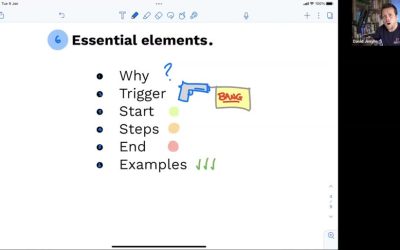
Here’s what that looks like in practice. I walked through our team’s actual onboarding template on a recent training call:
In this guide:
- What is employee onboarding?
- Why employee onboarding matters: 5 outcomes you control
- The 4 phases of employee onboarding (Day 1 to Day 90)
- A real example: Renee, Kaleb, and Lime Therapy
- How to build your employee onboarding system
- Common employee onboarding mistakes to avoid
- Frequently asked questions
What is employee onboarding?
Employee onboarding is the system that integrates a new hire into your business and brings them up to full contribution.
It’s not the same as orientation. It’s not the same as induction. It’s not the same as training. Most owners use those words interchangeably, which is half the problem.
Here’s how the four pieces actually fit together. (This four-way split comes from Brad Giles’ book Onboarded. It’s worth stealing.)
Orientation, induction, training, onboarding: what’s the difference?
Orientation is knowing your way around. Where the bathrooms are. Where the team goes for coffee. Twenty minutes on Day 1.
Induction is your licence to operate. Login credentials, the org chart, the policies signed, the first task in the queue. Enough to start working.
Training is skills-based. How to use your CRM. How to follow your sales script. How to run a service appointment.
Onboarding is success over 90 days. It’s the system that helps a new hire understand how to succeed in their role, in your business, with your team. Orientation gets done in a morning. Onboarding takes a quarter.
Most businesses confuse these. They put effort into orientation and induction, then call it onboarding. The new hire becomes operational by end of Week 1, which feels like progress. But operational and effective are different things. A new hire can be operational and still cost you money for 6 months.
A good onboarding system teaches three things:
- Technical and process expectations. How the work actually gets done here.
- Cultural expectations. How the team behaves and what “good” looks like.
- Manager expectations. What success in this specific role looks like, with numbers attached.
That’s why a new hire who could be useful in 3 weeks ends up taking 6 months. And why the team members who should be running your documented SOPs can’t, because nobody taught them the systems exist.
Why employee onboarding matters: 5 outcomes you control
Done badly, onboarding is invisible. Nobody calls it out as the problem. It just shows up everywhere else: missed targets, slow ramp-up, surprise resignations, training time you didn’t budget for.
Brad Giles calls this onboarding debt. Like sleep debt, you can run on a deficit for a while. You won’t notice anything for the first couple of hires. But the cost compounds. Six bad onboardings into a 20-person business and you’ve built something the team can’t run without you.
Done well, onboarding controls five outcomes that show up directly on your bottom line.
Time-to-productivity
This is the big one. Brad Giles’ research found the average new hire takes 9 months to hit maximum productivity. A documented 90-day onboarding system compresses that to 3. Same hire. Same role. Three times faster contribution. Multiply that by every hire you’ll make this year.
Retention
The first 90 days predict the next 3 years. New hires who feel lost in week one are already half out the door. New hires who feel confident, supported, and clear about expectations stay. Onboarding is the cheapest retention tool you’ll ever build.
Consistency
Without a system, every new team member gets a slightly different version of the business. The 5th hire learns from the 4th, who half-remembers what the 3rd was told. By hire 10 you have 10 different versions of “how we do things”. A documented onboarding system gives everyone the same baseline.
Culture transfer
Remember the elevator. Day 1 is the moment your new hire decides which way to face. If your onboarding showcases that you take systems, documentation, and continuous improvement seriously, they’ll face that direction. If it shows them you wing it, they’ll face that direction too.
Owner freedom
The reason this matters most: a documented onboarding system means the owner doesn’t have to be the one running it. You stop being the bottleneck for every new hire. The system runs the system. You get on with the work only you can do.
The 4 phases of employee onboarding (Day 1 to Day 90)
Before the phases, here’s the conversation that crystallised this thinking for me. I sat down with Brad Giles, author of Onboarded, to talk through why most onboarding fails and what to do about it:
Why 90 days, not 9 weeks:
The 90-day window isn’t arbitrary. It maps to a real psychology curve. Hermann Ebbinghaus showed in the 1880s that we lose roughly 90% of new information within 7 days unless it’s reinforced through different contexts.
That’s why a single induction week doesn’t stick. You need to teach the same content three different ways across three different months. Month 1 you’re teaching. Month 2 you’re mentoring. Month 3 you’re coaching. Same content, three contexts. Cut the window to 4 weeks and you skip 2 of the 3 reinforcements. The new hire walks out competent in name only.
A complete employee onboarding system runs in 4 phases. Most businesses stop at Phase 1, which is why they wonder why their new hires aren’t producing 6 months in. Use the sequence below as a scaffold, then adapt the specifics to your business.
Phase 1, Day 1: Welcome and orientation
The first day sets the emotional and cultural tone. Don’t waste it on paperwork.
Send the paperwork the week before, so Day 1 is for connection, not admin. Run a short welcome from the founder or CEO. Keep it under 5 minutes. They share the company’s story, why the business exists, and the role this new person will play in it.
Then introduce the Critical Client Flow: a one-page visual of how your business delivers value to a customer. Walk them through it. By lunchtime they should know which part of that flow their job touches. This anchors everything that comes next.
End Day 1 with a tour of the tools they’ll use daily. Where you store your systems. Where you run your projects. Where they’ll find the answer next time they have a question. Show them how to find an SOP. Have them open one. Have them watch a video. The behaviour you want from month 6 starts here.
One nice touch: a “Day 1 surprise”. We give every new starter a copy of the SYSTEMology book on their first morning. It’s a small thing. It tells them what we take seriously before anyone has to say it.
Phase 2, Week 1: Learning the ropes
Week 1 is for context and competence. The new hire needs to understand how their role actually works.
For the first 5 days, the new hire is mainly with HR or whoever runs your onboarding. They’re consuming policies, meeting the team, getting their bearings. Pair them with a buddy — not their manager, just a peer who can answer the dumb questions nobody wants to ask on Day 2.
At the end of Week 1, there’s a formal handover. HR steps back. The new hire’s supervisor steps in. From here, the supervisor owns the journey.
Walk them through their daily routine. How they log time. Who they go to for what. What their first month looks like, broken down by week.
Have them sit with the person who currently holds the most knowledge for their role. Not for a chat. For documented shadowing: open the SOP for a task, watch it being done, then have the new hire do it under observation. This is where verbal-only onboarding falls apart, and where a documented system shines.
By Friday of Week 1, the new hire should be able to do one real task end to end. Even something small. That single completion moment builds 10x more confidence than a week of meetings.
Phase 3, First 30 days: Systems and culture immersion (the Learn stage)
The first month is when your culture either takes or doesn’t. Your new hire is studying everything: how managers behave under pressure, whether the team actually uses the tools you trained on, whether the systems you showed on Day 1 are followed in practice.
Brad Giles calls this the Learn stage. You’re still in teacher mode. Document the expectations. Show them the way. Hold a Day 30 review with one objective: how did they go on the core tasks? What’s the speed and quality? Are they settling in? Are they a good fit on first read?
Assign them a Systems Champion to check in weekly. Not their manager. Someone whose job is to ask: How are you finding the systems? What’s confusing? What’s missing? Document the answers. Most new hires spot gaps in your documentation that 5-year veterans have learned to work around.
By Day 30 the new hire should have completed at least one full client interaction (or whatever the equivalent is in their role). They should be opening SOPs without prompting. They should know who to ask, and where to look first, before asking.
Phase 4, Day 30 to Day 90: Contribution and the first review (the Apply and Embed stages)
The final phase splits into two psychological shifts. Month 2 is the Apply stage. The manager switches from teacher to mentor. Same content as month 1, asked differently. “How did the training session go? What worked? What would you change?” By Day 60 the new hire should be running their core responsibilities without daily oversight.
Month 3 is the Embed stage. The manager switches from mentor to coach. The questions shift again. “Looking at this week, where did the system serve you? Where did it get in the way? What would you change for the next person?” By Day 90 the new hire is contributing improvements, not just following them.
Hold a formal 90-day review. Two-way. Yes, you give feedback. But the more important half is what they give you. New hires see your business with fresh eyes. The 90-day review is when those eyes are still working. After 90 days they’ve been around long enough to stop noticing the gaps.
Ask them three questions: What surprised you about how we work? What was the hardest thing to figure out? If you ran the onboarding for the next person, what would you change? Then write the changes into the SOP. The next hire benefits from this one.
The Day 90 review forces a decision. Brad Giles uses two deliberate terms: successful fit or unsuccessful fit. Not “good fit” or “bad fit”. The shift is intentional. It moves the question from “is this person any good?” to “did our system cause this person to succeed?” That’s a much fairer question, and it forces the borderline call. Hire-and-hope cases that drift for 12 months are the most expensive mistake in onboarding. The 90-day window exists to prevent them.
Tip: If you want the day-by-day specifics underneath this 4-phase scaffold, link new hires to the employee onboarding checklist. This guide is the strategy. The checklist is the run-sheet.
A real example: Renee, Kaleb, and Lime Therapy
I want to show you what a systems-first onboarding actually looks like in practice.
Renee Kelly and Kaleb, Lime Therapy
Renee runs Lime Therapy, a fast-growing allied health practice with 40 staff. The business was scaling. The systems weren’t keeping up. Invoicing was taking days. Knowledge lived in people’s heads. Every new clinician needed Renee personally for the first 2 months before they could see clients independently.
She made an unusual hire: Kaleb, a 2-year occupational therapist with no systems experience and no business background. She brought him in not as a clinician but as a Systems Champion.
His entire onboarding was systems-first. Before he ever logged a clinical hour, he was walked through Lime’s documented processes, the tools, the daily routines, the philosophy. He learned the business as a system, not as a list of tasks.
Within a few months the result spoke for itself. Invoicing time dropped 10x. The team adopted the new systems because Kaleb’s onboarding had taught him to lean on them and improve them, and his enthusiasm spread. Renee got her time back. New clinicians started ramping in weeks instead of months because Kaleb had documented the path.
The lesson: Kaleb had no systems experience. He had no business management background. But the onboarding system Renee built around him meant none of that mattered. The systems made him effective. Read the full Lime Therapy case study here.
How to build your employee onboarding system
You don’t need to design this from scratch. The fastest way to build an employee onboarding system is the same 3-step approach SYSTEMology uses for any system: identify, extract, refine.
1
Identify the knowledgeable worker
Who currently runs your best onboarding? Often it’s you. Sometimes it’s a long-tenured team lead. Either way, find them.
2
Extract and document
Record them walking through Day 1, Week 1, and the 30-day plan. Turn the recording into a documented system stored somewhere the team will actually use.
3
Test and refine
The next hire runs the doc. They flag what’s missing, broken, or unclear. You update. Every new hire makes the system stronger.
Simple beats perfect. The first version of your onboarding system doesn’t need to cover every edge case. It needs to cover the standard path well enough that the next new hire isn’t asking you the same 30 questions you answered last time.
Two tools worth stealing from Brad Giles:
Onboarded distils the whole 90-day system into two one-pagers per role.
The Role Scorecard answers: what does success look like in this role? Specific numbers. “Sell $X by Q4.” “Document 11 SOPs by end of probation.” No vague job description fluff.
The Sprint Plan answers: how will we get the new hire there? Week-by-week checkpoints. 13 weekly meetings across the quarter. Ends in a forced “successful fit” or “unsuccessful fit” decision at Day 90. Brad’s number for total manager time across the quarter: about 15 hours. Less than half a day a week.
If you want help speeding up the documentation part, AI-powered documentation tools can turn a 30-minute screen recording into a draft SOP in seconds. The principle is the same; the time cost just drops.
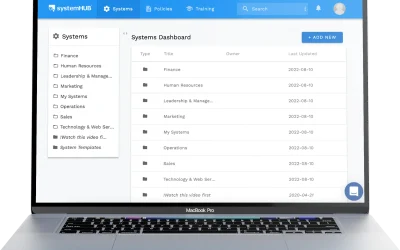
The other big rule: store the system somewhere your team will actually open. A binder on a shelf doesn’t count. A Google Doc nobody can find doesn’t count. You want a single home for every system, where SOPs live, get updated, and get followed. That’s the difference between an onboarding plan and an onboarding system.
One more piece most owners miss when they build an onboarding system: the induction conversation about why the systems exist at all. Without it, your SOPs get ignored by month two. Steal our team systems induction, free. It’s the 84-minute session and shareable template we run with every new hire.
Stop reinventing onboarding for every hire
systemHUB gives your team one home for every SOP, every checklist, and every process. Onboard new hires by handing them a link instead of a week of meetings. See plans & pricing.
Common employee onboarding mistakes to avoid
I’ve watched hundreds of businesses try to fix their onboarding. The same mistakes show up over and over.
No clear owner. Ask most businesses who owns onboarding and you’ll get a shrug. HR? The manager? The team lead? The owner? Without explicit ownership, it’s a part-time job nobody does well. The right answer, almost always, is the new hire’s direct manager. They’re accountable for the team’s performance, so they own the system that creates that performance.
Confusing orientation with onboarding. Paperwork on Day 1 is not onboarding. It’s admin. If your onboarding “system” stops once the contract is signed and the email account is set up, you don’t have an onboarding system. You have a hiring system with a gap after it.
Day-1 information overload. Don’t try to teach everything in Week 1. The new hire’s job on Day 1 is to start understanding the business, not to memorise it. A documented system means they can pull the detail when they need it, not when you push it at them.
Verbal-only onboarding. Everything taught in conversation gets half-remembered, half-forgotten, and fully unrepeatable. If it’s not written down, it doesn’t exist for hire number 11.
Skipping the culture and philosophy intro. This is the elevator moment. Tell new hires explicitly that you take systems seriously, that documented processes are how the business runs, that “blame the system, not the person” is a core belief. Otherwise they learn culture by accident. (For a deeper dive on getting team buy-in for your systems, that’s a guide in itself.)
No 30 / 60 / 90 cadence. A new hire without scheduled check-ins quietly drifts. The check-ins don’t need to be long. They need to be on the calendar.
Letting borderline hires drift past 90 days. The probation period exists for a reason. If a hire isn’t a successful fit at Day 90, the system has told you. Honouring that is kinder to everyone, including the hire, than another 9 months of hoping it works out.
Want a head-start on documenting?
Pull from 100+ ready-made SOP templates. Recruitment, IT setup, training, daily routines: every standard onboarding piece is there, ready to adapt to your business.
Frequently asked questions
What are the 4 phases of employee onboarding?
The 4 phases of employee onboarding cover Day 1 (welcome and orientation), Week 1 (learning the ropes), the first 30 days (systems and culture immersion, the Learn stage), and Day 30 to Day 90 (contribution and the first formal review, the Apply and Embed stages). Each phase has a specific objective, and skipping any of them is what creates a 6-month ramp-up instead of a 6-week one.
How long should employee onboarding take?
Plan for 90 days end to end. The intensive period is the first 30 days, but the full onboarding window runs to the Day 90 review. The 90-day length isn’t arbitrary: it maps to the Ebbinghaus forgetting curve, which says you need to teach the same content in three different contexts before it sticks. Cut the window to 4 weeks and you skip 2 of the 3 reinforcements. Anyone who tells you onboarding is finished after a 2-day orientation is selling you orientation, not onboarding.
What’s the difference between orientation, induction, training, and onboarding?
Orientation is knowing your way around the office. Induction is your licence to operate: login credentials, org chart, first task. Training is learning a new skill. Onboarding is success over 90 days: helping the new hire understand how to succeed in the role, the culture, and against the manager’s expectations. Orientation and induction take a day. Onboarding takes a quarter.
Who is responsible for employee onboarding?
The new hire’s direct manager owns onboarding. They’re accountable for the team’s performance, so they own the system that creates that performance. HR can support the admin side and the first 5 days. The owner might still record a welcome video. But ultimate ownership sits with the manager. In small businesses where the owner is also the manager, that means the owner owns it until they hire managers who can take it over.
What should happen at the 90-day employee onboarding review?
The 90-day review forces a decision: successful fit or unsuccessful fit. Brad Giles deliberately uses those terms instead of “good fit” or “bad fit” because they shift the question to what the system did, not what the person is. Did the onboarding cause this person to succeed? If yes, they continue. If no, you exercise the probation period that legally exists for exactly this reason. The worst outcome is the borderline case who drifts for 12 months before everyone reluctantly agrees it isn’t working. The Day 90 review exists to prevent that.
What should be included in an employee onboarding process?
At minimum: a founder welcome (live or video), an introduction to how the business delivers value to its clients, a daily routine breakdown for the role, hands-on tool training using the actual tools they’ll use, access to documented SOPs for their core tasks, scheduled check-ins at 30, 60, and 90 days, and a clear plan for what “competent” looks like by Day 90. Everything else is supporting detail.
What does a good employee onboarding system look like?
A good employee onboarding system is documented (not in someone’s head), repeatable (the 10th hire and the 1st get the same baseline), measured (you know whether it’s working), and continuously improved (every new hire flags gaps that get fixed for the next one). It also runs without the owner, which is the whole point.
What are the 5 C’s of employee onboarding?
The 5 C’s are compliance (the legal and policy basics), clarification (what the role actually involves), culture (how things work here), connection (relationships with the team), and check-back (the 30 / 60 / 90 review cadence). It’s a useful summary framework. The SYSTEMology view is that the 5 C’s matter, but only if they sit inside a documented system. Without that, they’re a checklist somebody half-remembers to follow.
How do you onboard a remote or virtual employee?
The phases don’t change, but the delivery does. A welcome video from the founder becomes essential, not optional. Tool walkthroughs need to be screen-recorded so the new hire can rewatch them. Systems Champion check-ins move to video calls on a fixed schedule. The biggest single rule: deliver onboarding through the same tools the team uses every day. A remote hire onboarded inside your real workflow ramps faster than one onboarded by a separate “onboarding portal” they never log back into.
Start with Day 1
You don’t need to design the whole 90 days this week. You need to start with one day.
Pick Day 1. Write down exactly what you want a new hire to experience, see, hear, and do on their first day. Walk through it once with the next person who joins your team. Note what worked, what was missing, what was confusing. Update the document. That’s the loop. Run it for every new hire and inside 6 months you’ll have an onboarding system that ramps people 3x faster than the version you have today.
The fastest way to put this in motion is to give your team one shared home for the system, where every SOP, checklist, and process lives together. That’s what systemHUB does. Or grab the free SOP templates if you’d rather start with a head-start on the documentation itself.
Build it once. Run it forever. Simple beats perfect.