SOPs in Project Management: What They Are and How They Differ from PM Software
Project management software tracks who is doing what by when. SOPs and the software that holds them record how the work gets done. Here is what an SOP is in project management, six examples and how to run both tools without one compromising the other.
What is an SOP in project management?
In project management, a standard operating procedure (SOP) is a written, repeatable set of steps for the recurring parts of running projects, such as kickoff, scope changes, status reports, escalating risks and closeout.
The project plan says what gets delivered, by whom and by when. The SOP says how each recurring step is done. That keeps it the same on every project and for every project manager.
Project management tracks
- What needs to be done
- Who is doing it
- When it is due
SOPs document
- How each task is done
- The standard to meet
- Who owns the procedure
Six SOPs every project team needs
Most project work is unique. The way you run it isn’t. These are the recurring steps worth writing down once.
1. Project kickoff
Confirm scope, goals, roles and the communication plan, then brief the team the same way every time.
2. Scope change request
How a change is raised, assessed for cost and time, approved and recorded.
3. Weekly status update
What to report, where, to whom and by when. Updates then look the same across projects.
4. Risk and issue escalation
What counts as a risk, who logs it, the point at which it escalates and who decides.
5. Handover and closeout
The checklist to deliver the work, collect sign-off and close the project cleanly.
6. Post-project review
A short standard review of what worked, what didn’t and what changes next time.
Why project managers need them: without SOPs every project manager runs kickoff, status updates and closeout their own way. Quality then depends on who you hired. With them a new project manager can run a project your company’s way from the first week. For how to write one, see how to write an SOP.
The trap most owners fall into
A growing owner searches “best software to manage my business processes” and gets a list that mixes two completely different kinds of tool. They pick one, roll it out and hope it covers everything.
Six months later one of two things has happened. Either the team is using a project management tool as a poor substitute for SOPs (templates with videos and attachments crammed into a task description nobody reads) or they are using an SOP tool to run the day-to-day work (a beautiful library with no idea who is meant to do what today).
Both feel like the software is failing. It isn’t. The wrong category of tool was picked for the job. It is the most common operational software mistake I see in growing businesses and it costs more in lost productivity than the software itself.
Watch: project management vs SOP software, which does your business need? (3 minutes)
What each kind of software does
Project management software: what, who, when
It answers three questions all day: what needs doing, who is doing it and when it is due. It is the accountability layer of your operations.
- Task and sub-task creation with assignment and due dates
- Templates for recurring projects that save you rebuilding the same task list every Monday
- Status tracking across departments
- Permissions that show the right people the right work
- Integration with calendar, chat and email
It is not a reference manual for how each task should be done. It is a scheduler for the work.
SOP management software: how
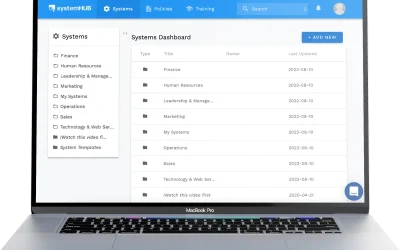
It answers a different question: how is this task done. It is the reference layer of your operations.
- Dedicated structure for systems, not generic files
- Videos, images, attachments and links inline
- Role-based permissions that keep the warehouse system away from finance
- Sign-off that lets team members confirm they have read and understood a system
- Templates that stop common processes being rebuilt from scratch
- Search that lets a new hire find a system in seconds
It is not built to track who is doing what today. It is the source of truth for how the work happens.
Project management software vs SOP management software
| Dimension | Project management software | SOP management software |
|---|---|---|
| Primary question | What needs to be done, by whom, by when? | How is this task done? |
| Output | A scheduled, assigned, tracked task list | A library of documented systems the team follows |
| How often it is used | Many times a day | When a system is created, learned or updated |
| Who uses it most | Every team member, every day | New hires, the Systems Champion and anyone unsure how to do something |
| Time horizon | Today, this week, this sprint | The whole life of the business |
| Example tools | Asana, Trello, Monday, ClickUp, Basecamp, Teamwork | Dedicated SOP platforms such as systemHUB |
| What goes wrong if it is missing | Tasks fall through the cracks, deadlines slip and accountability dissolves | Knowledge stays in people’s heads, new hires take months to ramp up and the owner stays the bottleneck |
The round peg, square hole problem
The most common mistake is forcing one tool to do the other’s job. It looks reasonable on day one. You already use a project tool. Why not put the SOPs in the task descriptions? Or you already have an SOP tool. Why not run today’s tasks from it? It doesn’t hold up.
Project tools are built around the task. A task is short-lived, assigned to a person, dated and archived when complete. SOPs are the opposite: long-lived, owned by a role, evergreen and updated, not archived.
SOPs crammed into tasks
- The SOP disappears when the task closes
- It can’t be found by search
- It has no version history
- The next person never knew it existed
Daily work run from an SOP tool
- Built for documents and not for assignment
- No clean way to say “Sarah does this by Friday”
- Beautifully documented and disconnected from whether anyone does the work
“Let project management tools manage your projects. Let SOP management software manage your system documentation. The confusion creates inefficiency, and inefficiency costs you time and money.” David Jenyns, founder of SYSTEMology
Why integrated all-in-one tools usually fail
“All-in-one” platforms pitch project management plus SOPs plus wiki plus chat plus CRM. One subscription and one login sounds efficient. In practice the compromise usually breaks both halves. The project features end up weaker than a dedicated project tool and the SOP features weaker than a dedicated systems tool. You pay for breadth and lose depth. When something goes wrong you can’t swap one half out without losing the other.
There are exceptions: very small teams where depth doesn’t matter yet, solo founders and early experiments. But for a team past about 10 people that wants work done predictably, two dedicated tools beat one half-baked one almost every time. You also reduce the chance of switching software later and an acquirer expects to see the separation. It is what serious operations look like.
How the two tools work together
Here is how the teams that get the most out of both tools wire them together. Two tools, one clean link, no compromise on either side.
- 1Document itThe system lives in your SOP tool
- 2Assign itThe task lives in your project tool and carries the link
- 3Improve itCompletion is tracked in one tool and the system evolves in the other
- Document the system in your SOP toolYour Systems Champion or knowledgeable worker writes the step-by-step process, with a video walkthrough, supporting attachments and sign-off switched on. The system lives in the SOP tool from now on and is edited there as the process evolves.
- Create the task in your project management toolWhen someone has to do the work, a task is created in the project tool with an assignee, a due date and sub-tasks drawn from the system’s steps.
- Link the system into the taskThe task description contains a direct link to the system in your SOP tool. One click and the team member is reading the how-to. This is the connective tissue between the two tools. Don’t skip it.
- Use task templates so the link is already thereIf a task repeats (and most do) save it as a template with the SOP link built in. New instances include the link automatically. You aren’t pasting URLs every week.
- Track completion in the project tool and evolve the system in the SOP toolThe project tool records that the task was done, by whom and on what date. The SOP tool is updated as you learn better ways to do the work. Each tool keeps doing its own job.
Good project management options
There are dozens of solid project management tools. If you already have one that works, don’t switch. If you are starting fresh, these six are worth a look. All of them handle the fundamentals: tasks, assignment, deadlines, sub-tasks, templates and permissions. Pick based on how your team thinks about work.
Asana
The most widely used general-purpose tool. Strong on tasks and sub-tasks.
Trello
Kanban-board first. Best for teams that think in columns and cards.
Monday.com
Heavy on customisation and views. Strong if you want to model your own workflow.
ClickUp
Feature-rich. Sometimes too much so. It does what you need.
Basecamp
Opinionated, simple and low-feature. Strong if your team wants less software.
Teamwork
Solid for client services and agency work where billable time matters.
What to look for in SOP software
The SOP side has fewer purpose-built options. Use these five tests, which come from the SYSTEMology framework:
- Built for systems. Not file storage, not a wiki and not a project tool with a “docs” tab.
- Rich media inline. Videos, images and checklists in the system, not links out.
- Permissions by role. People see the systems that belong to their job.
- Sign-off tracking. A record that each person has read and understood it.
- Easy for everyone. If it needs training to navigate, your team will avoid it.
For the full criteria and the case for why the tool’s job is the SOP and not just storage, see the SOP software buying guide. If you are weighing it against shared folders, see Google Drive vs Dropbox.
How to know which half you’re missing
If you are not sure where you are weak, here are the symptoms.
You’re missing project management software if…
- Things slip through the cracks
- The same task is done twice or not at all
- Status updates happen in chat threads that scroll away
- Nobody can say what the team is working on today without a meeting
- Deadlines are calendar invites that don’t connect to the work
You’re missing SOP management software if…
- New hires take months to ramp up
- The same questions get asked over and over
- Knowledge lives in one person’s head and you worry when they take leave
- “How do we do this?” gets answered by pinging whoever did it last
- You have documented things in Google Docs but nobody can find them
If you recognised both lists you are missing both. If you recognised one, that is your next add. Either way the goal isn’t to fold both jobs into one tool. It is to put each job in the right tool with a clean link between them.
Get the SOP half of the stack right
systemHUB pairs cleanly with whatever project management tool you already use. Free trial, no credit card.
Start your free trialFrequently asked questions
What is an SOP in project management?
A standard operating procedure in project management is a written, repeatable set of steps for the recurring parts of running projects, such as kickoff, scope changes, status updates, risk escalation and closeout. The project plan covers what is delivered, by whom and by when. The SOP covers how each recurring step is done.
Do project managers need SOPs?
Yes, for the steps that repeat on every project. Without them each project manager runs kickoff, reporting and closeout their own way. Results then depend on who you hired. With SOPs a new project manager can run projects your company’s way from the first week.
What is the difference between project management software and SOP software?
Project management software tracks what needs to be done, who is doing it and when it is due. SOP software records how the work is done: documented systems, step-by-step procedures, videos, checklists and sign-off. They do different jobs and most growing teams need both.
Can I just use Asana (or ClickUp or Monday) for everything?
Technically yes. Operationally no. You can put SOPs in task descriptions and call it a system. Then knowledge gets stuck in tasks that archive, there is no search or version history and new hires get confused. The tool wasn’t built for it. Use your project tool for what it does well and add a dedicated SOP tool for the SOPs.
Can I use a documents or wiki tool for everything?
Same answer in reverse. Documents-first tools can handle some scheduled work and some training tools have assignment features. Neither gives you the daily project management experience of a dedicated project tool. Teams won’t adopt them for daily task management the way they adopt a tool built for it.
Doesn’t ClickUp claim to do both?
It does. So do several others. The all-in-one promise is real but the depth on each side is usually shallow. For very small teams, under about 10, where neither half is heavy yet, an all-in-one can be enough. For teams past 10 that need both halves to perform, two dedicated tools almost always beat one bigger one.
How should the two tools talk to each other?
The simplest integration is also the most reliable: put the URL of the relevant SOP in the description of the matching task in your project tool. One link, one click and no extra connector needed. If you want more later, both kinds of tool have APIs and most work with automation tools such as Zapier or n8n.
What is the cheapest way to run both?
For a 10-person team, a project management tool typically costs roughly $5 to $15 per user per month, which is about $50 to $150. systemHUB’s team plans are $95 or $195 a month. Together that is about $150 to $350 a month for ten people. Prices change. Check each tool’s pricing page. It usually costs less than the incidental software teams already pay for.
Do I really need both or can I start with one?
If you have to start with one, start with the half you are missing more. Most fast-growing teams are missing the SOP side first because they instinctively buy a project tool early. If you already have a project tool in place, the SOP tool is usually the bigger gap to fill.
Key takeaways
- Project management is what, who and when. SOPs are how. Different questions, different tools.
- Round peg, square hole. Forcing one tool to do the other’s job almost always backfires.
- All-in-one platforms usually compromise both halves. Use two dedicated tools for any team past 10 staff.
- Connect them with one link. Put the SOP URL in the task description. That is the integration most teams need.
- Most growing teams miss the SOP half first. If you already have a project tool, add the SOP tool next.
Keep reading
Give your SOPs a home your team will use
systemHUB keeps your SOPs, checklists and training in one place, ready to link from any project tool you use.
14-day free trial. No credit card required.