What would change if your business could run for three months without you?
Not a hypothetical. A real question. Could you walk away from your business tomorrow, come back in 90 days, and find it running just as well as when you left? Or would it fall apart before you reached the airport?
Most business owners already know the answer. And it’s not the one they want.
Here’s the thing. Mastering business systems isn’t about creating a binder full of procedures no one reads. It’s about building something bigger than yourself. A business that delivers consistent results, grows without your constant involvement, and creates the freedom you originally set out to achieve.
That’s what it means to truly master business systems. And it’s a journey with clear, proven stages.
In this guide, you’ll learn exactly how to go from overwhelmed operator to systems-driven entrepreneur, using the SYSTEMology framework that’s helped hundreds of business owners make that shift.
In this guide:
- What does it mean to master business systems?
- Why mastering systems matters more than you think
- The SYSTEMology framework: 7 stages to systems mastery
- Where to start: building your Critical Client Flow
- The mindset shift that makes mastery possible
- Building a systems culture in your business
- Common mistakes when trying to master business systems
- Frequently asked questions
What does it mean to master business systems?
Let’s start with what it doesn’t mean. Mastering business systems is not about documenting every single thing that happens in your company. It’s not about turning your team into robots who can’t think for themselves. And it’s definitely not a one-time project you tick off and forget about.
Mastering business systems means building a business where documented, repeatable processes drive the results, not individual people. It means extracting the knowledge that’s trapped in the heads of your best team members, organising it, and making it available to everyone. It means creating a business that is genuinely independent of any one person, including you.
The four stages of business systemisation.
Most businesses sit in one of four stages: Survival (chaos, no systems, owner does everything), Stationary (some loose processes, but still owner-dependent), Scalable (core systems documented, culture shifting), and Saleable (complete business reliability, systems are the competitive advantage). Mastering systems means reaching Saleable, where the systems work and the people work the systems.
If you’re honest with yourself, you’re probably in the Survival or Stationary stage right now. That’s not a criticism. It’s where most business owners find themselves. You’ve built something successful, but you’ve also built something that depends entirely on you.
The good news? There’s a clear path forward. And it starts with understanding why this matters so much.
Why mastering systems matters more than you think
You already know systems are important. You’ve probably read books about it. You might have even tried to systemise your business before. But understanding why mastering systems matters at a deeper level is what separates the business owners who actually do it from the ones who keep saying “I’ll get to it next quarter.”
1. Freedom to seize opportunities you can’t predict
When I was running my digital agency, Melbourne SEO Services, I was working 60-70 hours a week. Then one morning I received an email from Luz Delia Gerber. Her husband, Michael E. Gerber (author of The E-Myth), wanted me to help launch his final book. It would take three months of full-time work, unpaid.
Two years earlier, I would have had to say no. I was too embedded in daily operations. But because I had systemised the business using SYSTEMology, I said yes. My business ran just fine without me. That experience led to a relationship with one of the most influential business thinkers in history.
Opportunities like that don’t come at the end of a steady upward curve. They arrive when you least expect them. And the only question that matters is: are you free enough to take them?
2. Reduced owner dependency
If your business can’t function without you for more than a day or two, you don’t have a business. You have a job. A demanding, stressful job where you’re the bottleneck for every decision. Mastering systems removes that dependency. Your team follows the process, not the person. That’s why businesses should use systems.
3. Consistent results without constant oversight
When systems are in place, your business delivers its products and services to the same standard every time. Not because you’re watching. Because the process is documented and your team knows what “right” looks like. Consistency builds trust with clients, reduces errors, and frees you from being the quality control checkpoint for everything.
4. A more valuable business
A business that depends on the owner is worth very little to a buyer. A business with documented proven business systems that run independently? That’s a saleable asset. Even if you never plan to sell, operating at that level changes how you run your company.
5. Space for creativity and strategic thinking
There’s a myth that systems kill creativity. The opposite is true. Einstein, Jobs, Zuckerberg, and Obama all used simple personal systems (like wearing the same outfit every day) to create mental space for bigger decisions. Systems don’t stifle creativity. They create the room for it. When you’re not buried in daily operations, you can finally work ON the business instead of in it.
Where does your business stand right now?
Take the free Systems Strength Test and find out exactly where you are on the journey from Survival to Saleable.
The SYSTEMology framework: 7 stages to master business systems
SYSTEMology is a proven, step-by-step methodology for systemising your business. It was designed specifically for small to medium businesses, not adapted from corporate methodologies that don’t fit. Here are the seven stages, in order.
1. Define: identify the critical few
The first stage is about reducing overwhelm. You don’t need hundreds of systems to get started. You need 10 to 15. The tool for this is the Critical Client Flow (CCF), which maps the journey of one client through one product, from the moment they discover you to the point they become a repeat customer. This gives you a shortlist of the systems that matter most.
2. Assign: find the right people
The business owner is usually the worst person to create systems. Not because they don’t know the work. Because they’re too busy doing it. In this stage, you identify the “knowledgeable workers” on your team, the people who already know how to do each task well. You assign them as the source of truth for each system using the Departments, Responsibilities and Team Chart (DRTC).
3. Extract: capture the knowledge
This is where SYSTEMology differs from everything else. Instead of asking busy team members to sit down and write long documents, extraction is always a two-person job. The “knower” (the person who does the task well) demonstrates the process while a “systems champion” records it. The knower talks, the champion documents. It takes a fraction of the time and produces far better results.
4. Organise: store systems so they get used
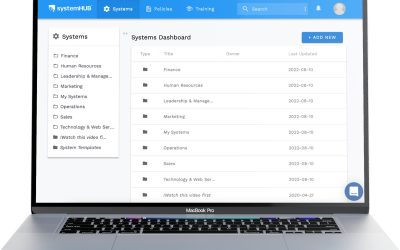
A system that no one can find is a system that doesn’t exist. In this stage, you organise your documented processes in a central location, separated from project management. The goal is simple: when a team member needs to know how something is done, they know exactly where to look. This is where a tool like systemHUB makes a real difference.
5. Integrate: get your team on board
Having documented systems is one thing. Getting your team to actually follow them is another. Integration is about change management. It’s about positioning systems as something that benefits each individual, not just the company. People support what they help to create, so involve your team early. This stage requires persistence, but it’s the bridge between “we have systems” and “this is how we do things here.”
6. Scale: expand beyond your core
Once your core client delivery systems are in place, it’s time to scale. This means documenting systems across all departments: HR, finance, management, marketing, and sales. The goal is to remove every single-person dependency in the business. Prioritising the right systems at this stage is critical. Your business is only as strong as its weakest link.
7. Optimise: continuous improvement
The final stage is where mastery truly lives. You build a dashboard that gives you visibility into business performance, then you continuously improve your systems based on real data. You identify problems, make system improvements, and monitor results. When your team becomes unconsciously competent at this, you’ve reached what SYSTEMology calls “complete business reliability.”
Key insight: The seven stages are designed to be followed in order, but the process is iterative. You don’t need to perfect one stage before moving to the next. Progress, not perfection, is the goal.

The old way: everything runs through the owner.

The SYSTEMology way: your team runs the systems, you run the business.
Where to start: building your Critical Client Flow
If the seven stages feel like a lot to take in, here’s the simple starting point. Everything begins with your Critical Client Flow.
The CCF is a visual map of how your business delivers its core product or service, from start to finish. It follows one rule: one client, one product, one journey.
Here’s how to build yours in about 20 minutes:
- Pick your target client. Choose the one type of client you serve most. If you serve multiple audiences, pick the most common one.
- Pick your core product or service. The one that generates the most revenue or represents your bread and butter.
- Map the journey. Start from the moment a prospect becomes aware of you and follow the steps through to when they become a repeat client. Typically this follows: Attention, Enquiry, Conversion, Onboarding, Delivery, Repeat.
- List the systems. Each step in the journey represents a system. You should end up with 7 to 12 core systems.
- Only include what you currently do. This isn’t aspirational. Document reality, not your wish list.
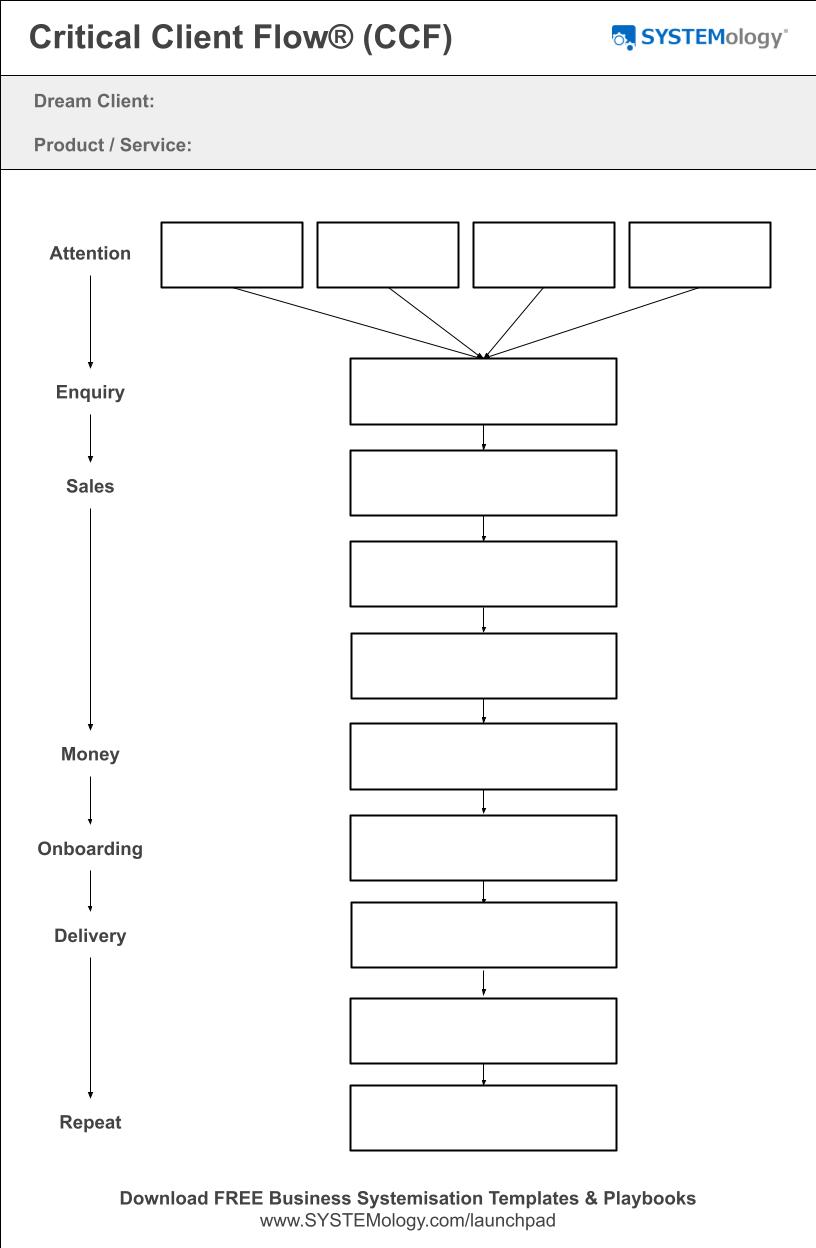
The Critical Client Flow maps your client’s journey from first contact to repeat business. This becomes your systemisation starting point.
The CCF applies the 80/20 rule to systemisation. Instead of trying to document everything at once (which never works), you focus on the critical few systems that drive 80% of your results. Once these are in place, you expand from there. This is how you identify the most important business systems for your specific situation.
Tip: Share your completed CCF with someone outside your business. If they can look at it and understand how your business delivers value without you explaining it, you’ve done it right.
The mindset shift that makes mastery possible
Let me be honest. The biggest obstacle to mastering business systems isn’t time, tools, or team capability. It’s you.
I say that as a recovering micromanager myself. When I was running my digital agency, I believed that for something to be done “right,” I had to be involved. If projects weren’t progressing the way I wanted, I’d jump in and take over. I had great team members doing fantastic work, but I was the cog in the middle that held everything together.
Sound familiar?
There’s an old anecdote about a fully grown elephant held in place by a tiny stake in the ground. The elephant could escape with minimal effort, but it doesn’t try. Why? Because that same stake held it in place when it was a calf. It learned helplessness.
Business owners do the same thing. Maybe you’ve tried to systemise before and it didn’t stick. Maybe your team resisted. Maybe you started documenting processes and ran out of steam. Those past attempts can teach you to stop trying. But the problem wasn’t systemisation itself. It was the approach.
The key mindset shifts for mastering systems are:
- You are not the best person to create the systems. Your best team members already have the knowledge. Let them be the source.
- Patience is required. Unlike a new ad campaign that shows results in days, systemisation has a lag. The real magic happens when multiple systems layer on top of each other, compounding efficiency over weeks and months.
- Good enough is the enemy of done. Your first version of any system will not be perfect. It doesn’t need to be. A 70% system that your team actually follows beats a 100% system that never gets finished.
- “This is how we do things here.” The goal isn’t compliance. It’s culture. When your team stops thinking of systems as rules to follow and starts thinking of them as “just how we operate,” you’ve crossed the bridge.
Ready to start mastering your business systems?
systemHUB gives you the platform, templates, and AI tools to document, organise, and optimise every system in your business.
Building a systems culture in your business
Documentation alone won’t transform your business. Culture will. The difference between a company that “has systems” and one that truly masters them is whether the team uses those systems without being reminded.
Think of it this way. At Stage 3 (Scalable), a business owner might look around and think, “We’re doing okay. We’ve got most of our systems documented.” But “good enough” is a trap. The biggest wins come when you push through to Stage 4 (Saleable), where systems become your competitive advantage and continuous improvement becomes automatic.
Here’s how to build that culture:
1. Position systems as a benefit to each individual
If you frame systemisation as “this is what the company needs,” you’ll get resistance. If you frame it as “this is going to make your job easier, reduce stress, and help you do better work,” you’ll get your team to love systems. People support what benefits them personally.
2. Involve the team in creating the systems
People support what they help to create. When team members are involved in the extraction and documentation process, they feel ownership over the systems. That ownership translates into compliance without enforcement.
3. Appoint a systems champion
Every business that successfully masters systems has a systems champion. This person drives the systemisation agenda, follows up on documentation, and keeps the momentum going. They don’t need to be the most senior person on the team. They just need to care about process and consistency.
4. Stay persistent through the transition
Your biggest challenge will come from existing team members who have been with you the longest. They’re used to doing things their own way. Change is uncomfortable. But persistence wins. Once you break through old habits and replace them with new ones, the resistance fades.
Case study: Ryan Stannard, Stannard Homes
Ryan ran a construction company where he was the centre of everything. Every question came to him. Every decision needed his input. His team of 7 was stuck at capacity because Ryan couldn’t handle any more. After implementing SYSTEMology and documenting core business systems, Ryan’s team doubled to 15 staff. He started taking proper holidays. The systems absorbed the weight that used to fall entirely on him. It wasn’t that the work disappeared. The systems just made it possible for the team to handle it independently.

Ryan Stannard’s team at Stannard Homes doubled in size after implementing documented business systems.
Common mistakes when trying to master business systems
These are the pitfalls that trip up even motivated business owners. If you can avoid them, you’ll save months of frustration.
Trying to document everything at once. This is the fastest way to burn out and give up. Start with your CCF. That’s 10-15 systems. Once those are working, expand. The 80/20 rule applies: a small number of critical systems will deliver most of the value.
Insisting the owner must create all the systems. You’re too busy. You’ll never get to it. And even if you do, the systems will be written from your perspective, which isn’t always the most useful one for your team. Assign the work to your team members and a systems champion.
Expecting perfection on the first version. Don’t try to systemise like McDonald’s. They’ve had six decades of refinement. Your first standard operating procedures just need to capture the current best practice. You’ll optimise later.
Skipping integration and team buy-in. Documenting systems and then expecting your team to magically follow them is a recipe for failure. Integration (Stage 5) is where most businesses fail. Invest the time to get your team involved and committed.
Stopping at “good enough.” Many business owners reach Stage 3 (Scalable) and think they’re done. They’re not. The real transformation happens when you push through to complete business reliability, where systems become your competitive advantage and continuous improvement is part of the culture.
Frequently asked questions
How long does it take to master business systems?
Systemisation is a journey, not a one-time project. Most businesses can get their core systems (CCF) documented within 90 days. Building a full systems culture across all departments typically takes 12 to 18 months. The key is to start with your most critical systems and build momentum from there. Even small wins compound over time.
Do I need special software to master business systems?
You can start with any format, even a simple binder. The most important thing is that your systems are stored somewhere central, separate from your project management, and accessible to your team. That said, purpose-built platforms like systemHUB are designed specifically for organising, sharing, and maintaining business systems, which makes adoption and optimisation much easier as you scale.
What’s the difference between a system and a process?
In practical terms, the words are interchangeable. A system (or process, or SOP) is a documented set of steps for completing a specific task consistently. Don’t get caught up in terminology. What matters is that the steps are written down, accessible, and followed by your team.
What if my team resists following systems?
Resistance is normal, especially from long-tenured team members. The key is persistence and positioning. Frame systems as tools that make their jobs easier, not extra rules to follow. Involve team members in creating the systems so they feel ownership. And stay consistent. Once new habits form (usually within a few weeks of persistent follow-through), the resistance fades. Learn more about getting your team to love systems.
Will systems remove creativity from my business?
No. Systems create space for creativity. When routine tasks are handled by documented processes, you and your team have more time and mental energy for strategic thinking, innovation, and problem-solving. Some of history’s most creative minds used personal systems specifically to free up brain power for bigger decisions.
Where should I start if I have no systems at all?
Start with your Critical Client Flow. It takes about 20 minutes to complete and gives you a shortlist of 10-15 systems to focus on. From there, assign a knowledgeable worker to each system, appoint a systems champion, and begin extracting. You don’t need to do everything at once. Just start with the systems that drive your core product or service delivery.
Can I master business systems in a service-based business?
Absolutely. SYSTEMology was built for service-based businesses. Whether you run an accounting firm, a construction company, a marketing agency, or a healthcare practice, the framework applies. Every business has a growth stage where systems become essential. The CCF works for any business that has clients and delivers a product or service.
How do I know when I’ve truly mastered my business systems?
You’ve mastered your systems when your business reaches the Saleable stage. That doesn’t mean you have to sell it. It means your business operates with complete reliability, independent of any single person. Your team follows the systems without being reminded. You’re continuously optimising based on data. And you can step away for extended periods knowing the business will perform to your standards.
Mastering business systems isn’t a one-time project. It’s the most important skill you’ll ever develop as a business owner.
The path is clear. Seven stages. One framework. A business that works without you. Start with your Critical Client Flow, follow the SYSTEMology methodology, and build a systems culture that compounds over time. Every business owner who has made this shift says the same thing: they wish they’d started sooner.
Ready to take the first step? See how systemHUB can help you get started.