Employee Onboarding Checklist: 4 Phases From Pre-Arrival to Month One
A step-by-step checklist for everything that needs to happen when a new team member joins, from the paperwork before day one to the 30-day review. Copy it, adapt it and let your team run it without you.
By David Jenyns, founder of SYSTEMology and systemHUB · Updated November 2026
What is an employee onboarding checklist?
An employee onboarding checklist is a step-by-step list of everything that needs to happen when a new team member joins: the practical setup, the cultural introduction and the role training that gets them contributing fast.
It’s the simplest form of a standard operating procedure. Not a 50-page manual. A clear, ordered sequence anyone on your team can follow to welcome a new hire the right way every time.
A good checklist answers three questions
What?
What needs to happen before, during and after someone’s first days.
Who?
Who is responsible for each step so nothing falls between the cracks.
When?
When each step needs to be done, whether that’s before day one or by week four.
Without all three you have a wish list. With them you have a system. The difference between a checklist and “just showing them around” is consistency. When everything lives in your head the experience depends on how much time you have that day. A documented checklist removes that variability.
This page is the practical list. For the principles behind it see onboarding best practices. For the full Day 1 to Day 90 system see the employee onboarding guide.
Why your onboarding checklist matters more than you think
Most owners treat onboarding as something to get through so the new person can start real work. But the first few weeks set the tone for everything that follows.
It speeds up time-to-productivity
Without a structure new hires spend their first weeks working things out through trial and error. A clear checklist gives them the right information in the right order so they contribute sooner.
It frees you from training every hire
If you’re the only person who can train new team members you’ve built a bottleneck. A checklist lets any team member run the onboarding. It’s one of the two HR systems I recommend engineering early.
It creates consistency
When onboarding is ad hoc one person gets a thorough introduction and the next gets a rushed overview because you were busy. A checklist gives every hire the same foundation, the same values conversation and the same training on your core tools.
It reduces early turnover
A poor onboarding experience is a common reason people leave in their first year. A structured process makes people feel welcome, informed and confident.
It builds a systems culture from day one
When the first thing a new hire sees is a well-organised, documented process the message is clear: “this is how we do things here”. They’ll follow your other documented procedures more readily.
From SYSTEMology: “A-players love to know what’s expected of them and how they can succeed in a role. This is why it’s so important to get your core systems documented and set the standards early. Establish, right from the start, ‘This is the way we do things here,’ and you’ll be well on your way.”
Need templates to build your onboarding system?
Download 100+ ready-made process templates, including onboarding, HR and operations checklists you can customise for your business.
Get free SOP templatesThe complete employee onboarding checklist (4 phases)
The most effective checklists break onboarding into phases. Cramming everything into day one overwhelms new hires. Spread it across four stages and adapt each item to your business.
Tip: you don’t need to build all four phases at once. Start with pre-arrival and day one. Those alone will transform how new hires experience their first days. Add week one and month one as you refine the process.
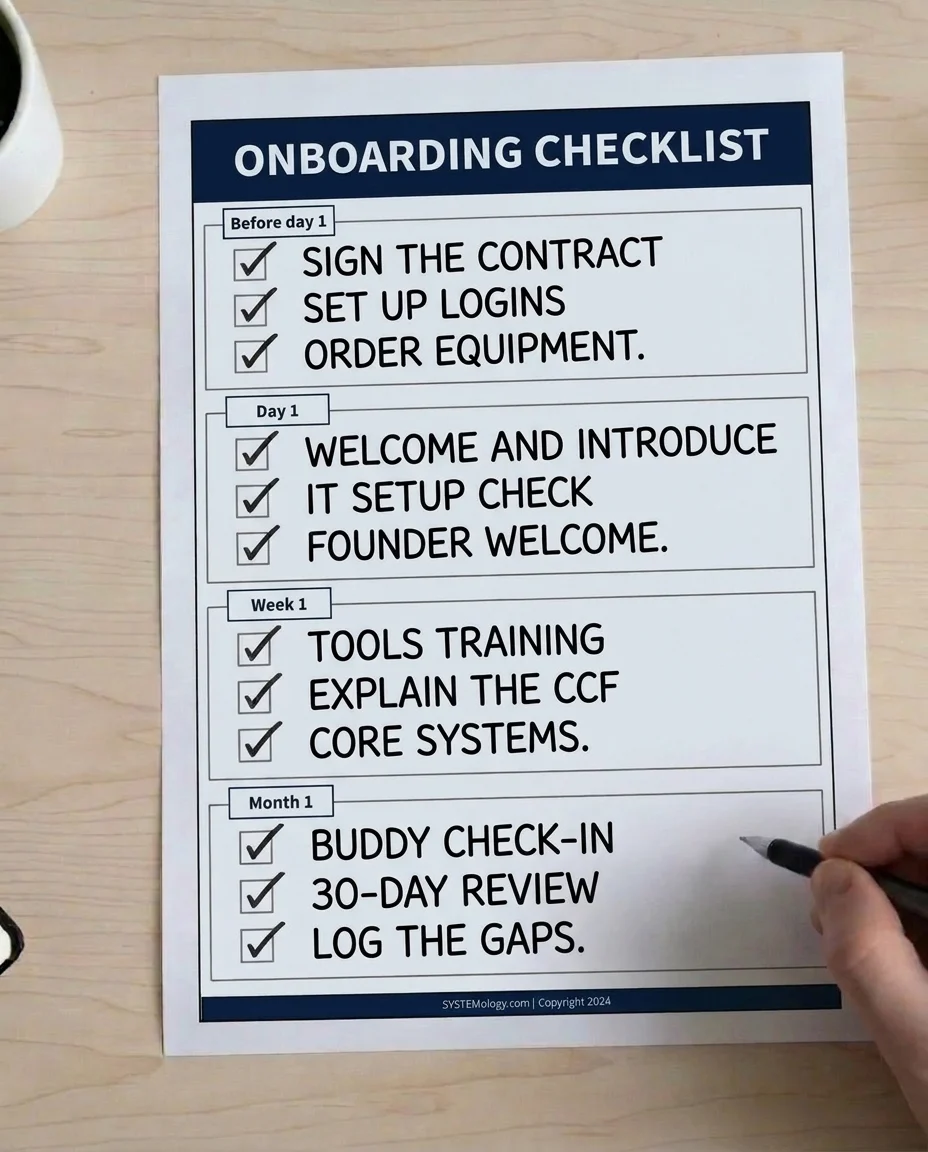
Pre-arrival checklist (before day 1)
Everything is ready before they walk in so the first day feels organised and welcoming.
- Send the offer letter and employment contract for signature
- Collect completed tax, superannuation and banking forms
- Set up their email account, system logins and software access
- Order equipment (laptop, phone, uniform, tools, keys)
- Prepare their workspace or workstation
- Add them to the relevant channels (Slack, Teams, email groups)
- Send a welcome email with start date, time, location, dress code and the first-day agenda
- Tell the team about the new hire (name, role, start date)
- Assign a buddy or mentor for the first week
- Share any required reading (handbook, company values)
Owner: Office manager or HR lead. Complete at least 3 business days before the start date.
Day 1 checklist (first impressions)
Day one sets the emotional tone. Make them feel expected, valued and clear on what happens next.
- Welcome them personally and introduce them to the team
- Give a tour of the office, warehouse or worksite (including safety essentials)
- Walk through IT setup: confirm email, logins and system access all work
- Share the founder’s welcome video or message (history, mission and values)
- Review the employee handbook and answer questions
- Explain your approach to systems: “this is how we do things here”
- Show them where to find documented processes in your systems platform
- Cover logistics: hours, breaks, parking, kitchen, supplies
- Set expectations for week one: what they’ll learn, who they’ll meet and what success looks like
- Schedule a 15-minute check-in at the end of the day
Owner: Direct manager or assigned buddy. The end-of-day check-in catches confusion early.
Week 1 checklist (building foundations)
Get them comfortable with your tools, your people and your way of working before role-specific depth.
- Train on core tools: email, project management (such as Asana or Monday) and your systems platform
- Explain the Critical Client Flow and where their role fits
- Review the 3 to 5 core systems relevant to their role
- Introduce the key people they’ll work with across departments
- Share their daily routine and recurring responsibilities
- Show how to find answers: where systems live, who to ask and how to flag issues
- Complete any required compliance or safety training
- Have them shadow a knowledgeable worker doing a key task
- Hold a formal week-one review with their manager
Owner: Direct manager with support from the buddy. The week-one review checks understanding and addresses gaps.
Month 1 checklist (integration and independence)
By the end of month one they should be completing tasks independently and following your documented systems.
- Assign first independent tasks with clear deadlines and quality standards
- Have them complete a key process using the documented system, without hand-holding
- Review their work against the system’s standards and give feedback
- Ask them to flag gaps, confusions or improvement ideas in the documented systems
- Complete remaining HR paperwork and benefits enrolment
- Hold a formal 30-day review: performance, cultural fit, questions and goals for months two and three
- Update the onboarding checklist with the lessons learned
Owner: Direct manager. Flagging gaps matters because new hires spot things your experienced team overlooks.
Watch: an employee onboarding template, step by step (9 minutes).
How to build an onboarding checklist your team will follow
Having a checklist is one thing. Having one your team actually uses is another. This is the approach I teach in SYSTEMology.
- Start with your best people, not a blank pageDon’t sit down with a blank document to design the perfect process. Use the SYSTEMology extraction method. Find the person who does the best job of getting new people up to speed and ask them to walk you through exactly what they do when someone starts. Record it and document it. That becomes version one.
- Keep it simpleCover the key steps, not every word someone needs to say. A 100-item checklist for day one will not be followed. Focus on the critical milestones and let people click through to a full procedure when they need more detail.
- Assign a Systems Champion to own itYour onboarding checklist needs an owner. It isn’t you. A dedicated team member keeps it updated, makes sure it’s followed and improves it with every hire. They don’t need to be senior. They need to be organised, curious and comfortable holding others to a standard. See how to get your team to embrace systems.
- Use every new hire to improve the systemView each new hire as a chance to review every system related to their role. A fresh pair of eyes reveals ways to improve and streamline things. After they finish ask what was confusing and what was missing, then update the checklist. Every hire makes it better for the next one.
Why checklists get ignored: usually it isn’t the checklist. New hires never had the conversation about why it exists. If your team treats documented processes as optional, run a systems induction. Here’s ours, free: the 84-minute session and shareable template we use with every new hire.
Real examples: onboarding systems that transformed businesses
Theory is useful. Seeing it work in real businesses is better.
A checklist beats a warning
One owner was about to give a crew member a last warning because a truck handover kept being left unfinished. Instead he posted a checklist beside the key hook. The keys can’t be hung up until fuel, restocking and cleaning are done.
It’s the same principle as onboarding. Treat the problem as a systems problem rather than a people problem and the right behaviour becomes the easy one.
He was about to fire them. He wrote a checklist instead (1 minute).
Den Lennie: “You can’t just hire specialists and let them figure it out”
Den Lennie runs a business coaching program for video production companies. For years his approach to new hires was to find a specialist and let them work it out. “The biggest problem I had in my business was actually me,” he says.
The result was too much room for interpretation. New hires did what they thought needed doing, not what actually needed doing. Everything fell on Den’s shoulders.
When he implemented SYSTEMology he had a virtual assistant build out his systems and onboarding processes. The grey areas disappeared. “All new hires need guidance,” Den learned. Documented checklists provided it. He found liberation in six months, plus more revenue. One of his clients removed himself from day-to-day operations in only three months.
From 3 clients a month to 30
A digital marketing agency had a comfortable pace of 3 to 4 new clients a month. As they grew that spiked to 30. The first couple of times they were backed up by months and had to pause advertising because they couldn’t handle the volume. “We would be losing business just because we couldn’t handle the customers properly.”
The breakthrough was documenting their Critical Client Flow and using it to train new hires. For the first time they kept advertising running for an entire year with no starting and stopping. With time to be creative instead of buried in onboarding and firefighting, they grew ten times faster. If you want to hire and retain A-players it starts with a strong onboarding system.
Common mistakes with employee onboarding checklists
I’ve seen each of these derail an otherwise well-intentioned onboarding effort.
Relying on “shadow someone for a week”
The most common approach and the least effective. The new hire’s experience depends on who they shadow, what mood that person is in and whether they remember to cover everything. That’s winging it, not onboarding.
Making the checklist too detailed
If your day-one list has 40 items nobody will follow it and the new hire will feel overwhelmed. Focus on the key milestones and link to full procedures for anyone who needs more depth.
Not updating it when processes change
A checklist that references software you replaced six months ago does more harm than good. Every time you onboard someone check the list is still current. Revisit your onboarding best practices each quarter too.
Skipping culture and values
Practical setup matters but culture decides whether someone stays and thrives. Include a founder welcome video, your values and an honest conversation about how you work. The SYSTEMology book recommends it as one of the first items in any onboarding process.
Having the owner run every onboarding
If you do every onboarding personally you’ve created a single-person dependency that limits your growth. Delegate it, document it and let your team own it. It’s one of the easiest systems to hand off.
Frequently asked questions
What should be included in an employee onboarding checklist?
A thorough checklist covers four phases: pre-arrival (equipment, accounts and paperwork), day one (welcome, introductions, IT setup and company values), week one (tool training, role-specific systems and key contacts) and month one (independent tasks, a performance review and system feedback). Each item should have a clear owner and deadline.
How long should the employee onboarding process take?
Most effective programs run for at least 30 days and many extend to 90 days for complex roles. The first week covers essentials and orientation. Weeks two to four focus on role-specific training and guided independence. After 30 days the new hire should be completing core tasks on their own with ongoing support as needed.
What is the difference between onboarding and orientation?
Orientation is typically a one-day event covering logistics: where things are, how to use the systems and who is who. Onboarding is the full process of integrating a new employee into your team and culture over weeks or months. Think of orientation as day one of your onboarding checklist.
Who should be responsible for onboarding new employees?
Not the business owner. Ideally assign a Systems Champion or HR lead to own the process, with the direct manager handling role-specific training and a buddy handling day-to-day questions. The key is one person accountable for making sure the checklist gets completed, even if several people contribute to different steps.
How do you onboard a remote employee?
The same four phases apply with some adjustments. Ship equipment in advance. Replace the office tour with a virtual walkthrough of your digital workspace. Use video calls for introductions and a recorded founder welcome. Make sure every standard operating procedure is accessible online. Schedule more frequent check-ins in week one because remote hires can't lean over and ask a question.
What are the biggest onboarding mistakes small businesses make?
Having no documented process at all and relying on show-them-around-and-hope. Other common errors are dumping too much on day one, skipping the culture conversation, not assigning a clear onboarding owner and never updating the checklist after the first version. Start simple, document what works and improve with every hire.
How do you measure onboarding success?
Track three things: time-to-productivity (how quickly a new hire completes core tasks independently), 90-day retention and new hire feedback (what worked, what was confusing and what was missing). Use those insights to improve the checklist for the next hire. The best onboarding systems get better every time they're used.
Your onboarding checklist is the first system every new hire sees
Make it count.
Start with one phase. Document your pre-arrival steps and get them out of your head and into a checklist anyone on your team can follow. Then add day one, week one and month one. Each hire gets a better experience than the last and takes less of your time. Before long you have a system that grows your team without growing your workload.
Keep reading
Or browse all guides and the business systems guide.
Build your onboarding checklist where your team will use it
systemHUB gives you one searchable place for every checklist, SOP and policy so each new hire gets the same strong start.
14-day free trial. No credit card required.