You’ve read The E-Myth. You know you should be working ON your business, not IN it. So why are you still stuck doing both?
If you’re like most business owners, you picked up Michael Gerber’s The E-Myth Revisited, felt that flash of recognition, and thought: “That’s exactly my problem.” Then you put the book down, went back to work, and nothing changed.
You’re not alone. The E-Myth is one of the best-selling business books of all time. Millions of owners have read it. But the vast majority never actually implement what it teaches. The philosophy is clear. The practical path is not.
This article bridges that gap. You’ll learn what the E-Myth really teaches, why the franchise prototype is Gerber’s most powerful idea, and how the SYSTEMology framework gives you a step-by-step method to bring those principles to life in your business. Plus, the personal story of how I ended up working directly with Michael Gerber, and what that experience taught me about turning E-Myth philosophy into real-world systems.
In this guide:
What is the E-Myth?
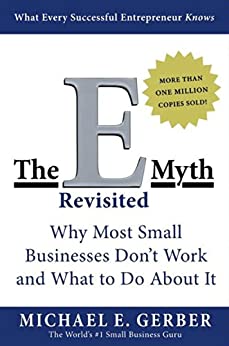
The E-Myth, short for “The Entrepreneurial Myth,” is a concept introduced by Michael E. Gerber in his 1986 book The E-Myth and expanded in the widely-read The E-Myth Revisited. It challenges a belief that almost every small business owner holds without questioning it.
The myth goes like this: because you understand the technical work of a business, you can successfully run a business that does that technical work.
In other words, being a great plumber doesn’t mean you’ll be great at running a plumbing company. Being a talented graphic designer doesn’t automatically make you a skilled business operator. Being an excellent accountant doesn’t prepare you for managing staff, marketing, sales, financials, and operations all at once.
The core E-Myth idea:
Most small businesses are started by technicians who are good at what they do, not by entrepreneurs who know how to build a business. This creates a fundamental tension. The owner ends up doing the work instead of building the business. Gerber calls this the “technician trap.”
Gerber argued that every business owner needs to develop three distinct roles: the Entrepreneur (the visionary), the Manager (the planner and organiser), and the Technician (the doer). Most owners default almost entirely to the Technician role, because that’s where they started.
The result? You end up working IN the business, not ON it. You become the most important employee. And the business becomes completely dependent on you.
If that sounds familiar, keep reading. Because understanding the E-Myth is step one. The real question is what to do about it.
The technician trap (and why most business owners fall into it)
The technician trap doesn’t happen overnight. It builds slowly, over years, until you’re so embedded in the day-to-day operations that stepping away feels impossible. Here’s how it typically unfolds.
1. You started as the expert
You launched your business because you were good at something. You were the best builder, the sharpest marketer, the most experienced consultant. Your skills were the product. Clients came to you specifically because of what you could do.
There’s nothing wrong with that. But it creates an identity problem. You see yourself as the Technician. When a task needs doing, you do it. When quality needs maintaining, you check it yourself. When problems arise, you fix them.
2. You became the best problem-solver
As the business grew, so did the problems. And because you’d been solving everything from day one, you got really good at it. Your team noticed. They started coming to you for answers because you always had them.
As I describe in my book SYSTEMology, this skill of solving problems then leads to the business owner unconsciously training their team to become dependent on them. Instead of empowering your team to solve problems, you become the knight in shining armour who always saves the day.
3. Your team learned to wait for you
This is where the cycle accelerates. Your team stops trying to solve problems on their own because they know you’ll jump in. They bring every question, every decision, every exception to your desk. And each time you answer, you reinforce the pattern.
The more you solve, the better you get at solving. The better you get at solving, the more your team relies on you. It’s a cycle that’s almost impossible to break without a deliberate strategy.
4. You built a job, not a business
Eventually, you realise the truth. You don’t own a business. You own a job. A demanding, stressful, all-consuming job that you can’t take a holiday from. Your business is entirely dependent on you being there, every day, answering questions and putting out fires.
This is what Gerber warned about. And it’s the reality for most business owners who haven’t built systems. I know because I lived it.

The old way: everything runs through the owner.

The SYSTEMology way: your team runs the systems, you run the business.
When I was running my digital agency, Melbourne SEO Services, I was working 60 to 70 hours a week. I was trapped on the hamster wheel of finding clients, delivering for clients, maintaining relationships, and then circling back to get new clients again. Every part of the operation relied on me.
I was the textbook Technician. And despite being a fan of Gerber’s work, I was doing exactly what he advised against.
The franchise prototype: Gerber’s most powerful idea
Of everything Gerber wrote, the franchise prototype is arguably the most transformative concept. It’s simple in theory. Difficult in practice. And it’s the key to escaping the technician trap.
The idea is this: build your business as though you’re going to franchise it 5,000 times. Not because you’re actually going to franchise it. But because a franchise-ready business is, by definition, a business that works without the owner.
The franchise prototype principle: The system IS the solution. Not you. Not your best employee. The system. If you can’t write down exactly how something gets done, hand that document to someone new, and have them produce the same result, you don’t have a system. You have a dependency.
Think about McDonald’s. You don’t need a culinary genius making the fries. You need someone who can follow the system. The system ensures consistency. The system ensures quality. The system ensures the business runs whether the founder is there or not.
Now, before you object that your business is “different” or “too complex” for this approach, consider this. You don’t need McDonald’s-level documentation for every single task. You need proven systems for the critical 20% of your operations that drive 80% of your results.
My friend Mike Rhodes understands this better than most. Mike is a former E-Myth coach who owned a company called WebSavvy. He first learned the value of a systemised business when he sold his internet cafe in New Zealand. The buyer initially tried to save money by not keeping Mike’s key team members. The business nearly collapsed because there were no systems in place for new staff to follow.
When Mike started his next business in Australia, he went all-out on systems. He built his franchise prototype. Not because he planned to franchise WebSavvy, but because he wanted a business that could operate without him at the centre of everything.
That’s the franchise prototype in action. And it’s exactly what most E-Myth readers understand in theory but never build in practice.
How systemised is your business right now?
Take the free 2-minute Systems Strength Test and get a clear picture of where you stand.
David Jenyns and Michael Gerber: from philosophy to framework
I want to share a story that changed my life and my business. Not because it makes me look impressive, but because it proves the point Gerber was making all along.
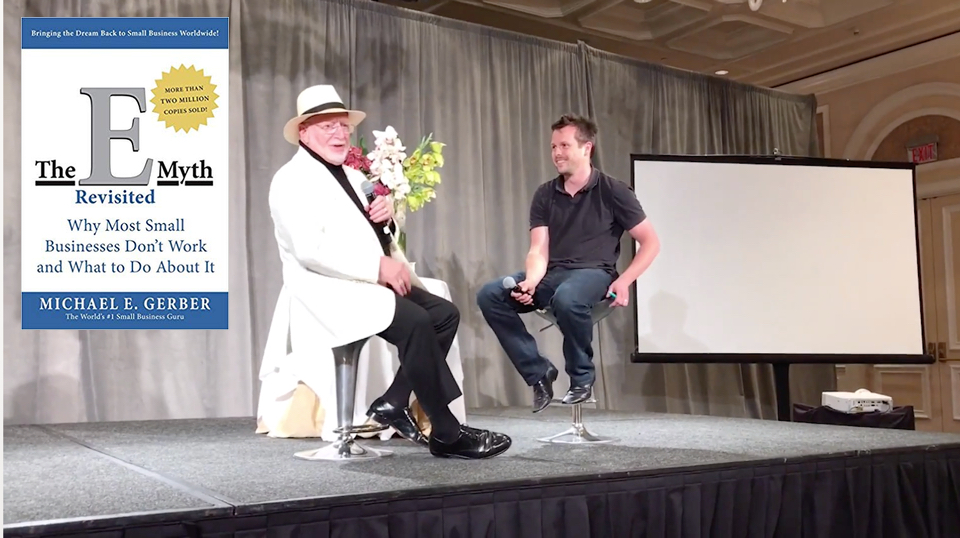
David Jenyns with Michael E. Gerber — from E-Myth reader to the man Gerber trusted with his final book.
One morning at 7 am, I looked at an email from someone called Luz Delia Gerber. I didn’t recognise the full name, but I was very familiar with a certain Michael E. Gerber, author of the E-Myth series. I figured it was a coincidence. I’d never met Gerber and had no connection to anyone who knew him.
I called the number. It was Luz Delia, Michael’s wife. She’d been watching my videos about business systems and had one of those moments of recognition. “I just knew I had to talk to you,” she said.
The bottom line was this. Gerber, at the age of eighty, was getting ready to launch his twenty-ninth book, the final work in the E-Myth series. For the first time, he wanted to self-publish. And they wanted me to head up the project.
There was one snag. It would take sixty-plus hours per week, for about twelve weeks. Three months of eating, sleeping, and breathing The E-Myth. All my own business responsibilities would need to be put on hold. And I volunteered to do it unpaid.
Here’s the key part of this story.
If Gerber had approached me two years earlier, I would have had to say no. I was too enmeshed in the day-to-day operations of my digital agency. Without me, there was no business. Ironically, for all my appreciation of Gerber’s work, I was doing exactly what he advised against. Working IN my business rather than ON it.
But this opportunity came along after I’d developed SYSTEMology. I knew for a fact that my business would be just fine without me. If anything, it would run smoother without me looking over everyone’s shoulders.
I worked on the project for three months. The result? Gerber’s twenty-ninth book became his first to be ranked as an Amazon Best Seller within twenty-four hours of its launch. Michael invited me to his Dreaming Room event in Carlsbad, California. I facilitated a mastermind group dedicated to the future legacy of his work.
And then the Gerbers asked if I’d consider running their business.
I declined, not because it wasn’t a great offer, but because I’m on my own path. The point of the story isn’t the offer. It’s that I was in a position to receive it. Because my business had systems. Because I’d built my own franchise prototype.
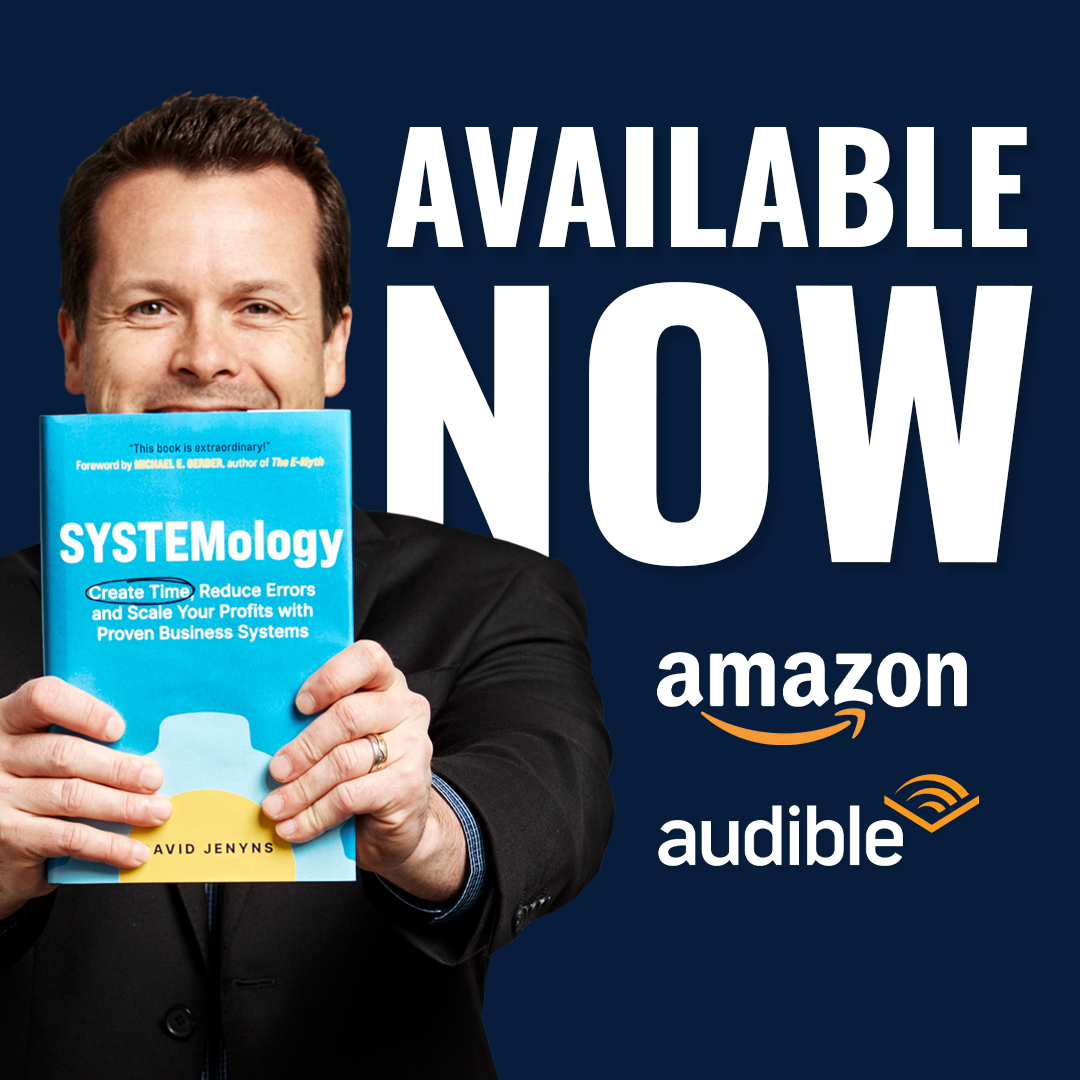
As Gerber himself wrote in the foreword to my book: “I invented ‘working ON your business, instead of IN it’ almost 43 years ago. And here I am telling you that David Jenyns has not only DONE it, but he’s now written the brilliant book to teach you exactly how to do it, too!”
The why.
Gerber showed owners the vision.
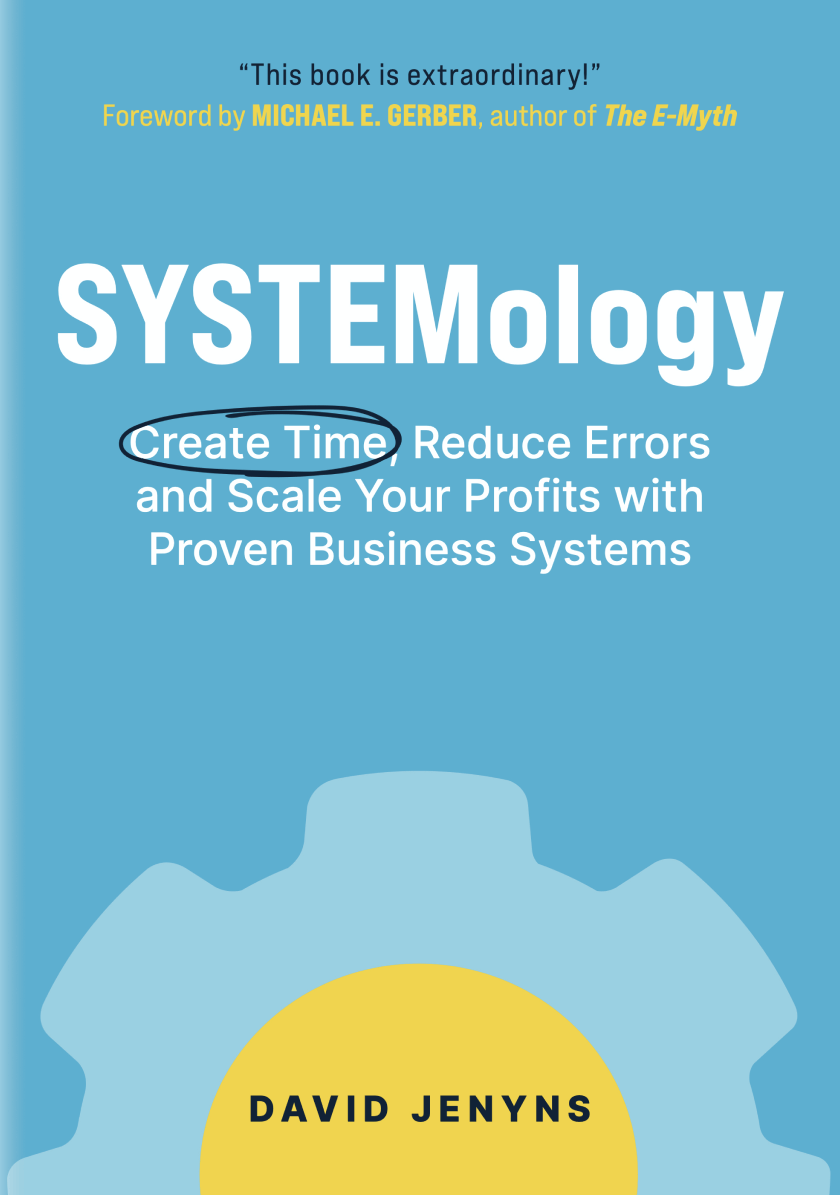
The how.
SYSTEMology is the step-by-step method. Foreword by Michael E. Gerber.
Or as Jack Daly put it: “What Michael Gerber started, David Jenyns completed.”
That’s the gap this article is about. Gerber gave the world the philosophy. He showed every business owner WHY they need to work on their business, not in it. SYSTEMology provides the HOW. The step-by-step framework to actually systemise your business and build the franchise prototype Gerber envisioned.
How SYSTEMology brings the E-Myth to life
Reading The E-Myth is inspiring. But inspiration fades fast when you’re back at your desk with 47 unread emails and a team member at your door with “a quick question.” Here’s how to actually implement what Gerber taught, using the SYSTEMology framework.
1. Define your Critical Client Flow (your franchise prototype in action)
The franchise prototype starts with knowing exactly what your business does, from the moment a prospect becomes aware of you through to delivering the final result. In SYSTEMology, this is called the Critical Client Flow (CCF).
Map out the journey a client takes through your business. Break it into stages: lead generation, enquiry handling, onboarding, delivery, follow-up, and retention. Under each stage, list the key tasks and processes. This gives you a visual map of your entire operation.
The CCF does exactly what Gerber’s franchise prototype concept demands. It shows you the whole business as a system of interconnected parts. And it immediately reveals where the bottlenecks are, where knowledge lives in one person’s head, and where you need standard operating procedures most urgently.
2. Identify your knowledgeable workers (not you, the owner)
Here’s where SYSTEMology diverges from what most people try. The E-Myth makes you think the owner needs to document everything. After all, you’re the one who knows how it all works, right?
Wrong approach. In SYSTEMology, you identify the “knowledgeable workers” within your team, the people who are already doing the work well. They’re the ones who should document the systems, not you. This is faster, more accurate, and it gets your team involved from day one.
Your job as the owner is to review and refine, not to create from scratch. This one shift is what makes implementation actually stick.
3. Extract and document the critical systems first (the 80/20 approach)
Gerber’s franchise prototype can feel overwhelming if you think you need to document every single process. You don’t. Apply the 80/20 rule. Roughly 20% of your systems drive 80% of your results.
Start with the critical path, the systems that directly affect client outcomes and revenue. These are the popular business systems that matter most: client onboarding, service delivery, quality checks, invoicing, and follow-up.
Document these first. Get them working. Then expand outward. The cost of avoiding systemisation compounds over time, but you don’t need to solve everything at once.
4. Assign a systems champion (the Manager that Gerber says you need)
Remember Gerber’s three roles? The Entrepreneur, the Manager, and the Technician? Most owners play all three. That’s the problem.
In SYSTEMology, you appoint a systems champion. This is the person who drives the systemisation project forward. They’re the Manager in Gerber’s framework. They don’t need to be a new hire. They could be an existing team member, a department head, or an operations manager who thrives on process and detail.
The leader and the manager partnership is one of those things that might be new to you. But once you’re aware of it, you’ll start to see examples of it in every great company. Walt Disney had his brother Roy. Henry Ford had James Couzens. Ray Kroc had Fred Turner. Behind every visionary leader is a process-driven manager who makes things happen.
If you’re the visionary type (and most founders are), trying to be your own systems champion is fighting against your nature. Find someone who loves prioritising and building systems. Let them drive the project.
5. Build accountability and manage through the systems
Once your critical systems are documented, the final step is managing through them. This is where the E-Myth vision fully comes to life. Instead of answering questions directly, point your team to the system. Instead of checking work yourself, use the system as the standard.
When someone comes to you with a question, the first thing you do is open the system together. If the answer is there, great. They know where to look next time. If the answer isn’t there, update the system so nobody has to ask again.
Over time, this shifts the entire culture. Your team stops depending on you and starts depending on the systems. That’s exactly what Gerber envisioned when he wrote about the franchise prototype. Ordinary people following well-designed systems to produce extraordinary results.
1
Define
Map your Critical Client Flow and identify the systems that matter most
2
Assign
Identify knowledgeable workers and your systems champion
3
Extract
Document your critical systems using the two-person recording method
Ready to build your franchise prototype?
systemHUB gives your team one place for every system, with AI-powered documentation tools and 100+ ready-made templates.
Common E-Myth implementation mistakes
The E-Myth gives you the vision. But the road from vision to implementation is littered with common mistakes. Here are the ones I see most often when working with business owners who are trying to build their franchise prototype.
Trying to document everything at once. The franchise prototype doesn’t mean creating a manual for every task on day one. That’s a recipe for overwhelm and abandoned projects. Start with the critical 20%. Build momentum with quick wins. Expand over time. The businesses that succeed with systemisation are the ones that master a few core systems first.
The owner doing all the documenting. Most business owners who read The E-Myth assume they need to sit down and write out every process themselves. That’s backwards. Your knowledgeable workers should create the documentation. They’re closer to the actual work. They’ll produce more accurate, practical systems. Your role is to review and approve.
Creating systems nobody follows. A system that lives in a folder nobody opens is worthless. Your systems need to be part of how your team actually works, day to day. They need to be easy to find, easy to follow, and kept up to date. This is why where you store your systems matters as much as what’s in them.
Skipping the “who” and going straight to the “what.” Before you document a single process, appoint your systems champion. Without someone driving the project, systemisation dies the moment you get busy with other things. Gerber understood this. The Manager role exists to ensure things get done when the Entrepreneur gets distracted by the next shiny idea.
Treating systemisation as a one-time project. Building your franchise prototype isn’t a weekend task you tick off and forget. Your business evolves. Your systems need to evolve with it. Build a culture of continuous improvement where systems are reviewed regularly and updated as things change. This is what separates a truly systemised business from one that did a burst of documentation and then let it gather dust.
If the E-Myth is your starting point, two other systems thinkers pair well with it: David Allen on Getting Things Done across a team, and Mike Michalowicz on the Profit First system for the money side.
Frequently asked questions
What is the E-Myth in simple terms?
The E-Myth (Entrepreneurial Myth) is the false belief that being skilled at a technical trade means you can run a business based on that trade. Michael Gerber coined the term to explain why so many small businesses fail. The owner gets stuck doing the technical work instead of building a business that can operate without them.
What is the franchise prototype from The E-Myth?
The franchise prototype is Gerber’s concept of building your business as if you’re going to franchise it thousands of times. The goal isn’t to actually franchise. It’s to create a business where systems, not individuals, drive consistent results. Every role, every process, and every outcome should be documented and repeatable by anyone who follows the system.
How do I apply E-Myth principles to my small business?
Start by mapping your Critical Client Flow: the step-by-step journey from attracting a lead to delivering the final result. Identify the critical systems within that flow. Appoint a systems champion to drive the documentation process. Have your knowledgeable workers record how they do the work. Then manage your team through the systems rather than through direct oversight. The SYSTEMology framework provides the detailed step-by-step method for doing this.
What is the technician trap?
The technician trap is when a business owner spends all their time doing the technical work of the business (delivering the service, making the product, handling clients) instead of working on the business itself. Because they’re good at the work, they become the bottleneck. Their team becomes dependent on them for decisions, quality control, and problem-solving, making it impossible to step away.
What’s the difference between The E-Myth and SYSTEMology?
The E-Myth provides the philosophy: why you need to work ON your business, not IN it. SYSTEMology provides the practical framework: how to actually do it. Gerber showed business owners the problem and the vision. SYSTEMology gives them the step-by-step method, tools, and software to implement that vision. As Gerber wrote in the foreword to SYSTEMology, David Jenyns “has not only DONE it, but he’s now written the brilliant book to teach you exactly how to do it.”
Do I need to read The E-Myth before using SYSTEMology?
No. SYSTEMology is a standalone framework. Reading The E-Myth will give you a deeper appreciation of the philosophy behind working on your business, and it’s a brilliant book in its own right. But you can start systemising your business with SYSTEMology immediately, regardless of whether you’ve read Gerber’s work.
How long does it take to systemise a business?
The core critical systems can be defined and documented within 90 days if you follow a structured approach. I systemised my digital agency in about twelve months, including hiring a CEO to replace me. Some businesses see meaningful results within weeks of starting their Critical Client Flow. The key is to start with the critical few systems, not try to document everything at once.
What is a Critical Client Flow?
A Critical Client Flow (CCF) is a visual map of every step your business takes to attract, convert, serve, and retain a client. It breaks your operation into stages (lead generation, sales, onboarding, delivery, follow-up) and identifies the key systems within each stage. Think of it as your franchise prototype laid out on a single page. It’s the foundation of the SYSTEMology approach and the first step to building proven business systems.
Gerber showed you the vision. Now it’s time to build it.
The E-Myth changed how millions of business owners think about their businesses, and nearly four decades on, in 2026, its core lesson hasn’t aged a day. But thinking isn’t enough. The gap between understanding the franchise prototype and actually building one is where most owners stall out.
You don’t need to figure this out alone. SYSTEMology gives you the framework. systemHUB gives you the platform. And the 100+ ready-made templates, AI-powered documentation tools, and step-by-step training inside the Accelerator plan give you everything you need to turn the E-Myth philosophy into a business that truly works without you.