Why do so many teams resist the very systems designed to make their work easier?
You have documented the processes. You have invested in the software. You have announced the big initiative. And yet, three weeks later, your team is back to doing things the way they have always done them.
If this sounds familiar, you are not alone. It is one of the most common frustrations business owners share with me. They pour time and energy into standard operating procedures, only to watch their team ignore them.
Here is the uncomfortable truth most owners miss: the problem is rarely your team. It is how systems are introduced. Most business owners try to enforce systems through control. But your team does not crave control. They crave clarity.
When you shift your approach from mandating systems to involving your team in building them, everything changes. People stop resisting and start owning the process. This article will show you exactly how to make that shift using the SYSTEMology framework.
In this guide:
- Why teams resist business systems (and why it is not their fault)
- The secret to team buy-in: it is a two-person job
- Five steps to get your team to embrace systems
- How to build a systems-thinking culture
- What to do when a team member still will not follow systems
- Common mistakes when rolling out systems
- Frequently asked questions
Why teams resist business systems (and why it is not their fault)
Before you can get your team to love systems, you need to understand why they resist them in the first place. And the answer might surprise you.
After working with thousands of businesses through the SYSTEMology framework, I have found that team resistance almost always boils down to three core excuses. Not dozens. Three.
1. “I didn’t know how”
This is the most common excuse, and it is exactly what it sounds like. Team members simply do not know there is a process to follow. Maybe proper training is missing. Maybe the documentation is unclear or hard to find. Sometimes they do not even know what “good” looks like for a particular task.
The good news? This is the easiest barrier to fix because it is purely about information and access. Put your systems exactly where people need them, when they need them. Make finding the answer easier than asking a colleague.
2. “I didn’t know it was my job”
This goes beyond knowing how. It is about clarity of responsibility. You will notice this when tasks fall through the cracks, when nobody owns the handoff between steps, or when you hear confusion about who is accountable for what. This challenge is solved by installing the right tools, creating clear handoff points and building checkpoints into your processes and procedures that make expectations impossible to miss.
3. “I don’t want to”
This is the trickiest resistance because it is really about motivation. You will hear versions of it everywhere: “I don’t have time,” “The old way works fine,” or “This is just more bureaucracy.” But these are rarely about actual constraints. They are about priorities. When someone is truly motivated, they find a way.
Here is the critical insight: most of the time, resistance is not a people problem. It is a rollout problem. If your team feels like systems are going to make their job harder, or they cannot see the clear benefit to their situation, you will get pushback. And honestly, can you blame them?
Tip: I learned this the hard way in my own digital agency. I was a self-admitted micromanager who thought I was a good manager. When my operations manager Melissa eventually posted a message telling the team to ignore my “urgent” requests because I was not following our own system for directing work, it was embarrassing. But it proved a vital point: if the business owner does not follow the systems, nobody will.
The secret to team buy-in: it is a two-person job
The single biggest reason systemisation efforts fail is that business owners try to get one person to do everything. They ask a busy team member to explain their process and document it at the same time. This creates friction, anxiety and resentment.
The SYSTEMology method flips this on its head. Systems creation is always a two-person job: one person shares their knowledge (the knowledgeable worker) and another documents it (your systems champion).
This change, while small in principle, is massive in its impact. If you try to get one person to do both parts, explaining and documenting, I can guarantee you will hit resistance. But if you make this a two-person job where you simply record what the person is already doing while they are doing it, and then assign someone else to write up the steps, you change the game entirely.
Think about it from your team member’s perspective. Instead of saying, “Write up how you do your job,” you are saying, “Just show me what you already do. Someone else will handle the documentation.” Which request would you rather receive?
Case study: Portavac and the twenty-year-old systems champion
Portavac, a company that cleans residential and commercial roofing gutters, identified their systems champion before we even started working together. Kane was a curious, give-anything-a-go twenty-year-old who worked in their head office.
Over a few months, he worked closely with me in coordinating, extracting and documenting the company’s key processes. By the end, Portavac had systemised its core operations. Kane did not need special training or a business degree. The right person will just “get” this stuff.
This is the power of finding someone who naturally gravitates towards order and giving them the authority to run with it.
There is a deeper principle at work here that goes beyond logistics. People support what they help to create. When your knowledgeable workers are involved in the extraction process, when they review and refine the documentation rather than having it imposed on them, they feel ownership. That sense of ownership is what transforms resistance into advocacy.

When teams are involved in the systems creation process, they become advocates rather than resisters.
Five steps to get your team to embrace systems
Getting team buy-in is not a single conversation. It is a sequence of deliberate moves. Here is the proven rollout process from the SYSTEMology framework that works whether you have five team members or fifty.
1. Appoint a systems champion
Is there someone on your team who naturally loves creating order? They might be the person who colour-codes spreadsheets without being asked, or who quietly creates checklists for recurring tasks. This person is your systems champion.
Your systems champion does not need to be a senior manager. They need to be organised, comfortable communicating with people at all levels, and willing to drive the initiative forward. Give them the Systems Champion book, make sure you are both on the same page, and let them lead the charge.
If you are a visionary, ideas-first business owner (and most founders are), you are probably not the best person to lead the day-to-day implementation. The most successful systemisation efforts happen when the business owner sets the vision and a dedicated champion handles the execution.
2. Sell the benefits to individuals, not the company
When you introduce systems, it is tempting to lead with business-level benefits: “This will help us scale,” or “We need this for consistency.” But your team members are thinking, “What does this mean for me?”
Frame it in terms of their world. For example:
“You know what it’s like when you go on holiday and come back to find all your work has piled up. Your inbox is full, tasks have been waiting on you, and you spend three weeks catching up from one week off. We’re looking to document some of your key systems so it’s easier for other team members to step in when you’re on leave.”
Or try the aspirational angle:
“We’d love to move you into a more senior position, but to do that we need to delegate some of your current duties. Creating step-by-step systems will make that infinitely easier.”
Different benefits appeal to different people. The key is to put yourself in their shoes.
3. Involve knowledgeable workers in the process
Walk your team through the Critical Client Flow and the departments, responsibilities and team chart. Then ask for their help in refining and tweaking those documents. Have them as part of the process.
Remember to address concerns upfront. Tell them this is a two-person job. Someone else will handle the documentation. All you need is their help to capture what they are already doing. Easy.
People are great at reading energy. Introduce this with excitement and focus on the opportunities it creates for everyone. If you present it as a burden, they will treat it as one.
4. Start with quick wins on the Critical Client Flow
Do not try to document everything at once. Focus on the systems that sit along your Critical Client Flow, the core steps that take a prospect from first contact to a happy, paying customer. These are the systems that, when documented, solve real problems your team is already feeling.
Aim for a minimum of two systems per week. Keep the momentum going. Ask yourself, “How can I ensure we keep moving forward?” When your team sees real results from the first few systems, the second batch becomes much easier to get buy-in for.
For guidance on choosing where to start, read our guide on prioritising the right systems.
5. Manage through the systems, not around them
Once your core systems are documented and stored, you must make them central to how you work. Train your team to always look to the system first. If they have a question, if they face a challenge, their first port of call should be the systems database.
I was guilty of slipping into old habits here. When a team member asked me a question, my instinct was to answer it on the spot because it was easy and fast. But all I was doing was training them to come to me whenever they had a problem.
These days, when someone comes with a question, the first thing we do is open our systems management software and look for the answer there. If the answer is not in there, that is an opportunity to improve a system or create a new one. This approach empowers your team to be self-sufficient and trains them to trust the system, not just the boss.
Not sure where your biggest systems gaps are?
Take the free Systems Strength Test to find out where your business needs the most attention. It only takes a few minutes.
How to build a systems-thinking culture
Getting your team to follow systems is one thing. Getting them to genuinely love systems? That requires culture change. And culture change does not happen through announcements or mandates. It happens through movements.
There is a famous video from the 2009 Sasquatch Music Festival that perfectly illustrates how this works. A lone man starts dancing on a hillside. People laugh. Then one person joins him. Then another. Within minutes, hundreds of people are running to join. The tipping point? It was not the first dancer. It was the first follower who made it safe for everyone else.
Your business owner is that first dancer, declaring “We are becoming a systems-driven business.” As a systems champion or team leader, you are the crucial first follower. Your role is to show everyone else how to join the movement.
Here are three steps to building that cultural momentum:
1. Commit to your beliefs
The most successful systems champions share something fundamental: they deeply believe in what they are doing. Not because it is their job title, but because they have seen the results. They believe that every problem is a systems problem, that structure creates freedom, and that systems make people more valuable, not replaceable.
If you cannot defend your systems initiative against every objection, your conviction will crumble the first time a senior team member pushes back. Build your belief through action and evidence, not just theory.
2. Find your supporters (ignore the resisters for now)
Who in your organisation naturally gravitates toward order and improvement? Who lights up when you talk about making work easier? Start with them. Work closely with them. Give them quick wins they can celebrate.
Do not waste energy trying to convince the sceptics. Movements are not built by converting critics. They are built by nurturing supporters. As those supporters succeed and their colleagues notice, the question changes from “Why should we do this?” to “How can I join in?”
3. Build your proof
Keep building evidence that systems are working. Share wins in your team chat. Make systems part of every meeting agenda. Document before-and-after results. Celebrate milestones. Consider adding “systems-thinking” as a company value. The more proof you stack, the harder it becomes for anyone to argue against the new way of working.

The old way: everything runs through the owner.

The SYSTEMology way: your team runs the systems, you run the business.
What success looks like: Shannon Smit at Smart Business Solutions
During a visit to Shannon’s office, I noticed something remarkable. There was no heavy-handed enforcement. No constant reminders about following protocols. Instead, when a team member encountered a question, their instinctive response was, “Is it in the system?” When someone discovered a better way to do something, they immediately moved to update the documentation.
New team members did not just receive a manual. They stepped into an environment where systems thinking was as natural as breathing. That is the level of cultural embedding you should aim for. Not rules and compliance, but an environment where using systems feels as natural as driving on the correct side of the road.

Shannon Smit built a culture where “Is it in the system?” became the team’s instinctive first question.
What to do when a team member still will not follow systems
Even with the best rollout, you will encounter resistance. Some people grumble and eventually come around. Others dig their heels in. Here is how to handle it without damaging team morale.
First, understand that most resistance is not outright defiance. It is discomfort with change. Be persistent and patient with these individuals. Make sure they are held accountable and these bumps will smooth themselves out.
For persistent non-compliance, the SYSTEMology framework uses a structured approach called the System for Unfollowed Systems (SFUS). Before you act, evaluate the situation through four lenses:
- Context: What is really going on? Is the team member overwhelmed, under-trained, or dealing with a personal issue? Look for the story behind the behaviour.
- Conduct: How is the resistance showing up? There is a world of difference between someone who occasionally slips into old habits and someone who actively undermines the initiative.
- Coaching: Have you done enough? Has the “why” been properly explained? Has adequate training been offered? Sometimes what looks like resistance is actually a cry for better support.
- Cost: What is the business impact? Assess the effect on team morale, productivity and your systems culture. The cost is not just financial.
Start with coaching, always. Sit down one-on-one. Your goal is not to reprimand but to understand. Sometimes resistance turns into valuable feedback about processes that genuinely need improvement.
Key mindset shift: When something goes wrong, it is always the fault of the system, not the person, assuming everyone has followed the established processes. This creates a safe environment where team members feel comfortable flagging issues rather than hiding them. The focus shifts to improving the process rather than blaming an individual.
If coaching does not work, make it clear that accountability is not optional. Link systems compliance to performance reviews. Time will be given for everyone to adjust, but opting out is not on the table.
And here is a truth I have learned from experience: not everyone is a systems person. Some people will never resonate with a structured way of working, no matter how well you roll it out. That is neither good nor bad. It just is. If someone identifies themselves as someone who cannot work this way, the sooner you discover this the better. You will be one step closer to building a team that loves the new way of doing things. For more on building the right team, see our guide to hiring and retaining A-players.
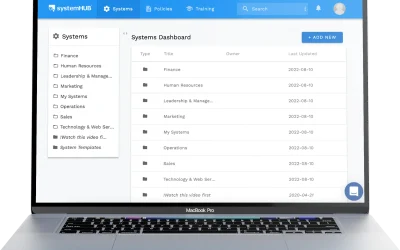
Give your team one place to find every system they need
systemHUB makes it easy to store, share and manage your business systems so your team always knows where to look.
Common mistakes when rolling out systems to your team
Trying to do it all yourself. Many business owners try to be the one who documents everything, manages the rollout and holds everyone accountable. This almost always stalls. You need a dedicated systems champion to drive the initiative, especially if you are a visionary-type leader.
Announcing it in one big meeting. Dropping a company-wide announcement without first getting your managers and key players on board is a recipe for eye-rolling. Take a top-down approach: get partners onboard first, then department heads, then the wider team. Each group has different questions and concerns.
Focusing on resisters instead of supporters. It is a common mistake to pour energy into the people pushing back. But that is not how movements start. Start with the willing. As they succeed, sceptics will either come around on their own or find themselves out of step with the new normal.
Making documentation too complex. If your systems are so detailed that they take longer to read than the task takes to complete, you have overcomplicated things. Aim for “good enough” documentation that a competent team member can follow. You can always refine later.
Not linking adoption to performance. If following systems is optional, people will treat it as optional. Tie systems compliance to performance reviews and bonuses. Make it clear that becoming accountable for their work is part of the job, not an add-on.
Frequently asked questions
How do I get my team to follow standard operating procedures?
Start by making it a two-person job. Have your knowledgeable workers demonstrate their process while a systems champion handles the documentation. Then introduce the finished SOPs as part of your project management workflow. The key is to frame benefits in terms of the individual (“this means less catch-up after holidays”) rather than the company (“this helps us scale”).
What is a systems champion and why do I need one?
A systems champion is a dedicated team member who drives your systemisation initiative forward. They coordinate extractions with knowledgeable workers, document processes, manage your systems software and champion adoption across the team. Most business owners are visionary leaders who are not the best fit for this detail-oriented, follow-through role. Having a champion means the work actually gets done.
How long does it take for a team to adopt new business systems?
Expect the initial rollout to take 3 to 6 months for core systems along your Critical Client Flow. Cultural adoption takes longer. You will see the biggest resistance from existing team members who have been with you the longest. New hires will adapt quickly because your systemised way of working is all they know. Consistent effort from your systems champion is what bridges the gap.
What if my team thinks systems are just more bureaucracy?
This is usually a sign that previous systems efforts were too rigid or imposed top-down. Show your team that these systems are designed to make their work easier, not harder. Focus on quick wins that solve real pain points they are already experiencing. When a system saves someone two hours a week, it stops feeling like bureaucracy and starts feeling like a gift.
How do I handle a team member who refuses to follow processes?
Use the SFUS (System for Unfollowed Systems) approach. Evaluate through four lenses: Context, Conduct, Coaching and Cost. Always start with a coaching conversation to understand the root cause. If coaching does not work, link compliance to performance reviews. Ultimately, if someone refuses to work within your systems culture, they may not be the right fit for where your business is heading.
Should the business owner lead the systems rollout?
The business owner should set the vision and show unwavering commitment to the initiative. But the day-to-day implementation should be led by a systems champion or operations manager. Most founders are leaders who thrive on new ideas, not managers who thrive on follow-through. Trying to do both often leads to stalled initiatives and a team that does not take it seriously.
How do I make systems part of our company culture?
Culture is built through consistent action, not announcements. Manage via the systems. Celebrate wins publicly. Make “Is it in the system?” the default response to any question. Include systems-thinking in your company values, onboarding process and performance reviews. Over time, this becomes “how we do things here” rather than a separate initiative.
What is the best way to introduce new systems to existing employees?
Use a top-down cascade approach. Start with partners and senior managers using business-level benefits. Then brief department heads and knowledgeable workers using team-member benefits (less overtime, clearer expectations, career growth). Do not move to the next group until the current group is committed. When you finally address the whole team, your key people are already on board, which makes adoption much smoother.
Your team does not hate systems. They hate confusion. Give them clarity, give them ownership, and watch them become your biggest advocates for how things are done around here.
Ready to systemise your business in a way your team will actually embrace? Whether you are just starting out or need to shake up your team’s approach to processes, the SYSTEMology framework and systemHUB give you everything you need to make it happen.