If SOPs are so important, why haven’t you created them yet?
You already know the answer. You’re too busy. There’s always something more urgent. A client needs your attention. A team member has a question only you can answer. Another fire to put out.
But here’s the thing. That constant firefighting? Those repeated questions? The inconsistency that creeps in every time someone new joins? Those are all symptoms of the same problem. Your business knowledge is trapped in people’s heads instead of captured in standard operating procedures.
In this guide, I’ll walk you through the compelling reasons why SOPs matter, what they actually do for a business, and why the most successful business owners I’ve worked with treat them as non-negotiable.
In this guide:
What SOPs actually do for a business
A standard operating procedure is simply a documented way of completing a task. It captures how your best people do their best work, and turns that into something anyone on your team can follow.
But the real power of SOPs goes much deeper than step-by-step instructions.
SOPs transfer knowledge from individuals to the business itself. Think about it. Right now, your best team members carry years of experience in their heads. They know the shortcuts. They know the edge cases. They know what works and what doesn’t. But if that knowledge only lives between their ears, it belongs to them, not to your business.
When you write a procedure, you’re extracting that knowledge and making it a business asset. The knowledge stays even when people move on.
The core shift SOPs create:
Without SOPs, your business depends on individuals. With SOPs, your business depends on the system. This is the fundamental difference between a business that traps its owner and one that creates freedom.
Having worked with hundreds of companies, I’ve found they typically fall into one of four stages of systemisation: Survival, Stationary, Scalable, and Saleable. Most businesses stuck in the first two stages have one thing in common. Their processes live in scattered notes, emails, and the heads of a few key people. SOPs are what move a business from dependent on individuals to driven by systems.

The old way: everything runs through the owner.

The SYSTEMology way: your team runs the systems, you run the business.
8 compelling reasons to use standard operating procedures
Let’s get specific. Here are eight reasons why SOPs are worth every minute you invest in creating them.
1. Consistency across your entire team
Without SOPs, every team member does things their own way. One person handles client onboarding one way. Another takes a completely different approach. The result is inconsistent quality that erodes trust.
SOPs set the standard. They capture how your best performers do the work and make that the baseline for everyone. When every team member follows the same repeatable process, your customers get a consistent experience every time. That consistency builds trust, and trust builds revenue.
2. Faster training and onboarding
How long does it take to get a new team member up to speed? In businesses without SOPs, the answer is usually “months.” The new person shadows someone, asks a lot of questions, makes preventable mistakes, and slowly pieces things together.
With SOPs, onboarding can happen in weeks instead of months. New team members have a clear reference they can follow from day one. They spend less time guessing and more time contributing. The cost of replacing an employee can run 50 to 200 per cent of their annual salary. SOPs cut that cost dramatically by shortening the ramp-up period.
3. Quality control that doesn’t depend on you
When the standard is documented, quality becomes measurable. You can see exactly where someone deviated from the process. You can identify weak points and fix them. And critically, you don’t need to be standing over someone’s shoulder to make sure the work is done right.
SOPs give your team guardrails. They know what “good” looks like because it’s written down, not just in your head.
4. Delegation becomes possible
One of the biggest struggles I hear from business owners is “I can’t delegate effectively because nobody does it the way I would.” I get it. I’m a recovering micromanager myself.
But here’s the truth. If you’re the only person who can do a task, there’s something wrong with the way your business is built. SOPs solve this. They document the “how” so you can hand off the “what.” Your team doesn’t need to think like you. They just need to follow the procedure.
Tip: You don’t even need to be the one creating the SOPs. In the SYSTEMology framework, a “systems champion” on your team handles the documentation. The business owner is often the worst person to write systems because they skip steps that feel obvious to them.
5. Scaling without chaos
Growth without systems creates chaos. You hire more people, but problems multiply faster than revenue. Every new team member introduces more variation, more mistakes, and more demand on your time.
SOPs are the foundation of scalable growth. They let you bring on new team members, open new locations, or add new services without reinventing the wheel each time. The process is already documented. You just need people to work it.
6. Compliance and risk management
Depending on your industry, you may face regulatory requirements around how work is performed. SOPs create an audit trail. They demonstrate that your business has defined processes and that your team follows them.
Even outside heavily regulated industries, SOPs protect your business. If a customer complaint arises, you can point to the procedure and identify exactly where things went wrong, rather than guessing. This protects your reputation and reduces legal exposure.
7. Higher business value
This is the one most business owners don’t think about until it’s too late. If your business can’t run without you, it’s worth significantly less. Buyers and investors look for businesses with documented systems, clear procedures, and teams that can operate independently.
When I sold my digital agency, the buyer told me that seeing how comprehensively the systems were defined and recorded, resulting in a business that had been running independently for three years, gave him the confidence to take the helm. Without those SOPs, I wouldn’t have had a saleable business. That’s the difference between owning a job and owning an asset.
8. Freedom for the business owner
This is the reason behind all the other reasons. You didn’t start a business to become a prisoner of it. But without SOPs, that’s exactly what happens. Every decision runs through you. Every question comes to you. You can’t take a week off without everything falling apart.
SOPs change that equation. They create a business that works without your constant involvement. Not because you’re no longer needed, but because the day-to-day operations don’t depend on you being there.
Could you take three months off and have your business survive? That’s the test. SOPs are how you pass it.
What’s the cost of NOT having SOPs?
Use the free Cost of Chaos Calculator to put a dollar figure on your unsystemised operations.
What happens when businesses don’t use SOPs
If the benefits above sound theoretical, let me make the consequences concrete.
Businesses without SOPs pay a heavy price. And the worst part is, most of these costs are invisible. You don’t see them on a P&L statement, but they drain your business every single day.
- Knowledge walks out the door. When a key team member leaves, everything they knew about how things work leaves with them. You’re back to square one, training someone from scratch.
- Every new hire takes months to become productive. Without documented processes to learn from, new team members rely on shadowing, asking questions, and trial-and-error.
- Mistakes repeat. The same errors happen over and over because there’s no documented standard to measure against. You fix the symptom but never the root cause.
- The owner stays trapped. You can’t step back because the business can’t function without your daily involvement. Holidays feel stressful. Growth feels impossible.
- Inconsistency erodes customer trust. Clients get a different experience depending on who serves them and what day of the week it is.
I’ve seen this pattern play out hundreds of times. The cost of avoiding systemisation isn’t a one-off expense. It compounds. Every month without SOPs is another month of leaked revenue, wasted time, and missed opportunities.
Real-world examples of SOPs transforming businesses
Let me share three real examples from businesses that made the shift.
Absolute Immigration: from “five businesses under one roof” to consistent operations
Jamie Lingham runs Absolute Immigration, a firm that’s been operating for almost two decades. After filling in for a few key team members on leave, he discovered something alarming: his business had the appearance of five different organisations operating under one roof. Everyone was doing things their own way.
He knew systemisation was key, but he’d tried in the past and failed. Then he found the SYSTEMology framework and had an “a-ha” moment. He realised he wasn’t the best person to drive this initiative.
So he empowered his team to map the Critical Client Flow and document the systems. His operations manager drove the process. The result? Every department now works in a consistent fashion. The robust SOPs keep every job on track, and the firm is positioned to scale dramatically.
The lesson: Jamie’s business had grown despite inconsistency, not because of it. SOPs gave his team a shared standard and created the foundation for the next stage of growth.
Oh Crap: from garage side hustle to systems-powered growth
Bruce Hultgren and Henry Reith started Oh Crap, a compostable dog poop bag company, in Bruce’s garage. Marketing worked brilliantly and sales exploded. They went from 200,000 bags to 6.3 million in a couple of years.
But their growth outpaced their capacity. When order volume spiked, they had to turn off ads. Bruce’s yearly week-long holiday brought the business to a complete halt. Once they hired full-time staff, the start-and-stop approach wouldn’t cut it.
Henry knew from past ventures that they needed SOPs. After recording their first couple of systems, they appointed an internal systems champion who keeps everyone honest with documented procedures. Today, they have more resources than orders, and Henry predicts the business will double every few months.
The lesson: SOPs didn’t slow Oh Crap down. They made growth sustainable. Bruce and Henry now have the time and mental space to drive the vision instead of fighting fires.
David’s digital agency: SOPs made the business saleable
I owned a digital agency for over a decade. When my operations manager resigned to move overseas, I had a decision to make: replace her, take back management myself, or sell the business.
Because we had spent years building comprehensive SOPs, the business had been running independently for three years. That made selling possible. The buyer specifically cited the documented systems as the factor that gave him confidence to take over.
We negotiated a fair sale at a high multiple of annual earnings. Without SOPs, I would have been stuck. The business would have been unsaleable because its value was locked in people, not in systems.
The lesson: SOPs don’t just improve daily operations. They build a saleable asset. Even if you never plan to sell, building your business as though it’s saleable opens a world of opportunities. Read more case studies in the SYSTEMology book.
Common objections to SOPs (and why they’re myths)
If you’ve been putting off creating SOPs, you’re not alone. Most business owners have the same hesitations. Let me address the four I hear most often.
“I don’t have time to create SOPs.” This is the number one objection, and it’s understandable. But here’s the truth: the business owner doesn’t need to be the one writing them. In fact, the business owner is usually the worst person for the job. They skip steps that feel obvious and overcomplicate things that should be simple. A systems champion on your team can handle the documentation while you stay focused on running the business.
“SOPs will stifle creativity and make my team robotic.” This is a myth. SOPs don’t eliminate creativity. They free it up. When your team isn’t wasting energy figuring out how to do routine tasks, they have more mental space for the creative, high-value work that actually moves the business forward. SOPs handle the 80 per cent that should be consistent so your team can focus on the 20 per cent that requires creative thinking.
“Even if I create SOPs, my team won’t follow them.” Getting team buy-in is a real challenge, but it’s not insurmountable. The secret is positioning the benefits in relation to the individual, not just the company. People support what they help to create. When your team participates in building the SOPs, they’re far more likely to follow them. It takes persistence, but the reward is a culture where “this is just how we do things here.”
“I’d need to create hundreds of SOPs to make a difference.” No, you wouldn’t. The 80/20 rule applies to business systems just like everything else. Just 20 per cent of the SOPs you create will provide 80 per cent of your efficiency wins. Start with your Critical Client Flow, the core process that takes a customer from first contact through to delivery. That’s typically 15 to 20 systems, and it’s enough to see dramatic results.
Ready to build SOPs your team actually follows?
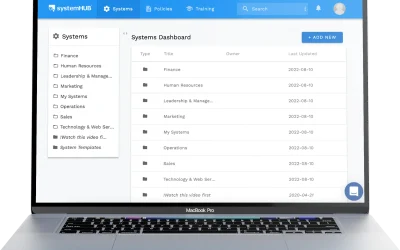
systemHUB gives you the software, templates, and training to document your business systems in one central place.
How to get started with standard operating procedures
You don’t need to stop everything and spend weeks writing SOPs. The SYSTEMology approach breaks it into manageable steps that won’t overwhelm you or your team.
1
Define your Critical Client Flow
Map the core journey from attracting a customer to delivering your product or service. This identifies the 15-20 SOPs that matter most.
2
Assign and extract
Identify your knowledgeable workers and assign a systems champion. Have the champion record the SOP while the expert walks through the process.
3
Organise and integrate
Store your SOPs in a central system your team can access. Then integrate them into daily operations, project management, and onboarding.
The key insight is that you don’t need to create anything new. You’re simply capturing what your best people are already doing. Once you have that documented, you can bring everyone else up to that standard.
If you want free SOP templates to get started quickly, we have a library of ready-made templates you can customise for your business. And if you want a complete beginner’s guide to creating SOPs, we’ve written one of those too.
Tip: Don’t aim for perfection on your first pass. Capture what you’re currently doing, even if it’s not perfect. You can optimise later. Tremendous wins come simply from getting consistency across your team, and that doesn’t require perfect SOPs.
Frequently asked questions
Why are standard operating procedures important for small businesses?
SOPs are especially important for small businesses because every person wears multiple hats. When someone is absent, on leave, or leaves the company, their knowledge goes with them unless it’s documented. SOPs help small businesses maintain consistency, train new hires faster, and free the owner from being the single point of failure in daily operations.
How many SOPs does a business need to get started?
You don’t need hundreds. Start with the 15 to 20 SOPs that cover your Critical Client Flow, the core process from attracting leads to delivering your product or service. The 80/20 rule applies: 20 per cent of your systems will deliver 80 per cent of the efficiency gains. Focus on those first.
Who should be responsible for creating SOPs in a business?
Ideally, a systems champion on your team handles the documentation. This person records the process while a knowledgeable worker (the person who does the task best) walks them through it. The business owner should oversee the initiative but is usually the worst person to write the SOPs themselves, because they tend to skip steps that feel obvious.
How do SOPs help with employee training and onboarding?
SOPs give new hires a clear, documented reference they can follow from day one. Instead of relying on shadowing and asking questions, they can learn independently, reduce mistakes, and become productive in weeks rather than months. This cuts training costs and reduces the burden on existing team members.
Do SOPs make a business more valuable?
Yes. Documented SOPs are one of the key factors buyers and investors look for when evaluating a business. A business that runs on documented systems is worth significantly more than one that depends on the owner or a few key people. SOPs demonstrate that the business can operate independently, which translates directly to a higher sale price.
What’s the difference between an SOP and a process?
A process is the high-level sequence of steps (for example, “onboard a new client”). An SOP is the detailed, documented procedure for how each step is performed. Think of a process as the what and an SOP as the how. Both are important for systemising your business, but SOPs provide the level of detail that makes delegation and consistency possible.
How often should SOPs be updated?
SOPs should be reviewed and updated whenever the process changes, or at minimum every six to twelve months. The goal isn’t perfection on the first draft. Capture how things are done now, then refine over time. Many businesses build SOP reviews into their regular meeting rhythm so updates happen naturally rather than being a separate project.
SOPs aren’t paperwork. They’re the building blocks of a business that works without you.
Every business owner I’ve worked with who has committed to documenting their standard operating procedures says the same thing: “I wish I’d done this sooner.” The consistency, the freedom, the ability to step back and work on the business instead of in it, none of that is possible without SOPs.
You don’t need to do it all at once. Start with your Critical Client Flow. Assign a systems champion. Capture what your best people are already doing. The rest follows from there.
If you’re ready to get your SOPs organised in one central place where your team can actually find and follow them, explore systemHUB and see how it works.