What happens when the one person who knows how to do something walks out the door?
It might be the way your team opens the shop each morning. The steps for following up with a new client after their first meeting. The process for sending invoices on time every single week.
These are the everyday procedures that keep your business running. They’re not glamorous. Nobody puts them on a mission statement. But when they’re missing, things start falling through the cracks. Orders get delayed. New hires take months to get up to speed. And you, the business owner, end up answering the same questions over and over again.
The good news? Creating everyday procedures doesn’t require a massive overhaul. It starts with documenting how your team already does things, one task at a time. In this guide, you’ll learn exactly how to identify, document, and store the everyday procedures that form the backbone of your business.
In this guide:
What are everyday procedures?
Everyday procedures are the recurring tasks your team performs on a daily or weekly basis to keep your business operating smoothly. They’re the small, repeatable actions that happen so frequently, most people do them on autopilot.
Think about it. Every business has them. Opening the office. Processing a customer enquiry. Running payroll. Following up on overdue invoices. Onboarding a new hire for their first day. These tasks happen constantly, and they all follow a pattern, whether that pattern is written down or not.
Everyday procedures vs. one-off projects.
A procedure is a repeatable sequence of steps that produces a consistent result. It’s different from a project, which is a one-time effort with a start and end date. Building a new website is a project. Updating the blog every Tuesday is a procedure. Both matter, but procedures are where consistency lives. They’re the foundation of a standard operating procedure (SOP) library.
The problem is that most everyday procedures live inside someone’s head. Usually the person who’s been doing the task the longest. In SYSTEMology, we call this person the “knowledgeable worker,” or the knower. They know how to do the job well, but that knowledge hasn’t been captured anywhere others can access it.
And that’s where things start to break down.
Why documenting everyday procedures matters
You might be thinking, “My team already knows what to do. Why write it all down?” That’s fair. When things are going well, undocumented procedures feel invisible. But the moment something changes, the cracks show up fast.
1. Consistency across your team
Without documented procedures, every team member develops their own version of “how we do things.” One person follows up with clients within 24 hours. Another waits three days. Someone sends a detailed welcome email. Someone else sends nothing at all.
Documented repeatable processes give your whole team a single standard to follow. Not because people can’t think for themselves, but because consistency is what builds trust with your clients.
2. Faster onboarding for new hires
Every time you hire someone new, the clock starts ticking. How long until they can do the job without constant hand-holding? Without procedures, the answer depends entirely on who trains them and what that person remembers to cover.
With a clear daily procedures checklist, a new team member can start contributing in days instead of months. They have something to reference when they’re unsure, and they don’t need to interrupt a senior team member every time they hit a question.
3. Reduced owner dependency
This is the big one. If your team can’t complete everyday tasks without asking you, you’re the bottleneck. Every question that lands on your desk pulls you away from the strategic work that actually grows your business.
When a builder called Gary first came across SYSTEMology, he was working 100-110 hours a week. Every tool and training he tried didn’t fix the core problem: everything ran through him. Once he mapped out his Critical Client Flow and began documenting everyday procedures, profitability increased approximately 80 per cent. His greatest win? A three-week holiday with his family, for the first time in his entire working life.
That’s the power of getting procedures out of your head and into a system your team can follow. It’s the path toward systemising your business so it works without you.
4. Fewer dropped balls and missed steps
When procedures aren’t written down, things get missed. Not because your team is careless, but because memory is unreliable. The Friday afternoon invoice run gets forgotten during a busy week. The new client welcome call slips through the cracks. A crucial quality check gets skipped because someone was in a rush.
A simple checklist solves this. Not a 50-page manual. Just a clear, step-by-step list that your team can follow and tick off.
5. The foundation for scaling
You can’t scale what you haven’t documented. If your business depends on tribal knowledge (the stuff that lives in people’s heads rather than in a system), growth just means more chaos. More people doing things differently. More fires for you to put out.
Everyday procedures are the building blocks. Get them right, and everything else becomes easier: delegation, hiring, training, even selling the business one day if that’s the path you choose.
SYSTEMology principle: You don’t need to document everything at once. Start with your Critical Client Flow, the core sequence of steps that takes a prospect from first contact through to becoming a repeat client. The everyday procedures within that flow are your highest-priority targets.

The old way: everything runs through the owner.

The SYSTEMology way: your team runs the systems, you run the business.
Need a head start on your everyday procedures?
Browse our library of free SOP templates, ready to customise for your business.
How to identify which everyday procedures to document first
This is where most people get stuck. They look at everything their business does and think, “Where on earth do I start?” The answer is simpler than you’d expect.
In the SYSTEMology framework, the starting point is always your Critical Client Flow (CCF). This is a linear map of the key stages your client goes through when working with your business, from first hearing about you through to becoming a repeat customer. It typically includes stages like attention, enquiry, sales, payment, onboarding, delivery, and repeat or referral.
Within each of those stages, there are everyday procedures happening. The daily tasks that keep clients moving through the flow. Your job is to identify which ones matter most.
Here’s a practical way to prioritise:
- Frequency: Which tasks happen every day or every week? These are your highest-volume procedures and the ones where inconsistency does the most damage.
- Impact: Which tasks directly affect your clients’ experience or your revenue? A missed follow-up call has a bigger impact than filing a document in the wrong folder.
- Knowledge concentration: Which tasks can only be done by one person? If that person is sick, on holiday, or leaves the company, what breaks? Those are your most vulnerable procedures.
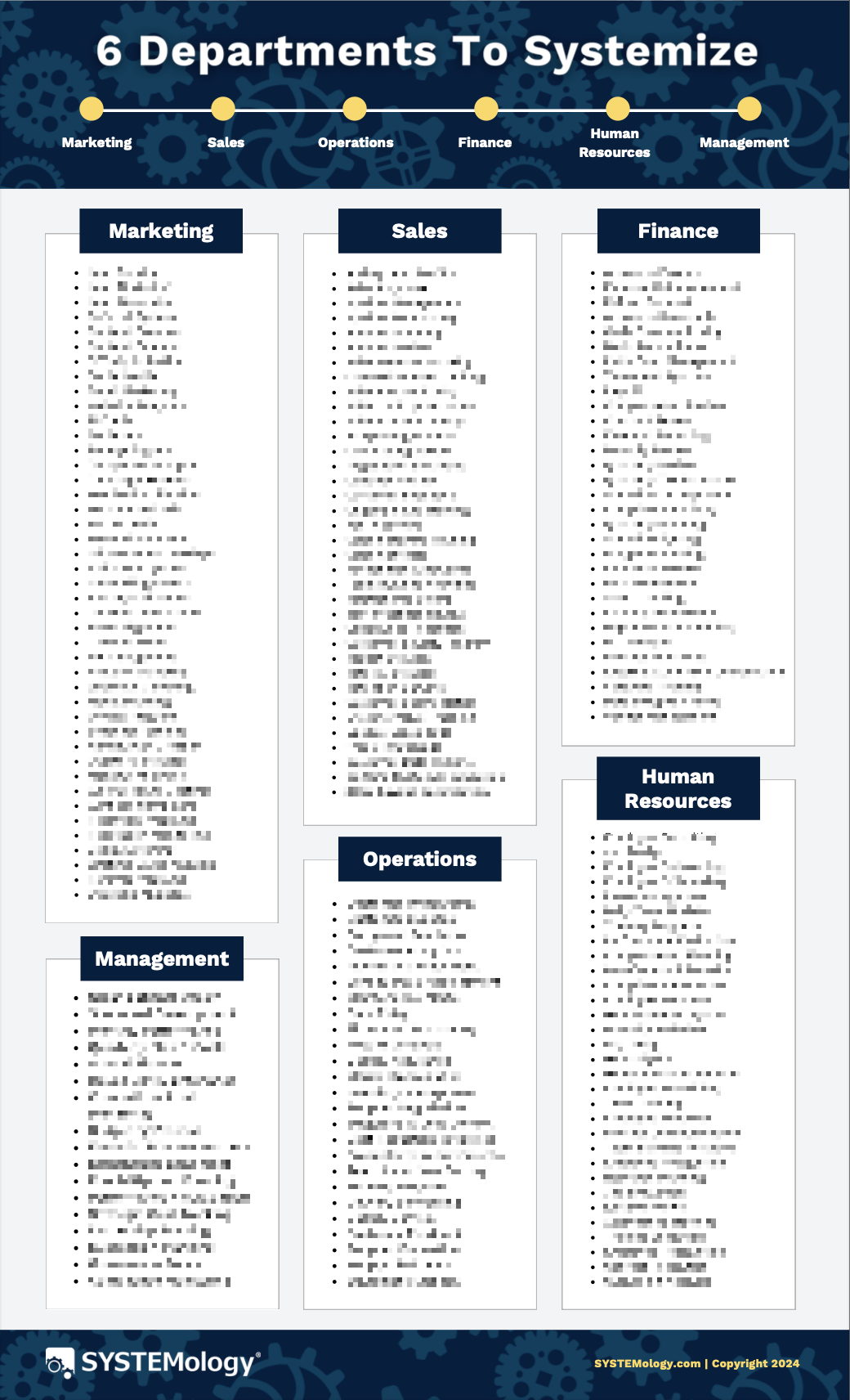
Every business has everyday procedures across these six core departments. Start with the ones that sit inside your Critical Client Flow.
You don’t need to be perfect here. Just pick 3-5 everyday procedures that score high on frequency, impact, and knowledge concentration. That’s your starting list. Once those are documented, you’ll have momentum, and you’ll naturally start seeing the next batch to tackle.
For a deeper look at prioritisation, check out our beginner’s guide to SOP creation.
Step-by-step: creating your first everyday procedure
Here’s the method we teach inside SYSTEMology. It’s built to work for real businesses with real teams, not just in theory. The core idea is this: don’t write the procedure yourself. Instead, capture it from the person who already does the task well.
1
Name & define
Give it a clear name and state the result
2
Find the knower
Identify who does this task best
3
Record & document
Capture it, then write the steps
1. Name the procedure and define the result
Start simple. Give the procedure a clear, descriptive name. “Handling an incoming enquiry.” “Weekly invoice run.” “Morning shop opening checklist.” The name should tell someone exactly what this procedure covers without needing to read the details.
Then define the result. What does “done” look like? For a morning opening checklist, the result might be: “Shop is clean, systems are running, displays are set, and the front door is unlocked by 8:55 AM.” This gives your team a clear target to aim for.
2. Identify the knowledgeable worker
This is the person in your team who currently does this task and does it well. In SYSTEMology, we call them the “knowledgeable worker” or the knower. They might not be the fastest, but they produce the best results consistently.
The key insight here is that the knower doesn’t write the procedure. Their job is to demonstrate it. Someone else, ideally your systems champion (more on that in a moment), watches and documents it. This separation is critical because it’s much easier for someone to show how they do something than to write it from scratch.
3. Record the task being completed
Have the knowledgeable worker do the task while being recorded. For a computer-based task, use screen-recording software. For a physical task, use a phone camera or GoPro. For a phone-based task, use a voice recording app.
The goal is to capture everything in real time, with the knower talking through what they’re doing as they do it. Don’t worry about perfection. If they stumble or make a mistake, keep rolling. You can edit later, and sometimes the mistakes are instructive.
A little preparation helps. Ask the knower to jot down a few bullet points beforehand so they’ve thought through a task they might normally do on autopilot. But don’t over-prepare. You want to capture how the task is really done, not an idealised version of it.
4. Create step-by-step documentation
Now your systems champion takes over. They watch the recording and break the task down into numbered steps. Literally: “Step 1: Do this. Step 2: Do that.”
Each step should be as detailed as it needs to be, but no more. You’re writing for smart people who need clear guidance, not robots who need every keystroke spelled out. A reader with some relevant experience should be able to scan the headings and know roughly what to do, then read the sub-steps for the finer details.
For a complete guide to writing procedures that actually get followed, see our dedicated tutorial.
5. Review and test with a fresh team member
Send the draft back to the knower first. Ask them to follow the steps next time they do the task and flag anything missing, unclear, or wrong.
Then, and this is the real test, have someone who has never done this task before try to follow the procedure. If they can complete it to a reasonable standard with minimal questions, your procedure works. If they get stuck, you know exactly where to add more detail.
6. Store it somewhere your team can actually find it
A procedure that’s buried in a Google Drive folder nobody checks is almost as useless as no procedure at all. Your documentation needs to live in a central, searchable location where your team can find it in seconds.
Organise procedures by department (Marketing, Sales, Operations, Finance, HR, Management) so people know where to look. And make sure the system you use is easy to update, because procedures will evolve. Version one is never the final version. That’s by design.
The systems champion: In SYSTEMology, we recommend appointing a systems champion. This is the person who drives the documentation process, watches the recordings, writes up the steps, and keeps everything organised. They don’t need to be a senior leader. They just need to be detail-oriented and consistent. It takes the documentation load off the knowledgeable workers (and off you) so the whole process actually gets done.
Ready to centralise your everyday procedures?
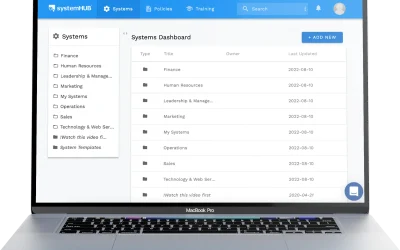
systemHUB gives your team one searchable home for every procedure, checklist, and SOP. Organise by department, assign owners, and keep everything up to date.
Everyday procedure examples
Sometimes the easiest way to understand what a procedure looks like is to see one. Here are four examples from different areas of a typical business. You can adapt any of these as a simple SOP template for your own team.
Operations: Morning opening checklist
Trigger: Start of each business day, 30 minutes before opening.
- Disarm the security system and turn on all lights
- Check overnight emails and voicemails for anything urgent
- Boot up point-of-sale system and confirm it’s processing correctly
- Walk the floor: check displays, restock shelves, clear any clutter
- Review the day’s appointments or scheduled deliveries
- Brief the team on any priorities or changes for the day
- Unlock the front door at opening time
Endpoint: Premises are clean, systems are running, and the team is briefed before the first customer arrives.
Sales: Client follow-up after first meeting
Trigger: Within 24 hours of completing an initial client meeting or discovery call.
- Send a personalised thank-you email referencing a specific point from the conversation
- Attach any relevant resources, case studies, or proposal documents discussed
- Log the meeting notes in the CRM with next steps and follow-up date
- Set a calendar reminder for the agreed follow-up date
- If no response within 3 business days, send a brief check-in email
Endpoint: Client has received a follow-up, meeting is logged, and next action is scheduled in the CRM.
Finance: Weekly invoicing procedure
Trigger: Every Friday at 2:00 PM (or the last business day of the week).
- Review completed jobs or delivered services for the week in the project management tool
- Cross-reference with client agreements for correct billing amounts
- Generate invoices in accounting software with correct line items, tax, and payment terms
- Double-check client details (name, email, ABN) before sending
- Send invoices via email and log the send date
- Flag any overdue invoices from previous weeks for follow-up on Monday
Endpoint: All completed work for the week has been invoiced, and overdue accounts are flagged for follow-up.
HR: New team member first-day onboarding
Trigger: New hire’s first day of employment.
- Greet the new hire and introduce them to the team
- Walk through the office layout: workstation, kitchen, bathrooms, emergency exits
- Provide login credentials for all required software and tools
- Share access to the company’s procedure library (e.g., systemHUB) and explain how to find what they need
- Walk through their role’s Critical Client Flow so they understand where they fit
- Assign a buddy or mentor for their first two weeks
- Schedule a check-in for end of day one and end of week one
Endpoint: New team member has access to everything they need, understands how the business operates, and has a clear point of contact for questions.
Free SOP templates and tools to get started
You don’t need to build your business procedures template from scratch. Starting with a proven template saves time and gives you a consistent format your team can follow from day one.
Here are some resources to help you get moving:
- Free SOP templates from systemHUB – A library of ready-to-use templates covering common business procedures across all six departments. Download, customise, and start using them with your team today.
- SYSTEMology: Create time, reduce errors and scale your profits with proven business systems – The full methodology behind everything in this guide. If you want the complete playbook for systemising your business, start here.
- Systems Strength Test – A free assessment that shows you where your business stands right now in terms of systemisation. Takes a few minutes and gives you a clear picture of where to focus first.
The templates give you a structure. The methodology gives you a process. And a tool like systemHUB gives you a central home where your team can find, follow, and update procedures without digging through shared drives or old email chains.
Common mistakes when creating everyday procedures
Trying to document everything at once. This is the fastest way to burn out and abandon the whole effort. Pick 3-5 high-impact procedures from your Critical Client Flow. Get those documented and working. Then move to the next batch. Momentum matters more than volume.
Writing for robots instead of smart people. Your procedures should guide knowledgeable adults, not spell out every mouse click. If a step says “Open your email,” you don’t need a sub-step that says “Click the email icon on your desktop.” Write for the skill level of the people who will actually use the procedure.
Skipping the recording step. Sitting down to write a procedure from memory almost always produces something incomplete. Recording the knowledgeable worker doing the task captures details that get forgotten when someone tries to write from their head. The recording doesn’t need to be polished. It just needs to exist.
Not assigning a systems champion. If nobody owns the documentation process, it doesn’t happen. The knowledgeable workers are busy doing their actual jobs. You, the owner, are busy running the business. Someone needs to be responsible for watching recordings, writing up steps, and keeping the library organised. That’s your systems champion.
Waiting for perfection before sharing. Version one of any procedure will have gaps. That’s expected. The SYSTEMology approach embraces constant improvement. Get your first version documented, test it with a team member, collect feedback, and improve. A decent procedure that exists beats a perfect one that’s still in your head.
Frequently asked questions
What is an everyday procedure?
An everyday procedure is a recurring task that your team performs regularly (daily or weekly) to keep your business running. Examples include opening the office, processing client enquiries, running payroll, sending invoices, and following up with leads. They’re the routine tasks that, when done consistently, produce reliable results.
How long should a business procedure be?
As short as it needs to be and no longer. Most everyday procedures can be captured in 5-15 steps. The goal is clarity, not length. A reader with relevant experience should be able to scan the step headings and understand the flow, then read the detail beneath each step for specifics. If a procedure runs longer than 20 steps, consider breaking it into two separate procedures.
Who should write the procedures?
In the SYSTEMology method, the person who does the task (the knowledgeable worker) demonstrates it, and a separate person (the systems champion) documents it. This works because showing someone how you do something is much easier than writing it from scratch. The systems champion then creates clear, consistent documentation from the recording.
How often should procedures be updated?
Review procedures whenever the task changes (new software, new team structure, updated client requirements) and schedule a broader review every 6-12 months. The SYSTEMology framework builds in continuous improvement, so procedures are treated as living documents. Version one is just the starting point.
What is the difference between a procedure and an SOP?
In practice, they’re often used interchangeably. Technically, a standard operating procedure (SOP) is a documented procedure that has been formally adopted as the standard way to complete a task. Think of a procedure as the written steps, and an SOP as those steps once they’ve been approved, stored centrally, and followed consistently by your team.
Where should I store my business procedures?
Ideally, in a dedicated systems management platform like systemHUB where procedures are searchable, organised by department, and easy to update. The worst place to store them is scattered across Google Docs, email attachments, and shared drives. Your team needs to find the right procedure in seconds, not minutes.
How do I get my team to actually follow procedures?
Three things help. First, involve your team in creating the procedures so they feel ownership, not compliance. Second, make procedures easy to access (a central, searchable library beats a 200-page PDF nobody opens). Third, lead by example. When the owner references and follows the documented procedures, the team will too.
Can I use free SOP templates as a starting point?
Absolutely. Free SOP templates give you a proven structure so you’re not starting from a blank page. Customise the template to match your specific business, then have your knowledgeable worker validate that the steps are accurate. A template gets you 60-70% of the way there. Your team’s knowledge fills in the rest.
Start with one procedure. Today.
You don’t need to systemise your entire business this week. You just need to pick one everyday procedure, the one your team asks about most often, and document it using the steps above.
Record the knower doing it. Have someone write up the steps. Test it with a fresh pair of eyes. Store it somewhere everyone can find it.
That’s it. One procedure, documented and accessible. Then do another one next week. Before long, you’ll have a library of everyday procedures that lets your team operate without constantly leaning on you.
And that’s when things start to change. Not just for the business, but for you.
The small tasks you document today are the foundation of the business freedom you’re building tomorrow.
If you’re ready to organise your procedures in one central place, explore systemHUB and see how it works for your team.