If your business can’t run without you for a week, something is holding it back. The question is: do you know what it is?
You started your business for freedom. More time, more money, more control over your life. But somewhere along the way, that freedom turned into a trap. You’re working longer hours than ever. Revenue has plateaued. And the thought of stepping away for even a few days fills you with dread.
Most business owners in this position blame external factors. The economy. Their team. The competition. But after working with hundreds of businesses, I can tell you the uncomfortable truth.
The thing holding your business back is almost always internal. And more often than not, it’s you.
That is not a criticism. It is a diagnosis. And once you see it clearly, you can fix it. This guide will walk you through the hidden barriers that keep businesses stuck, what they are really costing you, and the practical steps to break through every single one of them.
In this guide:
Why most business owners feel stuck
There is a pattern I see repeated in almost every business that has stalled. The owner built the company from nothing. They hustled, problem-solved, and wore every hat in the building. And it worked. The business grew.
But then growth hit a ceiling. Not because the market dried up or the product stopped working. Because the owner became the bottleneck.
In the SYSTEMology framework, we identify four stages every business moves through: Survival, Stationary, Scalable, and Saleable. Most business owners who feel stuck are sitting somewhere between survival and stationary. They have got some momentum, maybe a team, perhaps even a few loose processes. But everything still runs through them.
As I wrote in SYSTEMology: “The business owner is quite often the bottleneck in this stage, and there’s no real insight that systems are the ‘way’ and that they (the business owner) are not the best person to develop them.”
The barriers holding your business back are not random. They are predictable. And once you can name them, you can start dismantling them one by one.
Seven hidden barriers holding your business back
These are the barriers I see most often. You might recognise one or two. More likely, you will recognise several. They tend to cluster together, each one reinforcing the others.
1. Owner dependency
This is the big one. If you are the answer to every question, the approver of every decision, and the only person who can handle client escalations, your business is owner-dependent. You have not built a business. You have built a job, one that demands more hours than any employer would legally be allowed to ask.
The tell-tale sign? You cannot take a week off without things falling apart. Gary McMahon, founder of Ecosystem Solutions, was working 100 to 110 hours per week before he discovered this was the core problem. He hired staff. He bought tools and training. Nothing changed because the structure of the business still depended on him being present for everything.
Owner dependency creates a hard ceiling on revenue. You can only serve as many clients as you can personally touch. And when you hit capacity, growth stops.
2. Fear of delegation
“Nobody can do it like I can.” Sound familiar? This belief is one of the most common barriers to business growth. And it contains just enough truth to be dangerous.
Yes, you probably can do most tasks better than your team. At least right now. But that is not the point. The point is whether the task needs to be done by you, or whether it simply needs to be done to a consistent standard. Those are very different things.
Fear of delegation often disguises itself as high standards. But the result is always the same: you stay trapped doing $20-per-hour work when your time should be spent on $500-per-hour decisions.
3. Perfectionism
Perfectionism is the enemy of progress. I have watched business owners spend months trying to create the “perfect” process document before sharing it with their team. Months. During which time, mistakes continued, inconsistencies piled up, and nothing actually improved.
In SYSTEMology, I address this directly: “If you’re a detail-oriented person, or worse, a perfectionist, YOUR challenge at this stage is to hold yourself in check and avoid getting too granular.”
The goal is not a perfect system. The goal is a working system. Version one does not need to be flawless. It needs to exist. You can improve it later. But you cannot improve what does not exist.
4. No documented systems
Here is a simple test. If your best team member resigned tomorrow, how long would it take to get someone else performing that role at the same level?
If the answer is “months” (or worse, “we’d be in serious trouble”), your knowledge is trapped in people’s heads. You are team-member dependent. And that is just owner dependency spread across your staff.
Without documented systems, every new hire starts from scratch. Every absence creates a crisis. And every piece of institutional knowledge walks out the door when someone leaves. This is one of the most common reasons businesses should use systems but do not.
5. Ego and identity
This one is harder to spot because it feels like strength. Many business owners tie their personal identity to being the person who saves the day. The hero. The problem-solver. The one everyone turns to.
It feels good to be needed. But being needed and being effective are not the same thing. When your business ego drives your decisions, you hold onto tasks you should have handed off years ago. You insert yourself into processes that would run better without you. And you unconsciously resist building systems because systems would make you less essential.
I freely admit that I am a recovering micromanager. In my old business, the digital agency, I learned to put good people in charge and let go. But with my newest business, it became easy to slip into old habits, especially when it is something I am passionate about.
6. Resistance to change
“This is how we’ve always done it.” Those seven words have killed more business growth than any recession.
Resistance to change comes from two directions. From the owner, who is comfortable being the hero and nervous about losing control. And from the team, who may fear that documenting their work makes them replaceable.
In SYSTEMology, I identified three common sources of team resistance. Some people hide behind the idea that no one else knows how to do their job, using knowledge as job security. Others have learned to make their workload appear heavier than it actually is. And some have simply been there so long they feel entitled to dig in their heels.
The key to overcoming resistance is not force. It is framing. When you help your team see the benefit, buy-in follows naturally. “You know how every time you go on vacation you come back to a mountain of work? This will ensure we can get the team to manage things while you’re away.”
7. Shiny object syndrome
New marketing channel. New software tool. New product idea. New strategy. Business owners, especially visionary types, are wired to chase the next opportunity. The problem is that chasing new things means you never fully systemise what already works.
You end up with a dozen half-built initiatives and zero fully documented processes. Your team is constantly adapting to the latest direction, never getting comfortable enough with any approach to execute it consistently.
The fix is counterintuitive. Instead of chasing the new, systemise the proven. Lock down the 20 per cent of your operations that drive 80 per cent of your results. Then, and only then, you will have the capacity and clarity to pursue new opportunities without destabilising everything else.
The real cost of staying stuck
These barriers are not just frustrating. They are expensive. Every day you operate with these barriers in place, your business is paying a hidden tax.
1. A hard ceiling on revenue
When everything runs through you, your personal capacity becomes the business’s capacity. You can only serve so many clients, answer so many calls, and make so many decisions in a day. Revenue plateaus not because demand stops, but because you physically cannot handle any more.
2. Burnout
Before I discovered the power of systems, I was working 60 to 70 hours a week. I was trapped on the hamster wheel of finding clients, delivering for clients, and maintaining relationships. It took the birth of my first child to force a change. Without that catalyst, I might still be working those hours, moving closer to a life of high blood pressure and burnout.
3. An unsaleable business
Here is a question that exposes everything: would anyone buy your business today? If the answer is no, because the business cannot function without you, you do not have a saleable asset. You have an expensive, exhausting job. The cost of avoiding systemisation shows up directly in your business valuation.
When I sold my digital agency, the buyer told me what attracted him most was not just the financials. It was seeing how comprehensively the systems were defined and recorded, resulting in a business that had been running independently for three years. That gave him the confidence to take the helm.
4. Team disengagement
Good people leave businesses where they cannot grow. If your team is constantly waiting for your approval, if they are never trusted to make decisions, the best ones will eventually find somewhere that lets them do their work. You will be left with the ones who are comfortable being told what to do, which only deepens your dependency.
5. Missed opportunities
While you are firefighting, your competitors are building. They are systemising their operations, freeing up their time, and investing in growth. Every day you spend trapped in the day-to-day is a day you are not working on the strategic decisions that would move your business forward.

The old way: everything runs through the owner.

The SYSTEMology way: your team runs the systems, you run the business.
What is staying stuck really costing your business?
Use the free Cost Calculator to see the real dollar impact of operating without systems.
How systems break through every barrier
Every barrier I have described above has one thing in common. They all exist because the business lacks documented, repeatable systems. And that means there is a single solution that addresses all of them.
Let me be specific about how systems solve each barrier.
Owner dependency? Systems capture what is in your head so your team can execute without you. When the process is documented, you are no longer the only person who knows how things work.
Fear of delegation? Systems create trust. When you delegate a task backed by a documented process, you are not hoping your team member figures it out. You are handing them a proven method. The process is verified, not the person.
Perfectionism? The SYSTEMology approach removes the pressure. You do not write the systems yourself. Your knowledgeable worker (the person already doing the task well) explains how it is done, and a separate person, your systems champion, documents it. This two-person approach eliminates the perfectionism trap because the documenter is simply recording reality, not engineering an ideal.
No documented systems? This is the most straightforward one. Systemising your business means extracting the knowledge that currently lives in your team’s heads and putting it somewhere accessible, structured, and usable.
Ego? Systems prove that your business can run without you being the hero. And here is the paradox: a business that runs without you is far more valuable than one that depends on you. Your ego might resist this at first. But the results will convince you.
Resistance to change? The SYSTEMology approach is designed to minimise resistance. You are not asking people to change how they work. You are simply asking them to explain what they already do, then documenting it. “If you try to get one person to do both parts of the task (explaining and documenting), I can guarantee you’ll hit resistance. But if you make this a two-person job, you absolutely change the game.”
Shiny object syndrome? Systems create the discipline to finish before you start something new. When your core operations are documented and running, you earn the freedom to explore new opportunities without risking stability.
Key insight: You do not need to document every system in your business. Start with your Critical Client Flow, the core series of steps that takes someone from first contact to happy, paying customer. Systemise that first, and you will remove the biggest bottleneck holding your business back.
Getting started: your first steps to breaking through
The path from stuck to systemised is not as overwhelming as it sounds. You do not need to document 200 systems. You need to start with the ones that matter most. Here is how.
1
Define your CCF
Map the critical steps from first contact to paid client
2
Assign a champion
Find someone who loves systems to drive the process
3
Extract and document
Record what your best people already do, then document it
1. Take the vacation test
Before you change anything, diagnose where you are. Ask yourself and each key team member: “If you were going to take a month-long vacation, what tasks and responsibilities would we need to ensure we cover for you?” The answers reveal exactly where your business is most vulnerable. Those vulnerabilities are your highest-priority systems.
2. Map your Critical Client Flow
Your Critical Client Flow (CCF) is the backbone of your business. It is the series of steps that takes someone from their first point of contact with your business through to becoming a happy, paying customer. Map it out at a high level. Do not get bogged down in detail. Gary McMahon called his CCF a “game changer” because it allowed his team to visualise the bottlenecks they had never seen before.
3. Find your systems champion
Here is a critical insight most business owners miss: you are not the best person to drive systemisation. You need a systems champion, someone on your team who naturally gravitates towards order, documentation, and process. This person does not need to be a manager. They need to be organised, detail-oriented, and respected by the team.
When I was building my digital agency, Melissa became my systems champion. She was my perfect counterbalance. She understood, valued, and was committed to building a systems-centred business.
4. Start with one system at a time
Do not try to document everything at once. Prioritise the right systems using the 80/20 principle. Twenty per cent of your systems will deliver 80 per cent of the efficiency gains. Start with the system that causes the most friction, the most errors, or the most dependency on a single person. Get that one right. Then move to the next.
5. Use the right tools
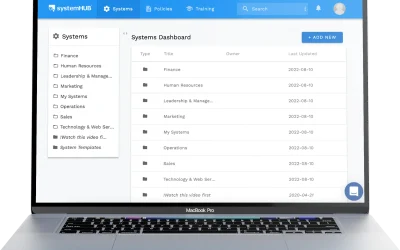
Where you store your systems matters. Scattered Google Docs and random Dropbox folders will not work. You need a dedicated platform designed for systems management, one that is intuitive, easy to navigate, and built for accountability. That is exactly why we built systemHUB: to give businesses a single home for all their documented systems.
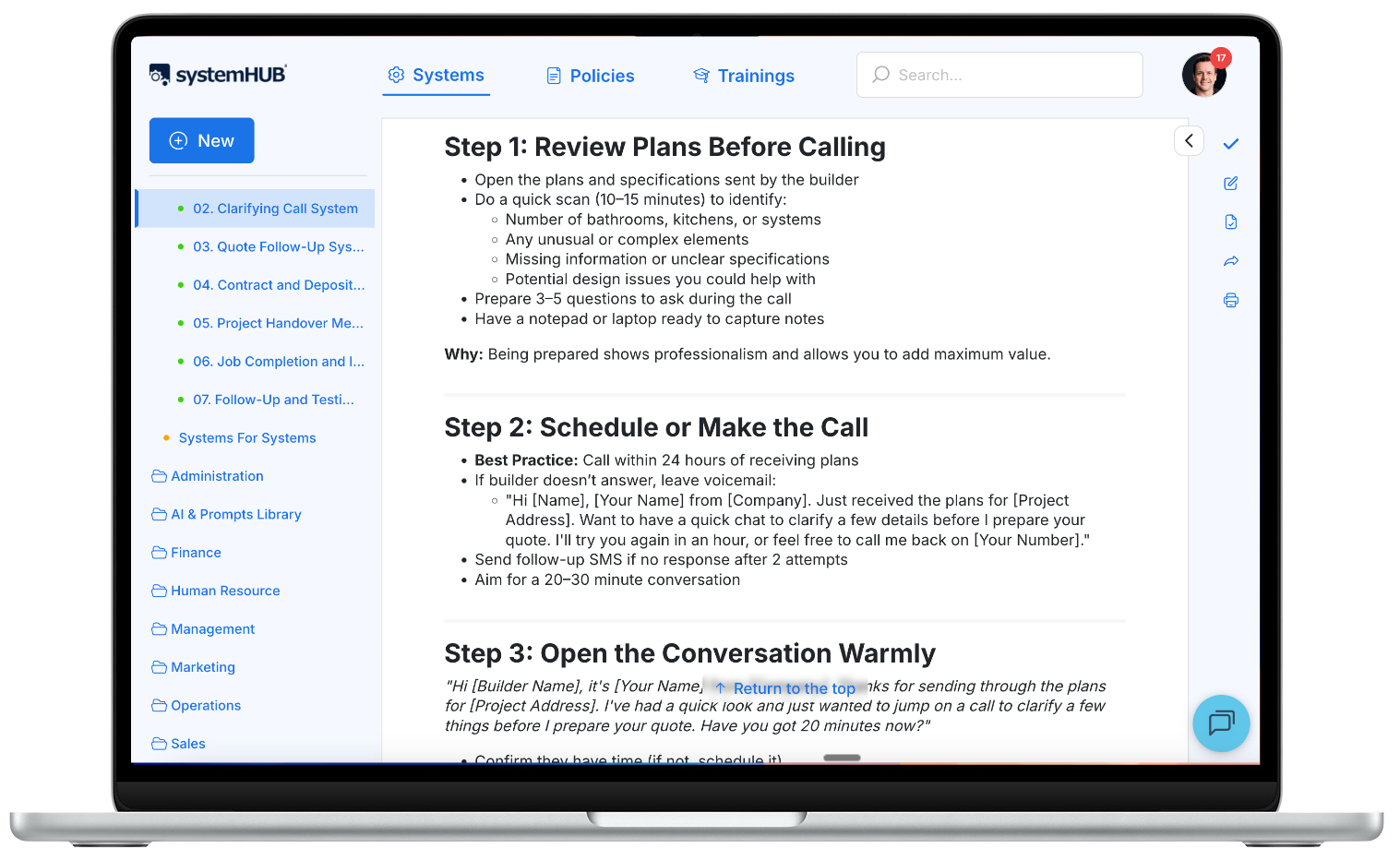
systemHUB gives your team one place to find, follow, and improve every system in your business.
Ready to remove what’s holding your business back?
Start building the systems that free you from the day-to-day. Plans start at $95/month.
Common mistakes that keep businesses stuck
Even when business owners recognise the barriers and decide to act, certain mistakes can send them right back to square one.
Trying to document everything yourself. The owner sits down to write out every process from memory. It takes forever, the documents end up overly detailed, and nobody else uses them. The SYSTEMology approach separates the knower from the documenter. Let your best people explain the process. Let someone else write it down.
Waiting for perfection before starting. “We’ll systemise once things calm down.” Things never calm down. A 70 per cent complete system that your team actually uses beats a perfect system that only exists in your head. Avoid seeking perfection. Get version one done, then improve it over time.
Blaming your team instead of your systems. When errors occur, the instinct is to blame the person. But if the system is unclear, incomplete, or nonexistent, the fault lies with the system. Fix the process first. Then hold people accountable to the improved standard.
Treating systemisation as a one-off project. Systemisation is not something you do once and tick off a list. It is an ongoing discipline. Systems need to be reviewed, updated, and improved as your business evolves. Build it into your monthly rhythm.
Not appointing a systems champion. Without someone owning the systemisation process, it will stall. The business owner is usually too busy with vision and growth to drive day-to-day documentation. Assign a champion. Give them authority. Let them run with it.
Frequently asked questions
What is the biggest thing holding most businesses back?
Owner dependency. When the business cannot function without the owner being personally involved in daily operations, there is a hard ceiling on growth, revenue, and business value. The owner’s capacity becomes the business’s capacity. Systems remove this dependency by documenting how work gets done so anyone trained on the process can execute it.
How do I know if I’m the bottleneck in my business?
Take the vacation test. If you cannot leave your business for two weeks without things falling apart, you are the bottleneck. Other signs include: your team waits for your approval before acting, clients insist on dealing only with you, revenue has plateaued despite strong demand, and you work more hours than anyone else on your team.
Why is delegation so hard for business owners?
Delegation is hard because it requires trust, and trust is difficult when there are no documented processes to follow. Without a clear system, delegating feels like hoping someone figures it out. With a documented system, delegating becomes straightforward because the person has a step-by-step guide. The SYSTEMology approach makes delegation natural by ensuring processes are captured before they are handed off.
What are the signs my business needs systems?
Common signs include: inconsistent quality in your products or services, high staff turnover, inability to onboard new employees quickly, clients receiving different experiences depending on which team member serves them, and the owner being involved in tasks that should be handled by their team. If any of these sound familiar, your business is overdue for systemisation.
How do I start systemising my business?
Start by mapping your Critical Client Flow (CCF), the core steps that take a customer from first contact to paid and happy. Identify who on your team already does each step well (your knowledgeable workers), assign a systems champion to drive the documentation, and begin extracting and recording one system at a time. You can learn more about how to systemise your business step by step.
Can I systemise my business without losing quality?
Absolutely. In fact, systems improve quality. The SYSTEMology approach models your best performers. You are capturing the method used by the person who already does the task to the highest standard. This means your systems raise the floor across your entire team. Everyone performs closer to the level of your best person, not your worst.
How long does it take to remove owner dependency?
It depends on the size and complexity of your business, but most businesses can document their Critical Client Flow and first batch of essential systems within 90 days. The shift from owner-dependent to systems-driven does not happen overnight. But the improvement starts from the very first system you document. Gary McMahon saw profitability increase approximately 80 per cent, and for the first time in his working life, he took a three-week holiday with his family.
The only thing holding your business back is the decision to start.
You now know the barriers. You know what they cost. And you know the path forward. The business owners who break through are not smarter, luckier, or better resourced. They simply decide that staying stuck is no longer an option. They start with one system, build momentum, and never look back.
If you are ready to take that first step, explore systemHUB and see how simple it is to start building the systems that set your business free.