You’ve tried every time-saving tip out there. Why are you still working 60-hour weeks?
You’ve read the articles. Time-blocking. Batching. Saying no. Waking up earlier. Delegating more. You’ve downloaded the apps, bought the planners, and reorganised your calendar more times than you can count.
And yet here you are. Still the first one in the office and the last one to leave. Still answering the same questions from your team. Still the bottleneck for every decision, every approval, every client issue that needs resolving.
Here’s the uncomfortable truth most time-saving tips for business owners won’t tell you: the problem isn’t your time management. The problem is that your business can’t function without you. And no productivity hack in the world can fix a structural problem.
I know this because I lived it. I spent over a decade running a digital agency, working 60 to 70 hours a week. I was trapped on a hamster wheel of finding clients, delivering for clients, and then circling back to find more. Every part of my business required my constant attention. It wasn’t until I stopped trying to manage my time better and started building systems that everything changed.
This guide is about the time-saving tip that actually works. Not another hack. A fundamentally different way of thinking about your time as a business owner.
In this guide:
Why business owners never have enough time
If you’re running a business with 10 to 50 employees and you still feel like there aren’t enough hours in the day, you’re not alone. But the reason might surprise you.
It’s not that you’re bad at managing time. It’s that you’ve built a business where everything flows through you.
In the SYSTEMology framework, we call this being in the “Survival” or “Stationary” stage. The business owner is in an endless loop of chasing the work, getting the work, and doing the work. Your team makes things up as they go. It’s not clear who is doing what and when tasks are due. There are no systems or processes, and nobody follows the ones that do exist.
Sound familiar? Here’s how it plays out in your day.
1. You’re the answer to every question
Your team has learned that the fastest way to solve a problem is to ask you. Not because they’re incapable, but because there’s no documented process for them to follow. So every question lands on your desk. Every “quick question” costs you 15 minutes of focus and 20 minutes to get back to what you were doing.
2. You’re the bottleneck for decisions
Every approval, every client escalation, every pricing decision waits on you. As the SYSTEMology book puts it, “the business owner is quite often the bottleneck” and there’s “no real insight that systems are the ‘way.'” You’ve accidentally trained your team to become dependent on you. Instead of empowering them to solve problems, you’re the knight in shining armour who always saves the day.
3. You’re doing work that shouldn’t require you
Generating reports. Onboarding new clients. Following up on invoices. These are important tasks, but they’re repeatable processes that someone else could handle if they had clear instructions to follow. The reason you’re still doing them is simple: the knowledge of how to do them lives in your head and nowhere else.
4. Your intellectual property is trapped
Is your business’s IP trapped in the brains of your best team members? Are you super dependent on a few key people? This is the core problem. The knowledge of how your business operates exists in scattered emails, verbal instructions, and the memories of people who might leave tomorrow.
The real time thief: It’s not poor discipline or a lack of productivity tools. It’s a business that can’t function without the owner. Every minute you spend doing repeatable work is a minute stolen from growing your business, mentoring your team, or being present with your family.
Generic time-saving tips vs systems thinking
Let me be clear. Traditional time-saving tips for business owners aren’t useless. They’re just incomplete.
Time-blocking? Great for protecting focus time. Batching similar tasks? Smart for reducing context-switching. Learning to say no? Essential for any leader. Applying the 80/20 rule? A powerful filter for what deserves your attention.
These tips all share one thing in common: they optimise YOUR time. They make you more efficient at doing the work.
But here’s the question nobody asks. What if you didn’t have to do the work at all?
That’s the difference between time management and systems thinking. Time management helps you squeeze more out of your hours. Systems thinking eliminates the need for your hours entirely.
Optimising your hours
You do the task faster, batch it, or time-block it. You still do the task. The ceiling is your personal capacity. When you go on holiday, the work stops or quality drops.
Eliminating the need for your hours
You document the task once, hand it off, and your team handles it from now on. The ceiling is your team’s capacity. When you go on holiday, the work continues.
Think about it this way. If you spend 30 minutes every week generating a client report, a time management approach might cut that to 20 minutes. Over a year, you save about 8 hours. Not bad.
But if you document the reporting process and delegate it effectively, you save 26 hours in the first year. And every year after that. The one-time investment of creating the system pays dividends for as long as the business runs.
That’s the shift. Stop trying to do more with your time. Start building a business that needs less of it.
What is your time actually costing your business?
Use the free Cost Calculator to see how much owner dependency is costing you in real dollars. The number might surprise you.
The SYSTEMology approach to saving time
The biggest time-saving tip I can give you isn’t a hack. It’s this: document a repeatable process once, hand it off to your team, and never do it yourself again.
Every hour you invest in creating a system saves hundreds of hours long-term. Not because the system is magic, but because you’re converting knowledge that’s locked in your head into something your entire team can follow, improve, and own.
This is exactly what SYSTEMology was designed to do. Here’s the approach in three steps.
1
Define
Identify the critical few systems using your Critical Client Flow (CCF). Not hundreds. Just 10-15 to start.
2
Assign
Find the knowledgeable workers who already do the task well. They capture the process, not you.
3
Extract
Record the process, turn it into a step-by-step system, and store it where your whole team can access it.
Here’s the part that surprises most business owners: you’re not the best person to document your systems. The business owner is typically the worst person to be documenting systems. You know how you want things done, but you’re never going to make it a priority. Systems are important, but they’re never urgent. So they never get done.
The SYSTEMology approach flips this. Your knowledgeable workers already know how to do the work well. They’re the team members who have been quietly executing at a high level. Your job isn’t to teach them. It’s to capture what they already know into a standard operating procedure that anyone can follow.
I used this exact approach in my own business. When my wife and I discovered we were expecting our first child, I was working 60 to 70 hours a week at my digital agency. The business literally couldn’t work without me. Within 12 months, I’d systemised almost all the key elements of the business AND hired a CEO to replace me at the top. My involvement dropped to near-zero, and it all happened before my son was more than a few months old.
Was it easy? No. But it was straightforward. Because the system works.

The old way: everything runs through you. Every task, every decision, every minute.

The SYSTEMology way: your team runs the systems. You get your time back.
Seven time-saving systems every business owner needs
Knowing that systems are the answer is one thing. Knowing where to start is another. Here are seven specific systems that will save you the most time. Each one targets a repeatable process that’s almost certainly eating your hours right now.
You don’t need to build all seven at once. Start with whichever one causes you the most pain. Use the prioritising the right systems approach: pick the one that’s most critical to your client experience and most dependent on you personally.
1. Client onboarding system
Every new client should have the same consistent welcome experience. The same introduction email. The same intake form. The same kickoff meeting agenda. If you’re personally walking every new client through the first week, that’s hours of your time that could be systemised and handed to your team.
Document the steps from “contract signed” to “first deliverable.” Record your best team member doing it. Create the checklist. Then hand it off.
2. Email and inbox management system
Most business owners spend 2 to 3 hours a day on email. Much of that is responding to messages that someone else could handle. The fix isn’t “inbox zero” willpower. It’s a system: categorise incoming emails, assign clear owners for each category, and create template responses for the 80% of messages that are repetitive.
You shouldn’t be answering support tickets, scheduling requests, or vendor follow-ups. Your team should, using a documented process.
3. Meeting and scheduling system
Unstructured meetings are one of the biggest time wasters in any business. Create a system that includes: a standard agenda template for each meeting type, a rule for who attends and who doesn’t, a maximum duration, and a follow-up process that ensures action items actually happen.
Pair this with a scheduling tool so your team can book time without back-and-forth emails. The goal: no meeting without a purpose, no meeting without an agenda, no meeting without outcomes.
4. Reporting and KPI system
If you’re manually pulling together numbers every week or month, you’re spending hours on work that should take minutes. Build a reporting system that automatically pulls data from your key sources (accounting software, CRM, project management tool) into a dashboard your team updates.
Your role shifts from “building the report” to “reviewing the numbers.” That’s a 90% time reduction on reporting alone.
5. Client follow-up system
Leads fall through the cracks when follow-up depends on memory. Build a system that triggers automatic follow-ups at key intervals: after an enquiry, after a proposal, after a meeting. Document when to follow up, who does it, what they say, and when to stop.
This isn’t just a time-saver. It’s a revenue saver. Consistent follow-up is the difference between winning and losing deals you’ve already invested time in.
6. Recruitment and onboarding system
Every time you hire someone new, do you start from scratch? If so, you’re wasting weeks of your time and your team’s time. Build a system that covers the entire journey: where to post the job, how to screen applications, interview questions, offer letter templates, and a structured first-week orientation.
The cost of avoiding systemisation is highest in recruitment. One bad hire because you rushed the process can cost your business tens of thousands of dollars.
7. Financial review system
Monthly financial reviews shouldn’t require an all-day scramble. Build a system for your monthly close process: who reconciles accounts, who reviews the P&L, what gets flagged, and how it gets reported to you. The goal is a 30-minute review meeting where you look at a dashboard, ask questions, and make decisions.
When your financial review system runs smoothly, you stop worrying about cash flow surprises and start making strategic decisions with real data.
Store all your time-saving systems in one place
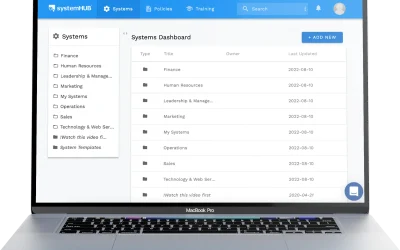
systemHUB gives your team a central location to find, follow, and improve every process in your business. No more scattered documents or forgotten SOPs.
How to measure time saved
Systems work. But you’ll stay motivated longer if you can see the results. Here’s a simple way to track the time your systems are saving.
1. Record the baseline
Before you document a process, write down how long it takes you (or your team member) to complete it. Be honest. Include the interruptions, the rework, and the time spent answering questions about it.
2. Document and delegate
Follow the SYSTEMology approach. Have your knowledgeable worker record the process. Turn it into a step-by-step system. Hand it to the person who will own it going forward.
3. Measure after 90 days
After three months, check in. How long does the task take now? How much of your personal time is still involved? Most business owners find their personal involvement drops by 80 to 100 percent within the first quarter.
Tip: Start with one system. Just one. Measure the hours saved over 90 days. When you see a single documented process saving you 5 to 10 hours a month, you’ll never look at “time-saving tips” the same way again.
This is the transition from the Stationary stage to the Scalable stage. Once you’ve got a good amount of your core business systems documented, things start to get interesting. System performance improves dramatically. Your team starts owning their areas. And you begin to reclaim not just hours, but entire days of your week.
Common time-saving mistakes business owners make
Building systems is straightforward. But there are a few traps that slow people down or derail them entirely. Watch out for these.
Chasing tools instead of building systems. A new app won’t save you time if you don’t have a process for your team to follow. The tool is the container. The system is what goes inside it. Get the system right first, then pick the tool.
Trying to document everything at once. You don’t need hundreds of systems to systemise your business. Just 20% of your systems will deliver 80% of your efficiency wins. Start with your Critical Client Flow, the 10-15 core systems that drive your client experience.
Insisting on being the one who documents it all. The business owner is typically the worst person to document systems. Your knowledgeable workers already know how to do the task. Let them capture it. Your job is to review and approve, not to write every step yourself. Let go of the business ego that says only you can do it right.
Optimising without delegating. Getting faster at a task you shouldn’t be doing is still a waste of your time. The goal isn’t to do things more efficiently. The goal is to stop doing them entirely and hand them to your team with a system they can follow.
Expecting instant results. Systems compound over time. The first month might feel slow. By month three, you’ll see real change. By month six, you’ll wonder how you ever ran your business without them. Stay the course.
Frequently asked questions
What is the best time-saving tip for business owners?
The single most effective time-saving tip is to stop doing repeatable tasks yourself and build systems that let your team handle them. One hour spent documenting a process can save hundreds of hours over the life of your business. Productivity hacks help in the short term, but systems create permanent time savings.
How do I save time when I’m already working 60+ hours a week?
Start small. Pick one task that you do every week that someone else could do if they had clear instructions. Spend one hour documenting that process using a screen recording or step-by-step checklist. Hand it to a team member. That single action can reclaim 2 to 4 hours a week. Repeat with the next task.
What is the difference between time management and systems thinking?
Time management optimises how you use your hours. It makes you faster and more focused. Systems thinking eliminates the need for your hours entirely by creating documented processes your team follows independently. Time management has a ceiling (your personal capacity). Systems thinking scales with your team.
Where should I start when systemising my business to save time?
Start with your Critical Client Flow (CCF). This is a simple exercise that maps the 10 to 15 core systems your business needs to deliver its central product or service. Focus on the processes that are most dependent on you personally and most critical to your client experience. Don’t try to document everything at once.
How long does it take to see results from building business systems?
Most business owners see measurable time savings within the first 90 days. A single well-documented process can save 5 to 10 hours per month. Over 12 months of consistent systemisation, it’s common to reclaim 15 to 20 hours per week. The results compound as more systems are built and refined.
Do I need to document the systems myself?
No. In fact, the SYSTEMology approach specifically recommends that the business owner is NOT the one documenting systems. Identify the “knowledgeable worker” on your team, the person who already does the task well, and have them record or demonstrate the process. Someone else then turns that into a written system. This keeps the business owner out of the bottleneck.
What tools do I need to build time-saving systems?
You need somewhere central to store your standard operating procedures where your whole team can find and follow them. A screen recording tool helps capture processes visually. And a project management tool tracks who’s responsible for what. The tool matters less than having a clear system inside it. Platforms like systemHUB are purpose-built for this.
The real time-saving tip? Stop managing your time. Start building systems that give it back.
Every hour you spend trapped in repeatable tasks is an hour you could spend growing your business, leading your team, or being present with the people who matter most. The productivity hacks will keep coming. New apps, new techniques, new morning routines. But none of them solve the structural problem of a business that depends on you for everything.
Systems do. One process at a time, you can build a business that runs without your constant involvement. That’s not a time-saving tip. That’s freedom.
Ready to see what’s possible? Explore systemHUB and start building the systems that give you your time back.