Your business has hundreds of processes. Which ones do you document first?
This question paralyses more business owners than almost any other. You know systemisation matters. You have heard the advice: document your processes, build SOPs, create consistency. But when you sit down to start, the list of potential systems feels endless. Marketing. Sales. Onboarding. Delivery. Finance. HR. Where do you even begin?
Most business owners either try to document everything at once (and burn out within a week) or pick something random and wonder why it makes no difference. Both approaches fail for the same reason. They skip the most important step: prioritisation.
The good news? You do not need to systemise everything. In fact, trying to do so is one of the biggest mistakes you can make. Just 20 per cent of the systems you create will deliver 80 per cent of your efficiency wins. The key is knowing which 20 per cent to start with.
This guide walks you through the exact framework for prioritising which business systems to document first, so every hour you invest in systemisation delivers the maximum possible return.
In this guide:
- Why most systemisation projects fail before they start
- The Critical Client Flow: your prioritisation starting point
- How to prioritise your systems (step by step)
- The three batches: a practical prioritisation roadmap
- Real-world prioritisation in action
- Common prioritisation mistakes
- Frequently asked questions
Why most systemisation projects fail before they start
I once shared office space with a colleague who had built an impressive digital marketing agency. He was serious about systems. He created an index of every single system in his business and stuck it to his office wall. Pages and pages, each line representing a different process with its own steps and sub-steps.
From the outside, it looked impressive. But in reality, it bombed.
Employees could not make sense of it. The business moved fast, and those systems changed almost daily. Keeping everything up to date became an impossible task. The wall of systems, meant to bring clarity, created overwhelm instead.
That experience taught me a valuable lesson. The Pareto principle, sometimes called the 80/20 rule, applies directly to business systems. Just as 80 per cent of your leads probably come from 20 per cent of your marketing efforts, 80 per cent of your operational wins will come from documenting just 20 per cent of your systems.
The problem is not a lack of systems to document. The problem is knowing which ones matter most.
Key insight: Not systemising a task does not mean it stops happening. Your team is already completing hundreds of tasks every day. Prioritisation simply means choosing which tasks to capture and standardise first for the biggest impact.
So how do you identify the critical few? You need a framework. And that framework already exists.
The Critical Client Flow: your prioritisation starting point
In the SYSTEMology framework, prioritising your business systems starts with a single tool called the Critical Client Flow (CCF).
The CCF is a one-page map of the 7 to 12 mission-critical steps your business follows to deliver its core product or service. It traces the journey from the moment a prospect first hears about you, through sales, payment, onboarding, delivery, and all the way to repeat business or referrals.
Think of it as the answer to a simple question: Could you explain how the core of your business works on the back of a napkin?
The CCF takes about 30 minutes to complete. It does not require fancy software. And it provides something invaluable: laser-like focus on exactly which systems to prioritise first.
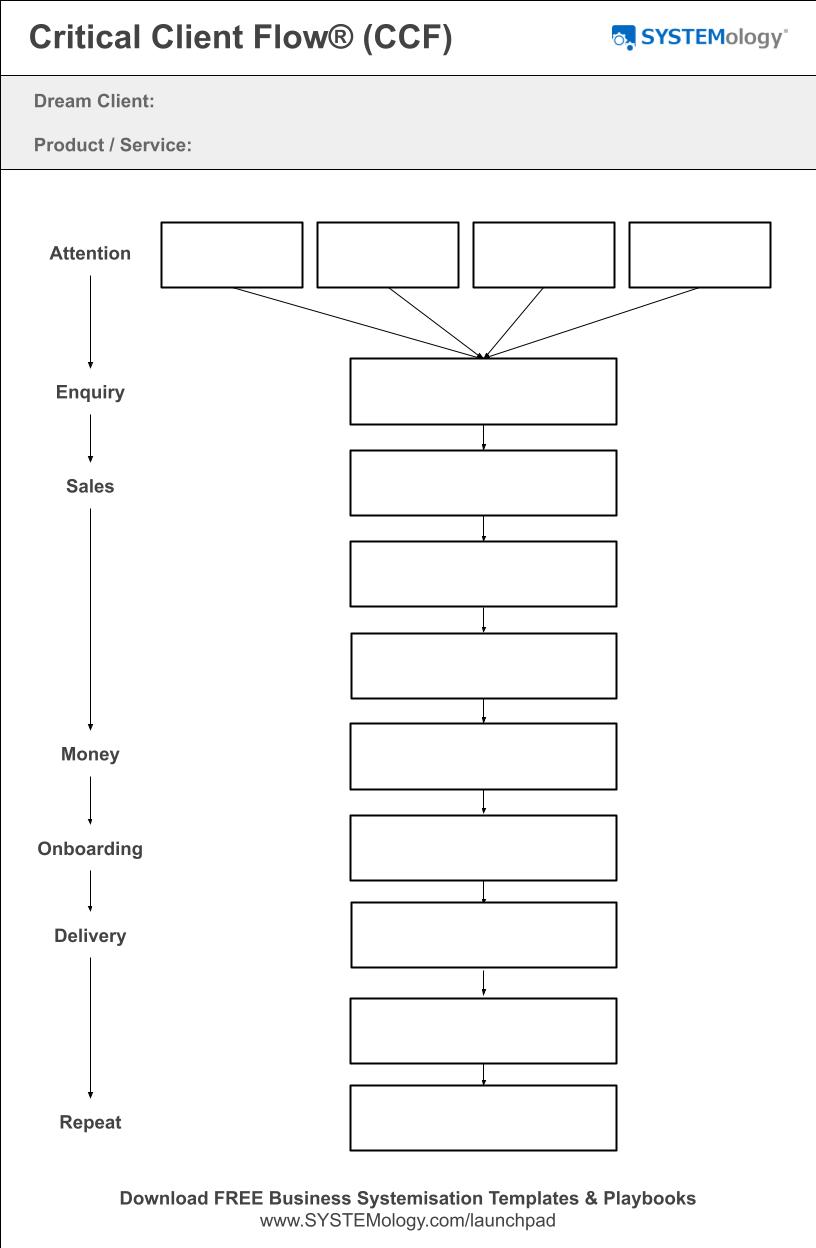
The Critical Client Flow maps the essential stages of how your business delivers value to clients, from first contact to repeat business.
Why does the CCF work as a prioritisation tool? Three reasons:
- It targets your revenue engine. The systems in your CCF are the ones that directly generate income and deliver value to clients. Systemise these first and you protect the core of your business.
- It exposes bottlenecks instantly. Weak invoicing? Cash flow problems. Inconsistent leads? Gaps in your attention stage. The CCF is diagnostic. It shows you where the problems are hiding.
- It is achievable. Documenting 7 to 12 systems is realistic. Documenting 200 is not. The CCF gives you a finish line you can see, which builds momentum for everything that comes after.
The CCF is always the first batch of systems to prioritise. Always. Regardless of your industry, your team size, or how chaotic things feel right now. You can learn the full step-by-step process in our guide to building your Critical Client Flow.
How to prioritise your business systems (step by step)
Once you understand the CCF, the prioritisation process becomes structured and repeatable. Here is how to work through it.
1. Map your Critical Client Flow
Start with one target client and one core product or service. Then map the linear steps your business follows to deliver that product, from first contact to repeat business.
Keep it to 7 to 12 steps. Label each step in two or three words. Do not overthink it. And only include what you are currently doing, not what you wish you were doing. This is about documenting reality so you can improve it systematically.
The CCF stages typically follow this pattern: Attention, Enquiry, Sales, Money, Onboarding, Delivery, Repeat/Referral. Your business will have its own variation, but every business follows a version of this flow.
2. Build your DRTC to identify who knows what
The second tool for prioritisation is the Departments, Responsibilities and Team Chart (DRTC). Think of it as a simplified organisation chart built specifically for systemisation.
The DRTC helps you answer three questions:
- What are the key departments in your business? (Marketing, Sales, Operations, Finance, HR, Management)
- Who is responsible for each department?
- Who are the “knowledgeable workers” for each critical system?
A knowledgeable worker is the person on your team who does a particular task and does it to a great standard. They are the ones you will extract the system from. Not the business owner (where possible), but the team member who consistently delivers above-average results for that task.
Why this matters for prioritisation: If you know who holds the knowledge for each system, you can schedule extractions efficiently, avoid bottlenecking the business owner, and start with systems where the knowledgeable worker is readily available and willing to participate.
3. Cross-reference the CCF with the DRTC
Now assign each step in your CCF to a department and a knowledgeable worker. This is straightforward. Your CCF step “Send proposal” goes under Sales. “Welcome email” goes under Operations or Onboarding. “Invoice client” goes under Finance.
For each step, write down the name of the team member who currently handles it best. This creates your action plan: what needs to be documented, and who you need to work with to document it.
4. Rank by impact
Not all CCF systems are equally urgent. Prioritise based on the problems you are already experiencing.
Having trouble with cash flow? Start with your invoicing and payment systems. Losing leads? Document your attention and enquiry processes and procedures. Clients complaining about inconsistent delivery? Focus on onboarding and delivery systems first.
Alternatively, look for the system that would deliver the biggest improvement if it ran consistently every single time. That is usually your highest-priority target.
5. Start with an easy win
If you are new to systemisation, consider starting with a simple system to build confidence. Pick something your team already does well and document that first. This gets everyone comfortable with the process before you tackle the harder, messier systems.
A great first system is often something like handling inbound enquiries or processing a standard order. It is repeatable, well understood, and produces a quick result your team can see and use immediately.
6. Commit to two systems per week
Sustainable pace beats heroic effort every time. Commit to documenting a minimum of two systems per week and stay within the bounds of your CCF. At that pace, you can have your entire Critical Client Flow documented within a month or two.
Do not try to document everything at once. Do not jump between departments randomly. Stay focused on the CCF, finish it, and then move to the next batch.
Not sure where your systems stand right now?
Take our free Systems Strength Test to see where your business sits on the systemisation spectrum and which areas need the most attention.
The three batches: a practical prioritisation roadmap
Once you understand the CCF, the full prioritisation roadmap becomes clear. Think of your systemisation work in three distinct batches. Do not move to the next batch until you have completed the previous one.
1
The CCF
Your 7-12 core revenue systems. The critical path from attention to delivery.
2
Department Systems
15-20 critical systems across finance, HR, and management.
3
Team Member Systems
5-7 systems per key person. Vacation-proof the business.
Batch 1: The Critical Client Flow (first priority)
This is where every business starts. Your CCF captures the systems that generate revenue and deliver your core product. These are your highest-priority systems because they directly affect your ability to make money and serve clients.
Document these first. All of them. Before you move on to anything else.
Batch 2: Critical department systems
Once your CCF is documented and running, turn your attention to the supporting departments. Focus on finance, human resources, and management. These are the systems that keep the business functioning behind the scenes.
For each department, ask the department head: “What needs to happen for this department to function at a bare minimum?” List everything, then highlight the critical 5 to 8 systems. Apply the 80/20 rule. You are looking for the essential business systems that keep the wheels turning.
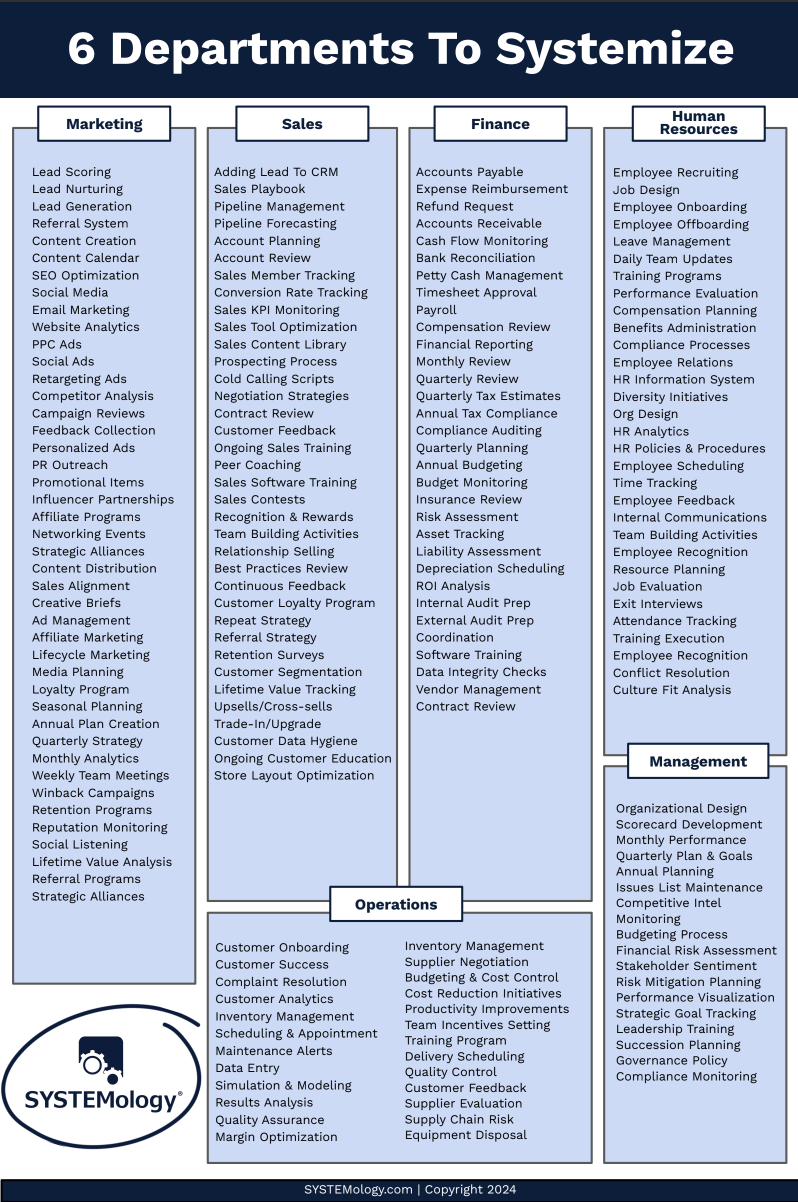
The six departments that form the foundation of a fully systemised business.
Finance is often the best starting point for Batch 2. Finance teams love systems. Their work is inherently repeatable: invoicing, payroll, reconciliation, reporting. And documenting finance systems early gives you better visibility into your numbers.
Batch 3: Key team member systems
The final batch is about making your business vacation-proof. For each key team member, ask: “If you were going on a month-long holiday, what tasks would we need to cover for you?”
Let them brainstorm everything. Then highlight the most critical 5 to 7 tasks per person. Focus on no more than five staff members at a time. The goal is to ensure the business can run smoothly when any individual is away.
By the time you complete all three batches, you will have 40 to 60 documented systems covering the critical operations of your entire business. That is far fewer than the hundreds many business owners fear they need. And it is more than enough to create a business that runs without constant owner involvement.
Real-world prioritisation in action
The prioritisation framework sounds logical in theory. Here is what it looks like in practice.
Case study: Ecosystem Solutions
Gary McMahon founded Ecosystem Solutions, a specialist ecological consulting firm, in 2005. The business grew quickly, but Gary was working 100 to 110 hours per week. His health suffered. His family relationships were strained. Every tool and training he tried failed to solve the problem.
When Gary discovered SYSTEMology, he started with the Critical Client Flow. It became a “game changer.” The CCF allowed him and his team to visualise bottlenecks they had never seen clearly before. Instead of trying to document everything, they focused on the critical path first.
The result? Profitability increased approximately 80 per cent. And for the first time in his entire working life, Gary took a three-week holiday with his family. “Peace of mind,” he said when asked what a systemised business means to him. That peace of mind started with knowing which systems to prioritise.
Case study: Oh Crap
Oh Crap, a compostable dog poop bag company, started in a garage in 2014. Marketing was so successful that sales exploded from 200,000 bags to 6.3 million over a couple of years. But growth outpaced their capacity. When orders spiked, they had to turn off ads. The founder’s annual holiday brought the business to a complete halt.
When co-founder Henry Reith implemented SYSTEMology, he prioritised ruthlessly. He recorded the first couple of core systems himself, then appointed an internal systems champion to continue the work. They stayed focused on the CCF, documenting their critical path from order processing through to fulfilment.
The result? For the first time, they had more resources than orders. The founders now have the mental space to focus on vision and growth. Henry predicts the business will double every few months, all because they prioritised the right systems instead of trying to document everything.
Both stories share the same lesson. The business owners who succeed at systemisation are not the ones who document the most systems. They are the ones who document the right systems first.
Ready to document your highest-priority systems?
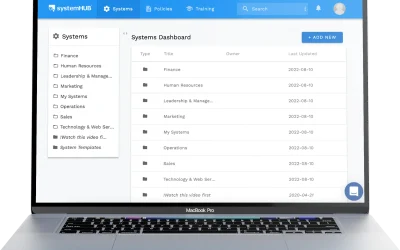
systemHUB gives you a central place to build, store, and manage every system in your business. Start with your CCF and expand from there.
Common prioritisation mistakes to avoid
Prioritising systems is not complicated. But there are traps that catch business owners every time. Watch out for these.
Trying to systemise everything at once. This is the most common mistake by far. You see the mountain of processes and want to conquer it all in one push. But systemisation is a marathon, not a sprint. Start with 7 to 12 systems. Finish them. Then move to the next batch. Trying to do it all at once leads to burnout, half-finished SOPs, and a team that loses faith in the process.
Starting with low-impact systems. It is tempting to start with something “easy” like organising the filing system or documenting how to order office supplies. But these systems will not move the needle. Start with the systems inside your CCF. They directly affect revenue, client experience, and owner dependency. Save the nice-to-haves for later.
Skipping the CCF and jumping straight to documentation. Without a CCF, you have no map. You end up documenting random processes in random corners of the business with no clear strategy. The CCF takes 30 minutes. It is the single most valuable exercise you can do before writing a single standard operating procedure.
Ignoring who holds the knowledge. Many business owners try to write every system themselves. This creates a bottleneck and often produces inferior results. Use the DRTC to identify your knowledgeable workers, the team members who actually do the task best. Extract the system from them. You will get better documentation and free yourself from being the only source of knowledge.
Waiting for perfection before moving on. Your first documented system will not be perfect. That is fine. Capture how things are currently done, get it working, and move on to the next system. You can always circle back and optimise later. Momentum matters more than perfection in the early stages. Read our SOP creation beginner’s guide for practical tips on keeping documentation simple.

The old way: try to document everything, get overwhelmed, give up.

The SYSTEMology way: prioritise with the CCF, work in batches, build momentum.
Frequently asked questions
How many systems should I document first?
Start with the 7 to 12 systems in your Critical Client Flow. These are the core systems that deliver your product or service and generate revenue. Once the CCF is complete, move to your next batch of 15 to 20 critical department systems. Most businesses need only 40 to 60 documented systems to run effectively without owner dependency.
What is the Critical Client Flow?
The Critical Client Flow (CCF) is a SYSTEMology tool that maps the 7 to 12 essential steps your business follows to deliver its core product, from first contact through to repeat business. It takes about 30 minutes to complete and becomes your prioritisation roadmap for systemisation. You can learn how to build yours in our step-by-step CCF guide.
How do I know which system is highest priority?
Look at the problems you are already experiencing. Cash flow issues point to invoicing and payment systems. Losing leads points to your attention and enquiry systems. Inconsistent delivery points to onboarding and fulfilment. The system causing the most pain right now is usually your highest priority. Alternatively, focus on the system that would create the biggest improvement if it ran consistently every time.
Should the business owner create all the systems?
No. One of the core principles of SYSTEMology is that systemisation should not depend heavily on the business owner. Use the DRTC to identify knowledgeable workers on your team who already perform each task well. Extract the system from them. This produces better documentation, avoids bottlenecking the owner, and gives the team ownership of the process. Ideally, appoint a systems champion to coordinate the work.
How long does it take to systemise the Critical Client Flow?
At a pace of two systems per week, most businesses can document their entire CCF within four to six weeks. Some move faster. The key is maintaining consistent momentum rather than trying to do everything in one burst. Building the CCF itself takes about 30 minutes. The real time investment is in extracting and documenting each individual system within it.
What if I have multiple products or client types?
Start with one. Pick your ideal client and your core product or service, the one that generates the most revenue or opens the door to long-term relationships. Build your CCF around that single combination. Once those systems are documented and running, you can create additional CCFs for other product lines. Trying to map multiple flows at once creates unnecessary complexity.
What comes after the CCF systems are documented?
Move to Batch 2: critical department systems. Focus on finance, HR, and management. Identify 15 to 20 systems across these departments that are essential for the business to function. Then move to Batch 3: key team member systems, where you document 5 to 7 critical tasks for each key person. The full SYSTEMology framework in the SYSTEMology book walks you through every stage.
Can I use AI to help prioritise and document systems?
Yes. AI tools can help you draft everyday procedures, structure your documentation, and even identify gaps in your processes. However, the prioritisation decisions still need human judgement. The CCF and DRTC frameworks give you the structure. AI can then accelerate the documentation work once you know which systems to focus on. Platforms like systemHUB are integrating AI to make the entire process faster.
Stop trying to systemise everything. Start with what matters.
You do not need hundreds of documented systems to transform your business. You need the right ones, documented in the right order.
Start with the Critical Client Flow. Use the DRTC to identify who holds the knowledge. Work in batches. Stay focused. And commit to a sustainable pace of two systems per week.
Within 90 days, you can have every critical system in your business documented, organised, and working for your team. That is not a theory. It is what happens when you prioritise correctly.
The businesses that win at systemisation are not the ones who document the most. They are the ones who document the right systems first.
Ready to get started? See systemHUB plans and pricing to find the right fit for your business.