What is the real cost of not systemising your business?
Most business owners think of systemisation as an expense. Something they’ll get to “when things settle down.” But here’s the truth: you’re already paying for it. You’re just paying in chaos instead of progress.
Every reworked task, every repeated mistake, every key employee who walks out the door with knowledge locked in their head costs your business real money. And those costs compound over time.
In this guide, we’ll break down the hidden costs of avoiding systemisation, show you what it’s actually costing your business right now, and give you a practical path forward.
In this guide:
What “the cost of not systemising” really means
When we talk about the cost of not systemising, we’re not talking about one big line item on your P&L. It’s more subtle than that.
The cost shows up as inefficiency. As inconsistency. As the constant feeling that you can’t step away for a week without everything falling apart.
The core idea:
Every business pays for systemisation. You either invest proactively by building systems, or you pay reactively through wasted time, lost revenue, staff turnover, and missed opportunities. The question isn’t whether you’ll pay. It’s how.
Having worked with hundreds of businesses, I’ve found they typically fall into one of four stages: Survival, Stationary, Scalable, and Saleable. Most businesses stuck in the first two stages are paying the heaviest price for unsystemised operations, often without realising it.
7 real costs of avoiding systemisation
Let’s make the invisible visible. Here are seven ways an unsystemised business bleeds money, time, and talent.
1. The owner bottleneck tax
When every decision runs through you, your business can only move as fast as you can. You become the bottleneck. Your team waits on you. Projects stall. Growth hits a ceiling because there are only so many hours in a day.
The cost isn’t just your time. It’s the opportunity cost of everything you’re NOT doing because you’re stuck answering the same questions, fixing the same problems, and redoing the same work.
2. Rework and inconsistency
Without documented standard operating procedures, every team member does things slightly differently. One person handles a client onboarding one way. Another takes a completely different approach. The result? Inconsistent quality, missed steps, and work that needs to be redone.
Rework is one of the most expensive hidden costs in business. You’re paying twice for the same output.
3. Staff turnover and knowledge loss
When a key team member leaves, what goes with them? If your processes live in people’s heads rather than in documented systems, you lose institutional knowledge every time someone walks out the door.
Then you’re back to square one. Training a replacement from scratch, rebuilding relationships, and hoping the new person figures out what the last person knew. The cost of replacing an employee can be 50-200% of their annual salary when you factor in recruitment, training, and lost productivity.
Smart businesses build systems that retain knowledge even when people move on.
4. Slow onboarding
How long does it take to get a new team member up to speed? In an unsystemised business, it often takes months. The new person shadows someone, asks a lot of questions, makes preventable mistakes, and slowly pieces together how things work.
With documented systems, onboarding can happen in weeks instead of months. New team members follow the same repeatable processes that your best performers use.
5. Missed growth opportunities
When you’re trapped in daily operations, you don’t have bandwidth for strategic work. That partnership opportunity? You’ll “get to it next week.” That new market? Maybe next quarter. That product idea? Someday.
The cost of missed opportunities is almost impossible to measure, but it’s often the biggest price you pay. While you’re firefighting, competitors with better systems are scaling past you.
6. Reduced business value
If your business can’t run without you, it’s worth significantly less on paper. Buyers and investors look for businesses with documented systems, clear processes and procedures, and teams that can operate independently.
An owner-dependent business is a job, not an asset. And jobs don’t sell for premium multiples.
7. Burnout and quality of life
This one’s personal. Working 60, 70, or even 100+ hour weeks isn’t sustainable. Missing family events, skipping holidays, and feeling like you can never switch off takes a real toll on your health and relationships.
You didn’t start a business to become a prisoner of it. But without systems, that’s exactly what happens.
What’s the chaos costing your business?
Use the free Cost of Chaos Calculator to put a dollar figure on your unsystemised operations.
Case study: from 110-hour weeks to 80% profit increase
Gary McMahon, Ecosystem Solutions
Gary McMahon founded Ecosystem Solutions in 2005, a specialised ecological consulting firm. Demand grew quickly, and so did the chaos.
Years of working 100 to 110 hours per week jeopardised his health, his relationship with his family, and the quality of his work. He hired staff and tried to expand, but he was still the bottleneck. Every tool and all the training he could find didn’t solve the problem.
“This is my only hope,” he said when he came across SYSTEMology.
He began implementing the steps one by one. The Critical Client Flow was a “game changer,” allowing him and his team to visualise the bottlenecks. He used it to onboard new team members and create a cohesive brand identity.
The result? Profitability increased approximately 80 per cent. But his greatest win was a three-week holiday with his family, for the first time in his entire working life.
The lesson: Gary was paying an enormous cost for avoiding systemisation: his health, his family, and his profit margin. Once he invested in building systems, the return was immediate and measurable. Read more case studies in the SYSTEMology book.
How the SYSTEMology framework addresses these costs
The SYSTEMology framework is built around a simple idea: you don’t need to document every process in your business. You need to identify the critical few that drive the most value.
The approach follows a clear path.
1
Define
Map your Critical Client Flow to find the systems that matter most
2
Document
Capture your best performer’s process, not a perfect one
3
Delegate
Hand off the process to your team using the documented system
The key insight is that most businesses try to systemise everything at once, get overwhelmed, and give up. SYSTEMology uses the 80/20 rule: 20% of your systems deliver 80% of the efficiency gains. Start with those.
This framework directly targets the seven costs we outlined above.
- The owner bottleneck disappears because systems handle routine decisions
- Rework drops because everyone follows the same documented process
- Knowledge stays in the business, not in people’s heads
- Onboarding accelerates because new hires follow proven workflows
- You free up time for strategic work and growth opportunities
- Your business becomes a valuable, saleable asset

The old way: everything runs through the owner.

The SYSTEMology way: your team runs the systems, you run the business.
Stop paying for chaos. Start building systems.
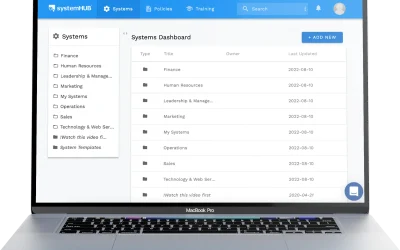
systemHUB gives you the platform, templates, and AI tools to document your business systems in weeks, not months.
How to get started (without the overwhelm)
The biggest mistake is thinking you need to document everything before you see results. You don’t. Here’s a practical starting point.
1. Map your Critical Client Flow
Your Critical Client Flow (CCF) is the journey a client takes from first contact through to delivery and follow-up. Map out the 10 to 15 mission-critical steps. This is your system priority list.
2. Identify the biggest pain point
Look at your CCF. Which step causes the most friction? Where do things break down? Where are you personally most involved? Start there.
3. Find your “knower”
Don’t document the process yourself. Find the person in your team who does it best (the “knower”) and have them walk through it while someone records each step. Imperfect documentation is better than no documentation.
4. Store it somewhere central
A system that lives in a Google Doc nobody can find is barely better than no system at all. Use a dedicated platform like systemHUB to store, organise, and share your business systems in one place.
5. Delegate and improve
Once documented, hand the process off. Let your team follow the system. Collect feedback. Improve the system over time. The first version doesn’t need to be perfect. It just needs to exist.
Common mistakes when systemising your business
Trying to document everything at once. This is the number one reason systemisation projects fail. You get overwhelmed and give up. Start with one process. Get a win. Build momentum.
Writing the systems yourself. As the business owner, you’re probably not the best person to document processes. You’ll either over-complicate them or skip steps you do on autopilot. Let your best team members (the “knowers”) capture the process instead.
Waiting for “perfect.” A good-enough system documented today is worth more than a perfect system that never gets written. You can always improve version two after version one is in use.
Not assigning ownership. Every system needs a champion, someone responsible for keeping it current and making sure the team follows it. Without ownership, systems go stale.
Using scattered tools. When systems live across Google Docs, Notion pages, email threads, and sticky notes, no one can find them. Centralise everything in one place so your team knows exactly where to look.
Frequently asked questions
How much does it cost to systemise a business?
The investment varies depending on your approach. DIY systemisation costs mainly time. A platform like systemHUB starts at $95/month. The real question is: how much is it costing you NOT to systemise? Use the Cost of Chaos Calculator to find out.
How long does business systemisation take?
You can document your first critical system in a single afternoon. A full Critical Client Flow typically takes two to four weeks. Building out all your core systems might take 90 days. The key is starting, not finishing everything at once.
What if my team resists systemisation?
Resistance usually comes from feeling like systems are about control rather than support. Frame it differently: systems give your team clarity, confidence, and the ability to work independently. When team members help create the systems themselves, buy-in follows naturally.
Where should I start with systemisation?
Start by mapping your Critical Client Flow. This gives you a clear picture of the 10 to 15 steps that matter most. Then document the one step causing the most friction. One system at a time.
Is systemisation only for large businesses?
Not at all. Systemisation is actually MORE valuable for small businesses because the owner is usually the biggest bottleneck. A business with 10 to 50 team members is the sweet spot where systems create the most dramatic improvement in owner freedom and business performance.
Can I systemise my business myself, or do I need a consultant?
You can absolutely do it yourself using the SYSTEMology framework. Many business owners start with the book and a platform like systemHUB. For faster implementation, the Champion plan includes guided 90-day sprints with live support.
What’s the difference between systemisation and automation?
Systemisation is documenting how work gets done. Automation is using technology to do parts of it without human involvement. You need to systemise first, then automate. Trying to automate a broken or undocumented process just creates faster chaos.
Stop paying the chaos tax
Every day without systems is another day paying for inefficiency, inconsistency, and missed opportunities. The cost compounds quietly, until it doesn’t.
Gary McMahon was working 110-hour weeks before he systemised. After? An 80% profit increase and his first family holiday in years.
You don’t need to document every process this week. You just need to start with one.
The best time to systemise was five years ago. The second best time is today.
Ready to see what’s possible? Explore systemHUB plans and start building your systems today.