You have a growing list of customers. Why aren’t you emailing them?
There’s a list sitting in your CRM right now. Hundreds, maybe thousands of people who already know your name, have bought from you, or at least raised their hand and said “I’m interested.”
And most business owners never email them. Not consistently. Not strategically. Not at all.
The benefits of email marketing are well-documented. It’s one of the highest-returning channels in existence. Yet it keeps falling off the to-do list because no one has built the system to make it happen. That’s the real problem: email marketing fails when it depends on you remembering to do it.
In this guide, you’ll learn why email marketing still works, the eight specific benefits that make it essential for business owners, and how to turn your email marketing into a system that runs without you.
In this guide:
What is email marketing?
Email marketing is direct communication with people who have given you permission to contact them. Unlike social media, where algorithms decide who sees your content, email lands in someone’s inbox because they chose to hear from you.
It includes newsletters, promotional campaigns, automated sequences, onboarding emails, and follow-ups. The beauty of email is that you own the channel. No platform can take your list away. No algorithm can throttle your reach overnight.
For business owners who already invest in online marketing strategies, email marketing is the backbone that ties everything together. It’s where leads become customers and customers become repeat buyers.
8 key benefits of email marketing
There’s a reason email marketing has survived every new trend, platform, and shiny object that’s come along. Here are the eight benefits of email marketing that matter most for business owners.
1. Highest ROI of any marketing channel
Email marketing consistently delivers the highest return on investment of any digital marketing channel. Industry research puts the average return at $36-42 for every $1 spent. That’s not a typo.
Compare that to paid social advertising, where costs keep rising and returns keep shrinking. With email, the infrastructure cost is low (most platforms start at under $50/month), the audience is already warm, and the conversion rates are dramatically higher than cold traffic.
For small business owners watching every dollar, there is no better place to invest than a channel where your audience has already said yes to hearing from you.
2. You own your audience
Social media followers are rented. Email subscribers are owned.
If Instagram changed its algorithm tomorrow (again), your reach would drop overnight. If Facebook shut down your ad account, your pipeline would dry up. These are real risks that businesses face every day.
Your email list is an asset you control. It sits in your database. Nobody can take it away or throttle your access to it. That’s why building an email list isn’t just a marketing tactic. It’s a business continuity strategy.
3. Automation that works while you sleep
This is where email marketing becomes a true system. With marketing automation software, you can build email sequences that nurture leads, onboard new customers, follow up on purchases, and re-engage inactive subscribers, all without you touching a thing.
A new lead downloads your resource? They get a welcome sequence. A customer buys? They get onboarding emails. Someone hasn’t opened in 90 days? They get a re-engagement campaign.
Set it up once, and it runs. That’s not a dream. That’s what email automation actually does.
4. Personalisation at scale
Email lets you speak to one person at a time, even when you’re speaking to thousands. Modern email platforms let you segment your list by behaviour, purchase history, interest, location, and engagement level.
This means a first-time buyer gets a different message from a long-time customer. Someone who clicked on a specific product sees related offers. A prospect who downloaded a guide gets content that continues that conversation.
Personalisation isn’t about inserting someone’s first name into a subject line. It’s about sending the right message to the right person at the right time. And email does it better than any other channel.
5. Nurtures leads into customers
Most people don’t buy the first time they encounter your business. They need multiple touchpoints before they trust you enough to hand over their money. Email is the best tool for building that trust over time.
A well-structured nurture sequence educates, builds credibility, addresses objections, and gently moves prospects toward a buying decision. It does the selling so you don’t have to chase every lead personally.
This is especially powerful for service-based businesses where the decision-making cycle is longer and the purchase price is higher.
6. Scalable without more staff
Here’s what most business owners miss: email marketing scales without adding headcount. Sending an email to 500 people costs the same as sending it to 50,000. The marginal cost per additional subscriber is essentially zero.
Compare that to hiring more sales reps, running more ads, or adding more customer service staff. Email lets you grow your revenue without growing your team at the same rate. It’s one of the most repeatable processes in any business.
7. Measurable and trackable
Every email you send generates data. Open rates, click-through rates, conversion rates, unsubscribe rates, revenue per email. You know exactly what’s working and what isn’t.
This means you can test subject lines, adjust send times, refine your messaging, and continuously improve. No guessing. No gut feelings. Just data-driven decisions that compound over time.
For business owners who want to make smarter marketing decisions, email gives you the feedback loop that most channels lack.
8. Strengthens customer relationships
Email isn’t just about selling. It’s about staying top of mind. A regular newsletter that provides genuine value keeps your brand in front of customers between purchases.
Share a useful tip. Tell a customer story. Offer an exclusive deal. Ask for feedback. These small touches build loyalty that turns one-time buyers into lifetime customers, and customers into advocates who refer their friends.
The businesses that win long-term are the ones that stay in the conversation. Email is how you do that consistently.
How strong are your business systems?
Take the free Systems Strength Test and find out where your marketing, operations, and team systems stack up.
How to systemise your email marketing
Knowing the benefits of email marketing is one thing. Actually making it happen consistently is another. Most business owners know they should be emailing their list. The problem is that it depends on them finding time, writing content, and hitting send. When things get busy, email is the first thing that drops.
The solution isn’t to try harder. It’s to systemise it. Here’s how the SYSTEMology framework applies to email marketing.
1
Document
Capture your email workflows as step-by-step processes anyone can follow.
2
Delegate
Hand the execution to a team member who follows the documented process.
3
Automate
Use automation to trigger emails based on behaviour, so the system runs itself.
Step 1: Document your email workflows
Start by writing down the email processes that already work. If you send a welcome email to new leads, document the steps: what triggers it, what the email says, when it goes out, and what happens next.
Do the same for your regular newsletter (if you have one), your promotional campaigns, and any follow-up sequences. The goal is to get what’s in your head into a standard operating procedure that someone else can follow.
You don’t need to document everything at once. Start with the email that generates the most revenue or the one that falls apart when you’re busy.
Step 2: Delegate the execution
Once the process is documented, delegate it. A virtual assistant, marketing coordinator, or team member can draft emails, schedule campaigns, and manage your list using the documented steps you’ve created.
The key is that you’re not delegating the strategy. You’re delegating the execution. You decide what topics to cover and what offers to make. Your team handles the writing, formatting, scheduling, and sending.
This is the shift that frees business owners from the daily grind of content creation while keeping the quality and consistency they want.
Step 3: Automate the triggers
The final layer is automation. Set up email sequences that trigger automatically based on subscriber behaviour:
- New subscriber? Welcome sequence fires immediately.
- Purchase made? Onboarding emails begin.
- Cart abandoned? Recovery email goes out within an hour.
- No engagement for 60 days? Re-engagement campaign activates.
These automated sequences work around the clock. They don’t forget, they don’t get busy, and they don’t need reminding. This is email marketing at its most powerful: a system that nurtures relationships and generates revenue while you focus on growing the business.
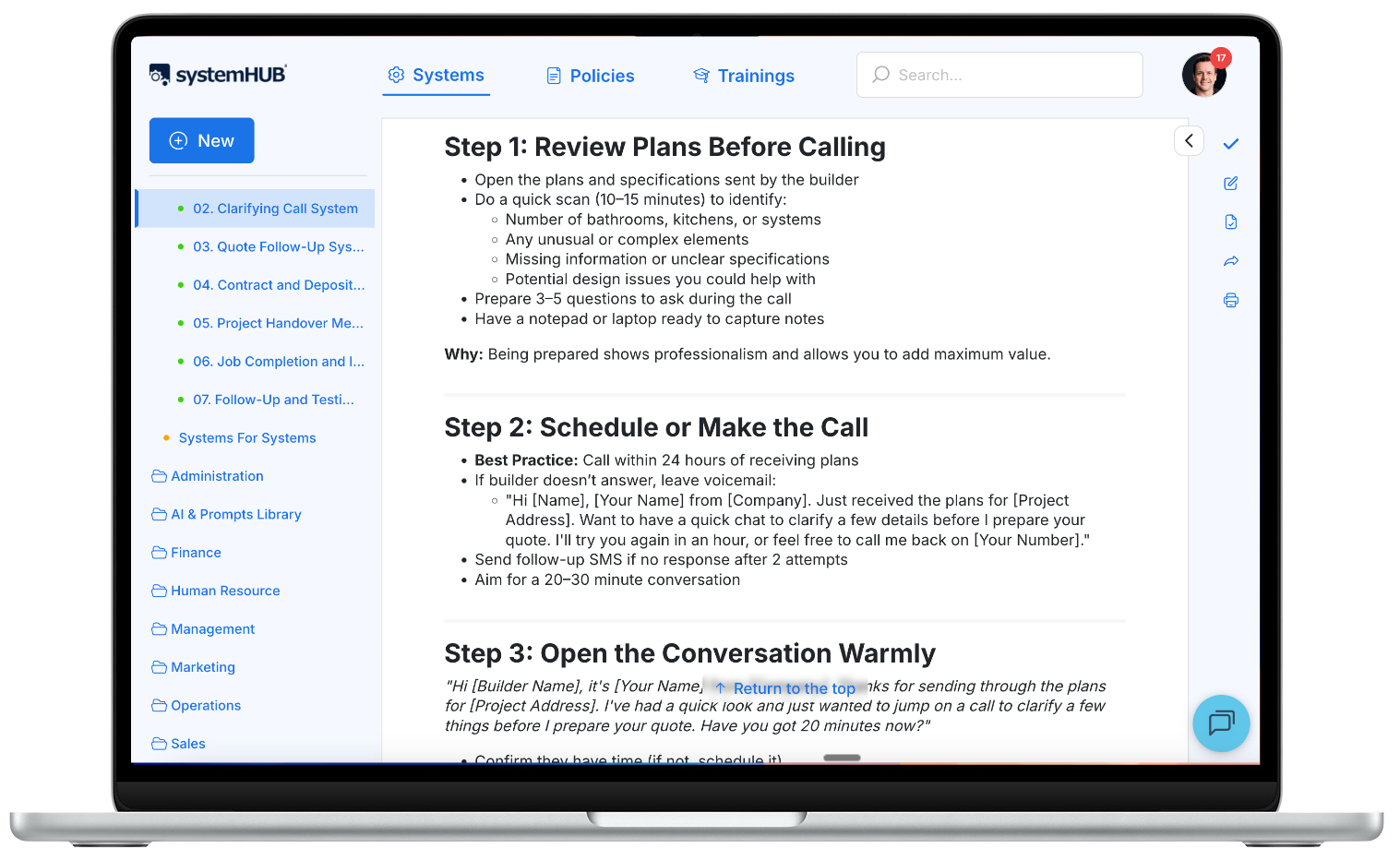
Document your email marketing workflows in systemHUB so your team can run them without you.
Ready to systemise your marketing?
Store your email marketing SOPs, onboarding sequences, and campaign checklists in one place your whole team can access.
Getting started with email marketing systems
If you’re starting from scratch (or starting over), here’s a practical checklist for building your email marketing system. You don’t need to do all of this in a week. Pick one step and start there.
- Choose an email platform (Mailchimp, ActiveCampaign, ConvertKit, or similar)
- Set up a simple opt-in form on your website with a clear value proposition
- Create a 3-5 email welcome sequence for new subscribers
- Document the process for writing and sending a weekly or fortnightly newsletter
- Build one automated sequence (welcome, onboarding, or re-engagement)
- Assign a team member to own the email calendar and execution
- Store your email SOPs in a central location like systemHUB so anyone on your team can follow them
- Review your email metrics monthly and adjust based on what’s working
Tip: Don’t try to build a complex email marketing machine from day one. Start with a simple newsletter and one automated welcome sequence. Get those running consistently before you add complexity. The best processes and procedures start simple and grow over time.
Common email marketing mistakes
Not emailing consistently. Sending three emails one week and then nothing for two months kills trust and deliverability. Pick a frequency you can sustain and stick to it. A fortnightly email sent every fortnight beats a “weekly” email that shows up randomly.
Buying email lists. Never do this. Purchased lists have terrible engagement, damage your sender reputation, and violate most email platform terms of service. Build your list organically with people who actually want to hear from you.
Writing to everyone instead of someone. Generic broadcasts get ignored. Segment your list and speak to specific groups based on their interests, behaviours, and where they are in the buying journey.
Making every email a sales pitch. If all you do is sell, people unsubscribe. Follow the value-first principle: educate, entertain, and inform most of the time. Sell occasionally. A good ratio is 3-4 value emails for every promotional one.
Ignoring your data. Your email platform gives you open rates, click rates, and unsubscribe rates for a reason. If you’re not reviewing this data at least monthly, you’re flying blind. Let the numbers guide your strategy.
Keeping email marketing in the owner’s head. This is the biggest mistake of all. If you’re the only person who knows the email strategy, the templates, and the process, it will never run consistently. Document it. Delegate it. Systemise it.
Frequently asked questions
How much does email marketing cost?
Most email platforms start at $20-50/month for small lists (under 2,000 subscribers). Costs scale with list size. Compared to paid advertising, the ongoing cost is low and the ROI is significantly higher because you’re marketing to people who already know you.
How often should I email my list?
Consistency matters more than frequency. A fortnightly email that goes out every fortnight is better than a daily email that burns out after two weeks. Start with weekly or fortnightly and adjust based on your engagement data and your team’s capacity to produce quality content.
How do I build an email list from scratch?
Offer something valuable in exchange for an email address: a free guide, checklist, calculator, or discount. Place opt-in forms on your website, at checkout, and on your social media profiles. Focus on attracting people who are genuinely interested in what you offer, not just big numbers.
What’s the best email marketing platform for small business?
ActiveCampaign, Mailchimp, and ConvertKit are all solid options. ActiveCampaign offers the strongest automation features. Mailchimp is easy to start with. ConvertKit is popular with content creators. Choose based on your budget, technical comfort level, and automation needs.
Can I automate my email marketing?
Yes, and you should. Start with a welcome sequence for new subscribers and a post-purchase follow-up. As you grow, add re-engagement campaigns, cart abandonment emails, and behaviour-triggered sequences. Automation turns email from a manual task into a system that runs in the background.
When should I start email marketing?
Now. Even if you only have 50 subscribers, start building the habit and the system. Every day you wait is a day your competitors are nurturing your potential customers. The best time to start was a year ago. The second-best time is today.
How do I measure email marketing success?
Track four key metrics: open rate (aim for 20-30%), click-through rate (2-5% is solid), conversion rate (how many clicks become customers), and revenue per email. Review these monthly and use them to guide what you write, when you send, and who you target.
Email marketing works. The only question is whether you’ll build the system to make it happen consistently.
Stop letting email marketing be the thing you’ll “get to eventually.” Document your process, hand it to your team, and let automation do the heavy lifting. Your list is waiting. Start building your email marketing system in systemHUB today.