What if the reason your processes never improve is because you’re waiting for them to be perfect first?
Here’s what I see all the time. A business owner knows their operations are messy. They know things fall through the cracks. They know their team keeps reinventing the wheel on tasks that should be straightforward.
But instead of documenting what they already do and making small improvements from there, they wait. They tell themselves they’ll get around to it once things settle down, or once they find the “right” tool, or once they have a spare week to map everything out properly.
That week never comes. And the processes never improve.
The truth is, business process improvement does not require a Six Sigma certification or a team of consultants. It starts with capturing what your team is already doing, then making it better one step at a time. That is the approach I have used across hundreds of businesses, and it is the foundation of the SYSTEMology framework.
In this guide, I will walk you through exactly how to improve your business processes, step by step, without falling into the perfectionism trap that stops most business owners before they start.
In this guide:
- What is business process improvement?
- Why business process improvement matters for growing businesses
- The SYSTEMology approach to process improvement
- How to improve your business processes: step by step
- Real example: process improvement in action
- Common process improvement mistakes
- Frequently asked questions
What is business process improvement?
Business process improvement (BPI) is the practice of identifying, analysing, and refining the way work gets done inside your business. The goal is straightforward: make your processes more efficient, more consistent, and better at producing the outcomes you want.
But here is the part most definitions leave out. Process improvement is not a one-time project. It is a cycle. You document how things work, you measure the results, you identify what is falling short, and you make targeted changes. Then you measure again.
The simple version:
Business process improvement is about getting your team to do things the best known way, every time, and then finding ways to make that “best known way” even better. It applies to everything from how you onboard new clients to how your team handles invoicing, support tickets, or marketing campaigns.
You do not need to be a large enterprise to benefit from BPI. In fact, small and mid-sized businesses often see the biggest gains because there is so much low-hanging fruit. When you have never documented a process before, simply getting it written down and followed consistently can transform your results overnight.
The key distinction is this: process improvement is not about adding complexity. It is about removing friction, eliminating waste, and helping your team deliver consistent quality without needing you to oversee every step. That is where it connects directly to building solid processes and procedures across your business.
Why business process improvement matters for growing businesses
If your business is growing, your processes are under pressure. What worked when you had five team members does not hold up when you have fifteen. The systems that got you here will not get you there. Here is why improving your business processes should be a priority.
1. Consistency drives quality and client trust
When every team member follows the same process, your clients get a consistent experience. No more situations where one team member handles onboarding brilliantly and another drops the ball. Consistency is what separates professional operations from businesses that feel like they are constantly winging it.
As I wrote in SYSTEMology, some of the biggest and quickest gains come from uncovering who on the team does a particular task best, documenting their approach, and then getting everyone else to follow that same method. You are not reinventing anything. You are just spreading what already works.
2. You free up time to work on the business
Every process that relies on you personally is a chain keeping you stuck in the daily grind. When you improve and document a process so that someone else can own it, you buy back your time. That time goes straight into strategy, growth, and the high-value work only you can do.
This is the core promise of systemising your business: building an operation that runs without your constant involvement.
3. Onboarding becomes faster and cheaper
When your processes are documented and continuously improved, bringing on a new team member goes from a months-long headache to a structured, predictable experience. They have clear standard operating procedures to follow. They know what “good” looks like. They can get productive in days rather than weeks.
4. Small improvements compound into big profit gains
This is one of the most powerful concepts I share with business owners. You do not need a massive overhaul. A 10% improvement in each of your key business metrics does not produce a 10% increase in profit. It compounds.
When you improve your lead flow by 10%, your conversion rate by 10%, your average transaction value by 10%, your repeat purchase rate by 10%, and your margins by 10%, those gains multiply across each other. The result? An increase in bottom-line profit of close to 80%.
That is the power of focused, incremental process improvement across your entire business.
5. Your business becomes sellable
A business that depends on its owner is not really a business. It is a job with overhead. When your processes are documented, improved, and running without you, a potential buyer sees a machine they can take over. That is what makes your business attractive to investors and acquirers.
What is poor process costing your business?
Use our free Cost of Chaos Calculator to see the real dollar impact of broken or missing processes in your business.
In this short video, I explain why business process improvement is so critical to your company’s growth and how to start thinking about it the right way.
The SYSTEMology approach to process improvement
Most business process improvement methodologies tell you to start by mapping your ideal process, building flowcharts, and then optimising everything from the top down. That sounds logical. But it almost never works for small and mid-sized businesses.
Why? Because perfectionism kills progress. Business owners get stuck trying to design the “perfect” process on paper before they have even captured what their team is currently doing. The result is that nothing gets documented, nothing gets improved, and the owner stays trapped doing everything themselves.
The SYSTEMology approach flips this on its head. We follow three stages, in this specific order:
1
Document
Capture how things are done right now. Don’t aim for perfect. Get version one on paper.
2
Delegate
Hand the process to a team member. Let them run it and test whether the documentation holds up.
3
Optimise
Now that you have a baseline, measure results and make targeted improvements.
The order matters. You cannot optimise what you have not documented. You cannot measure what nobody is following consistently. And you definitely cannot delegate a process that only lives inside your head.
Key principle: Your first version of any process is almost always the worst it will ever be. And that is completely fine. Every iteration improves the system and the results. The Kaizen philosophy of constant and never-ending improvement is embedded deeply in the SYSTEMology method.
Think about McDonald’s. Their system was far from perfect when they started. It took years of optimisation to reach near perfection. But they started by capturing what worked, not by designing the ideal system from scratch. The lesson for your business? Start where you are, not where you want to be.

The old way: everything runs through the owner.

The SYSTEMology way: your team runs the systems, you run the business.
How to improve your business processes: step by step
Here is the practical, step-by-step process improvement method I teach business owners. These are the same process improvement steps we use inside SYSTEMology, adapted for any business at any stage.
1. Identify your Critical Client Flow
Before you try to improve everything, focus on the processes that matter most. In SYSTEMology, we call this your Critical Client Flow (CCF). It is the end-to-end journey a client takes through your business, from first contact to delivery and follow-up.
Map out the 10 to 15 key steps in this flow. These are the processes where a breakdown causes the most damage, and where an improvement creates the most value. This is your starting point.
Trying to improve every process at once is a recipe for overwhelm. The CCF gives you a focused roadmap so you know exactly where to begin.
2. Capture how things are done right now
This is where most business owners get stuck. They want to design the ideal process before writing anything down. Resist that urge.
Instead, identify the person on your team who does the task best and get them to record themselves doing it. A simple screen recording or a quick walkthrough captured on video is enough. You are not looking for perfection. You are looking for version one.
As I always say, you should stress the point that you are not looking to have this system “perfect” or fully optimised. While it is okay to make minor tweaks, avoid trying to completely re-engineer things. Optimising comes later.
3. Assign a systems champion to own the documentation
A systems champion is someone on your team who takes ownership of turning that raw recording into a proper standard operating procedure. Most people, if they have a choice, much prefer to edit something that already exists rather than create from a blank page.
That is why you record first and write second. The systems champion watches the recording, writes up the steps, and then sends it back to the knowledgeable worker to review. This keeps the process moving without burdening your best people with documentation work they do not enjoy.
4. Delegate the process and test it
Now hand the documented process to someone who has not done the task before. Have them follow the steps. Where do they get stuck? What is unclear? What did the documentation miss?
This testing step is critical. It reveals gaps you would never spot by reading the document yourself. Each time a tester stumbles, it is an opportunity to improve the system. Repeat this until the tester can complete the task to a reasonable standard without intervention.
Every new hire is also an opportunity to review related processes. Fresh eyes will often reveal improvements that experienced team members have stopped noticing.
5. Measure the results
You cannot improve what you do not measure. Before you start tweaking processes, you need a baseline. Create a simple dashboard that tracks the key metrics from your Critical Client Flow.
What is your conversion rate at each step? How long does each stage take? Where are the bottlenecks? Where are things falling through the cracks?
A dashboard does not need to be complicated. A spreadsheet with your key numbers, updated weekly, gives you the visibility you need to make informed decisions about which processes to improve next.
6. Spot the problems and prioritise
With your dashboard in place, problems become visible. Maybe your proposal-to-close rate is lower than expected. Maybe client onboarding takes twice as long as it should. Maybe your team is spending hours on a task that could be done in minutes with a better process.
List the problems. Then prioritise them based on impact. Which process improvement would create the biggest result for your clients, your team, or your bottom line? Start there.
The SYSTEMology approach is to use your regular team meetings to address these items. Add “systems review” as a standing agenda item so problems get surfaced, discussed, and assigned for resolution on a consistent rhythm.
7. Make targeted improvements and re-test
Now you improve. But notice the word “targeted.” You are not overhauling everything at once. You are making a specific change to a specific process based on a specific problem you identified through measurement.
Make the change. Update the documentation. Have your team follow the updated process. Measure the results again. Did the numbers improve? If yes, great. Lock it in and move to the next problem. If not, adjust and try again.
This cycle of measure, identify, improve, and re-measure is what turns repeatable processes into a genuine competitive advantage. It is continuous improvement in action.
Ready to document and improve your processes?
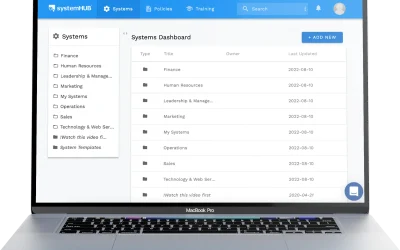
systemHUB gives your team one place to store, follow, and continuously improve every process in your business. Includes 100+ SOP templates to get you started fast.
Real example: process improvement in action
Let me give you a concrete example of how this works in practice. This is a real scenario from my own business.
Invoicing process: from constant chasing to on-time payments
The problem: We noticed through our dashboard that a significant number of clients were paying late. Some were three or even four months overdue. Our team was spending hours every week sending follow-up emails and chasing payments manually.
The investigation: We looked at our existing invoicing process. The system was: send an invoice, wait, send a reminder, wait some more, then call or send a personal email. The automated reminder emails were largely being ignored.
The improvement: Rather than just tweaking the reminder emails, we looked at the root cause. We decided to shift to automatic billing. New clients would be set up on auto-billing from the start. Existing clients who were late with a payment would be transitioned to auto-billing going forward.
The result: We had some initial pushback, but far less than we feared. Payments went from being months late to being collected on time, every time. Our team reclaimed the hours they had been spending on manual follow-ups.
The lesson: The improvement did not come from perfecting the old process. It came from measuring the results, identifying the real problem, and making a targeted change. This is what business process improvement looks like when you follow the SYSTEMology approach: document it, measure it, then improve the part that actually matters.
You can see business process diagrams and visual mapping tools that help illustrate these kinds of workflow changes for your team.
Common process improvement mistakes
After working with hundreds of businesses on their systems, I see the same mistakes come up over and over. Avoid these and you will be ahead of most.
Trying to perfect before documenting. This is the number one killer. Business owners want their processes to be “right” before they write them down. But you cannot improve a process that does not exist on paper. Get version one done. It will not be pretty. It does not need to be. Every iteration makes it better.
Improving everything at once. When you finally decide to fix your processes, the temptation is to tackle everything simultaneously. This leads to burnout and half-finished projects everywhere. Focus on your Critical Client Flow first. Get those core processes solid before expanding outward.
Over-engineering with flowcharts too early. I see this all the time when people read a book on Six Sigma. They think every process must first be mapped in a detailed flowchart before it can be improved. For small businesses, this is overkill. Save the flowcharts until after your system has been running for a while and you have been through the optimisation stage. Otherwise, you create beautiful diagrams that are out of date within a week.
Skipping measurement. You cannot improve what you do not measure. Without a baseline, you have no way of knowing whether your changes actually made things better or worse. A simple dashboard with your key numbers, updated weekly, is all you need.
Blaming people instead of systems. When something goes wrong, the instinct is to blame the person. But if everyone is following the documented process and the outcome is still poor, the problem is the system, not the individual. Focus on improving the flaw in the system rather than blaming your team. This creates a culture where people feel safe flagging issues, which is exactly what you need for continuous improvement to work.
Frequently asked questions
What is business process improvement?
Business process improvement (BPI) is the practice of analysing and refining the way work gets done in your business. The goal is to make processes more efficient, more consistent, and better at producing the results you want. It is an ongoing cycle of documenting, measuring, identifying problems, and making targeted changes.
What are the main steps of business process improvement?
The core process improvement steps are: identify which processes matter most (your Critical Client Flow), capture how things are currently done, delegate and test the documented process, measure results with a dashboard, spot problems and prioritise them, then make targeted improvements and re-test. The key is starting with documentation before attempting any optimisation.
What is the difference between BPI and BPM?
Business process improvement (BPI) focuses on making existing processes better. Business process management (BPM) is the broader discipline of designing, executing, monitoring, and optimising business processes as an ongoing practice. Think of BPI as one activity within the larger BPM framework. BPM is the ongoing management system; BPI is the act of making specific improvements.
How often should you review business processes?
At a minimum, review your critical processes quarterly. But ideally, process review becomes part of your weekly team rhythm. Add a “systems review” item to your regular meeting agenda so your team can surface issues, suggest improvements, and keep your processes evolving. New hires also present a natural opportunity to review every process related to their role.
Do I need special software for process improvement?
You do not need expensive enterprise software. What you do need is a central place to store your documented processes so your team can find and follow them. A dedicated platform like systemHUB makes this much easier than scattered Google Docs or shared drives, but the most important thing is to start documenting, regardless of the tool.
What is continuous improvement in business?
Continuous improvement (also called Kaizen) is the philosophy that no process is ever “finished.” There is always room to make things a little better, a little faster, or a little more efficient. In the SYSTEMology framework, this mindset is baked in from the start. You capture version one knowing it will be improved over time. The goal is progress, not perfection.
How does business process improvement relate to SOPs?
Standard operating procedures (SOPs) are the documented version of your processes. They are the foundation that makes improvement possible. Without an SOP, you have nothing to measure, nothing to test, and nothing to improve. BPI is what happens after you have documented your processes: you analyse, refine, and update those SOPs based on real results.
Can small businesses benefit from business process improvement?
Absolutely. Small businesses often see the most dramatic results from process improvement because there is so much untapped potential. Most small businesses have never documented their processes at all, so simply capturing how things are done and getting the team following a consistent method can transform results overnight. You do not need a Six Sigma team or a dedicated process department. You just need to start documenting, delegating, and improving one process at a time.
Stop waiting for perfect. Document what your team does today, delegate it, measure the results, and improve from there. That is how real business process improvement works.
If you want a structured framework to make this happen across your entire business, the SYSTEMology book walks you through the complete seven-stage process. And when you are ready to give your team a central place to store, follow, and improve every process, check out systemHUB.