You hired someone great. Two weeks later, they’re lost, frustrated, and already wondering if they made a mistake.
Sound familiar? It’s one of the most common stories I hear from business owners. You spend weeks finding the right person. You’re excited. They’re excited. Then day one arrives and it all falls apart. There’s no plan. No structure. Just a vague “shadow me for a while and you’ll pick it up.”
The problem isn’t the person you hired. It’s the lack of a system to bring them in.
Employee onboarding is one of the most overlooked systems in small and medium businesses. Get it right and new hires become productive fast, stay longer, and fit your culture from the start. Get it wrong and you’re back to square one, posting another job ad, three months from now.
I’ve seen this play out hundreds of times across the businesses I’ve worked with through SYSTEMology. The ones that crack onboarding don’t just reduce turnover. They build teams that actually run the business without the owner holding everyone’s hand.
This guide will walk you through what employee onboarding really means, why it matters more than most owners realise, and the practical steps to build an onboarding system that scales with your team.
In this guide:
What is employee onboarding?
Employee onboarding is the structured process of integrating a new hire into your business. It covers everything from their first day through to the point where they can perform their role confidently and independently.
Most business owners confuse onboarding with orientation. Orientation is a single event: fill out the paperwork, get a tour of the office, meet the team. It might take a morning. Employee onboarding is different. It’s a system that unfolds over days, weeks, or even months. It includes training on tools, introduction to processes, understanding the company culture, and gradually building competence in the role.
Think of it this way. Orientation tells someone where the bathroom is. Onboarding teaches them how the business works and where they fit inside it.
In the SYSTEMology framework, the onboarding system is one of two human resources systems that every business should engineer deliberately, alongside recruitment. These aren’t systems you can afford to leave to chance because they directly shape who joins your team and how well they perform.
Key distinction: Orientation is a one-time event. Employee onboarding is an ongoing system. The businesses that get onboarding right treat it as a documented, repeatable process that improves with every new hire.
Why employee onboarding matters
If you’ve ever hired someone who seemed perfect in the interview but struggled in the role, the issue probably wasn’t the hire. It was the onboarding. Here are five reasons employee onboarding deserves more attention than most business owners give it.
1. Without a system, every new hire learns differently
When there’s no documented onboarding process, each new team member gets a different experience. One person learns from you. The next learns from a senior team member who does things slightly differently. The third picks it up on the fly. The result is inconsistency across your team. People develop different habits, follow different shortcuts, and produce different quality levels.
A documented employee onboarding system solves this. Every new hire follows the same path, learns the same standard operating procedures, and reaches the same baseline of competence. Consistency in onboarding creates consistency in performance.
2. Documented systems cut ramp-up time
How long does it take a new hire to become fully productive in your business? For most small businesses without systems, the answer is three to six months. Sometimes longer. That’s three to six months of reduced output, constant questions, and someone else’s time being consumed by training.
When your onboarding process includes documented systems for the role, new hires have a clear reference to follow. They don’t need to interrupt a colleague every time they’re unsure. They check the procedure. This dramatically reduces the time it takes to get someone up to speed. In the SYSTEMology approach, we use the Critical Client Flow to show new hires exactly how the business works from end to end, so they understand not just their tasks, but how those tasks connect to the bigger picture.
3. People leave when they feel lost, not when the work is hard
Turnover in the first 90 days is one of the most expensive problems a growing business can face. And the number one reason new hires leave early isn’t the difficulty of the work. It’s feeling unsupported, confused, and unclear on expectations.
A structured employee onboarding process directly addresses this. When someone knows what’s expected of them, who to go to for help, and how the business operates, they feel confident. Confident employees stay. Uncertain ones start updating their resume.
4. You can’t personally train every new team member forever
If you’re the one who onboards every new hire, congratulations: you’ve created another bottleneck. Right now, maybe it’s manageable because you only hire a few people a year. But what happens when you need to bring on five people in a quarter? Or ten?
The whole point of systemising your business is to remove yourself from the day-to-day. That includes training. When onboarding is a documented system, anyone on your team can facilitate it. You don’t need to be in the room.
5. Onboarding is where you build a systems-thinking culture
Here’s something most business owners miss. Employee onboarding isn’t just about getting a new hire up to speed on their tasks. It’s your first opportunity to show them how your business operates. If you want a team that thinks in systems, you need to demonstrate that from the very first day.
In SYSTEMology, I recommend giving every new team member visibility of the business’s documented systems from the start. Show them the Critical Client Flow. Walk them through the department structure. Let them see that “this is how we do things here.” New hires who start in a systems-centred environment adopt that mindset naturally. Existing team members who’ve been around for years are often the harder ones to convert.

The old way: the owner trains each new hire personally, creating inconsistency and a bottleneck.

The SYSTEMology way: a documented onboarding system your team delivers consistently.
Want ready-made templates to build your onboarding system?
Download free SOP templates you can customise for onboarding, training, and every other process in your business.
What to include in your employee onboarding process
A common question I get from business owners is: “What should onboarding actually cover?” The answer depends on your business, but there are core elements that apply to almost every organisation. Here’s what I recommend based on the SYSTEMology framework.
1. Welcome video from the founder
Start with a short video from you, the business owner. Share the company history, your values, and the vision for where the business is heading. This doesn’t need to be polished. In fact, a genuine, conversational video is more effective than a corporate production. The goal is to make the new hire feel welcomed and connected to the purpose behind the work.
2. Core tools and software training
Every business has a stack of tools that team members need to use daily. Email, project management software, your systems management platform, communication tools. Don’t assume new hires will figure these out on their own. Create short walkthroughs or screen recordings for each tool. Better yet, have your procedures documented so new team members can follow them at their own pace.
3. The Critical Client Flow overview
This is one of the most powerful onboarding steps you can take. Show the new hire your Critical Client Flow (CCF): the end-to-end journey your clients take through your business. Walk them through each stage, from initial enquiry through to delivery and referral. Then show them exactly where their role fits within that flow.
When someone understands the whole picture, they make better decisions in their specific part. They stop working in a silo because they can see how their tasks connect to the client experience.
4. Role-specific system review
This is where you hand over the documented SOPs for their position. Every task they’ll be responsible for should have a corresponding procedure they can reference. If those systems don’t exist yet, that’s a signal that you need to prioritise building them. In SYSTEMology, we call the person who holds the knowledge for a particular task the “knowledgeable worker.” Your onboarding system should direct new hires to the documented versions of that knowledge.
5. Daily routine and expectations
Spell out what a typical day looks like. What time do they start? What recurring meetings should they attend? How should they prioritise their work? What does “done” look like? These details seem obvious to you because you’ve been living them for years. To a new hire, they’re invisible until someone makes them explicit.
6. Forms and compliance
Get the administrative pieces handled early. Tax forms, contracts, confidentiality agreements, emergency contacts, equipment allocation. Build a simple onboarding checklist that ensures nothing gets missed.
7. Team introductions and culture
Introduce the new hire to the wider team. Not just their direct colleagues, but people across the business. Help them understand who does what and who to go to for different types of questions. If you have a team handbook or company values document, this is when you share it. The goal is to help them feel like they belong before the end of week one.
Example: First-week onboarding for a new operations coordinator
Trigger: New team member’s start date is confirmed.
- Send welcome email with link to founder video, team handbook, and first-day instructions
- Day 1 morning: Office tour, introductions, set up email and core software accounts
- Day 1 afternoon: Walk through the Critical Client Flow and explain where the role fits
- Day 2: Review role-specific SOPs with their direct manager. New hire reads and asks questions
- Day 3: Shadow a team member performing the key tasks for the role
- Day 4: New hire attempts the key tasks independently with the SOP as a guide
- Day 5: Check-in meeting. Review the week, answer questions, gather feedback on what was unclear
Endpoint: New hire can perform core tasks independently using documented procedures. Feedback captured for onboarding system improvements.
How to build an employee onboarding system
If you don’t currently have a documented onboarding process, don’t overthink the starting point. The SYSTEMology approach to building any system follows the same pattern. Here’s how it applies to employee onboarding.
1
Identify
Find the knowledgeable worker who currently onboards new hires best.
2
Extract
Have your systems champion document the process step by step.
3
Test & refine
Use it with the next hire, gather feedback, and improve.
Step 1: Identify the knowledgeable worker
In every business, there’s someone who is naturally good at bringing new people up to speed. Maybe it’s a department head. Maybe it’s a long-tenured team member who always ends up mentoring new starters. That person is your “knowledgeable worker” for the onboarding system.
Your job isn’t to create the onboarding process yourself. It’s to identify who already does it well and capture what they do. This is one of the core principles in SYSTEMology: the person who holds the knowledge (the knowledgeable worker) shares it, and someone else (the systems champion) documents it.
Step 2: Extract and document the process
Once you’ve identified who holds the onboarding knowledge, have your systems champion sit with them and record the process. This can be as simple as watching them onboard the next new hire and writing down every step. Don’t try to make it perfect. The first version of any system is almost always the worst it will ever be, and that’s completely fine.
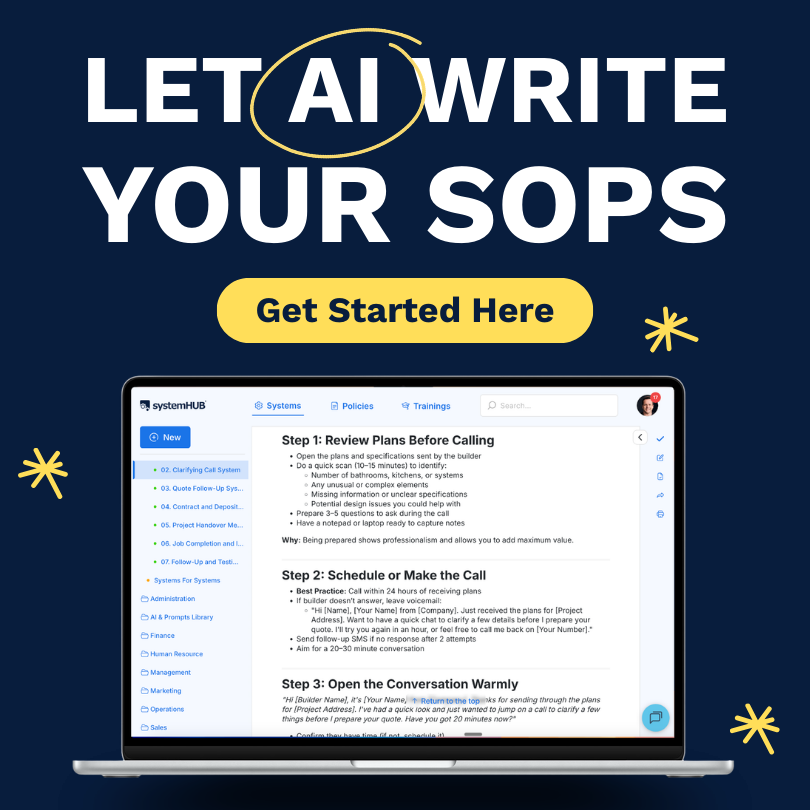
Document the major steps in plain language. Who does what, in what order, and what resources are needed? Store the finished document in a central, accessible location so your whole team can reference and follow it. A tool like systemHUB makes this easy because you can organise your onboarding system alongside every other business process.
Step 3: Test with the next hire and refine
The real test of any system is whether someone can follow it without the original knowledgeable worker standing over their shoulder. The next time you bring on a new team member, run them through the documented onboarding process. Then ask them: what was clear? What was confusing? What was missing?
Every new hire is an opportunity to improve the system. Fresh eyes will reveal gaps that people who’ve been with the business for years simply can’t see. In SYSTEMology, we treat this as an ongoing cycle. Each iteration makes the system better. Each new hire makes the onboarding smoother for the person after them.
Tip: View every new hire as a system reviewer. A fresh pair of eyes will often reveal opportunities to improve and streamline things that your existing team has simply gotten used to.
One important note: unlike most business systems where you document what you’re currently doing, onboarding and recruitment are the two exceptions in SYSTEMology where you may need to engineer something new. These systems are your new team members’ first experience with your business. It’s worth investing the effort to get them right, even if it means building from scratch rather than capturing existing practice.
Store your onboarding systems where your team can find them
systemHUB gives you a central place to organise SOPs, assign systems to roles, and onboard new hires with confidence.
Common employee onboarding mistakes
Most small businesses don’t have a bad onboarding process. They have no process at all. But even businesses that try to onboard properly fall into a few common traps.
No documented process. Every manager does it differently. One person gives a thorough walkthrough. Another sends the new hire a few links and says “have a read.” Without a documented system, you’re relying on whoever happens to be available that day. That’s not onboarding. That’s luck.
Information overload on day one. Dumping everything on a new hire in their first eight hours is a guaranteed way to overwhelm them. They’ll forget 80% of it by the next morning. Space the onboarding out over the first week or two. Let people absorb information in manageable pieces and put it into practice before moving on.
Skipping the culture piece. Some businesses focus exclusively on tasks and tools during onboarding and completely skip the “why.” Your company values, the way your team communicates, the expectations around quality. These things matter more than any individual procedure because they shape how someone approaches every part of their work.
The owner does all the training. If you’re personally responsible for training every new hire, you’ve created a bottleneck. This doesn’t scale, and it means onboarding only happens when your calendar allows it. Build the system, document it, and let your team deliver it. That’s the whole point of onboarding best practices.
No feedback loop. If you never ask new hires what was unclear, confusing, or missing from their onboarding experience, the system never improves. Build a simple check-in at the end of week one and month one. The insights you get will make your employee onboarding process better for every hire that follows.
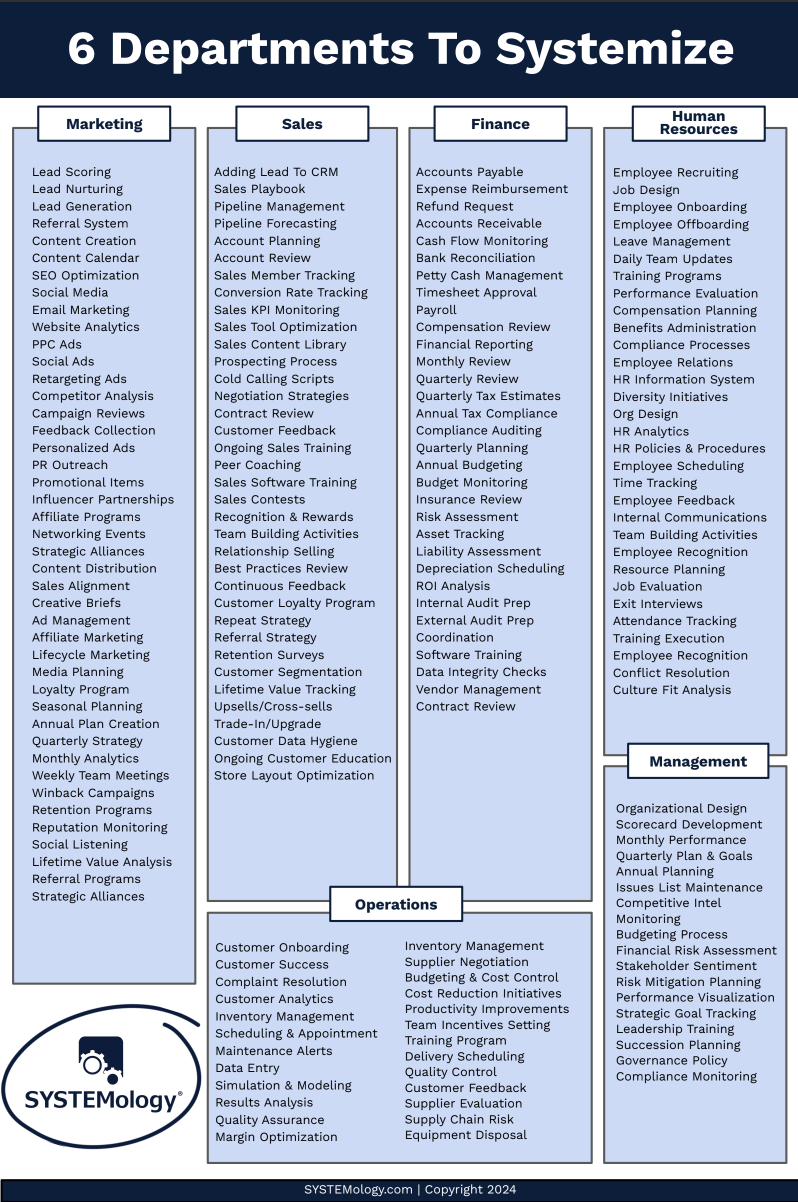
Employee onboarding sits within the HR department. In SYSTEMology, all six departments need documented systems to remove owner dependency.
Frequently asked questions
What is employee onboarding?
Employee onboarding is the structured process of integrating a new hire into your business. It goes beyond first-day orientation to include training on tools and software, introduction to company culture and values, review of role-specific standard operating procedures, and ongoing support until the new team member can perform their role independently.
How long should employee onboarding last?
A thorough employee onboarding process typically runs for 30 to 90 days, depending on the complexity of the role. The first week should cover the essentials: tools, team introductions, and core procedures. The following weeks should focus on role-specific training, shadowing, and gradually increasing independence. Don’t try to compress everything into day one.
What’s the difference between onboarding and orientation?
Orientation is a one-time event that usually covers logistics: paperwork, office tour, introductions. Employee onboarding is a longer, structured process that includes training, culture integration, system reviews, and ongoing check-ins. Orientation is a single step within the broader onboarding system.
Who should be responsible for onboarding new hires?
Ideally, not the business owner alone. In SYSTEMology, we recommend having a documented onboarding system that any team member can facilitate. The direct manager typically leads it, but the process should be standardised so the quality doesn’t depend on who’s delivering it. A systems champion can help build and maintain the onboarding documentation.
How do you onboard remote employees?
Remote onboarding follows the same principles as in-person onboarding, but documentation becomes even more critical. Use screen recordings, video walkthroughs, and written SOPs that a remote team member can follow independently. Schedule regular video check-ins during the first few weeks. Tools like systemHUB are especially valuable for remote teams because every procedure lives in one accessible location.
What should an employee onboarding checklist include?
At minimum, your onboarding checklist should include: a welcome message and company overview, tool and software setup, core process documentation for the role, team introductions, daily routine and expectations, compliance forms, a Critical Client Flow overview showing where the role fits, and scheduled check-ins at the end of week one and month one.
How do documented systems improve employee onboarding?
Documented systems are the foundation of effective onboarding. When every task has a written procedure, new hires have a reference they can follow without constantly interrupting colleagues. This reduces training time, improves consistency, and gives new team members the confidence to work independently. In SYSTEMology, we recommend getting your team to love systems by demonstrating their value from day one of the onboarding experience.
Your onboarding system is your first chance to show new hires how your business really runs. Make it count.
The businesses that hire and retain A-players don’t leave onboarding to chance. They build a system, document it, and improve it with every new team member. That’s how you go from personally training every hire to having a team that brings new people up to speed without you.
Ready to build the onboarding system your business deserves? See how systemHUB can help.