What if every new hire could be productive in half the time, without you personally training them?
If you’re like most business owners I work with, onboarding a new team member looks something like this: you spend the first week glued to their side, answering the same questions you answered for the last hire. You show them where things are, explain how things work, and hope they remember most of it. By week two, you’re back to firefighting your own workload. And the new person? They’re guessing.
It doesn’t have to be that way.
A well-built employee onboarding checklist is the simplest system you can create, and one of the most powerful. It takes the knowledge out of your head, puts it into a repeatable sequence, and gives every new hire the same strong start. No matter who’s doing the training. No matter how busy you are.
In this guide, I’ll walk you through a complete onboarding checklist broken into four phases, from pre-arrival through month one. I’ll also share the approach I teach in SYSTEMology for building onboarding systems that your team can run without you.
In this guide:
- What is an employee onboarding checklist?
- Why your onboarding checklist matters more than you think
- The complete employee onboarding checklist (4 phases)
- How to build an onboarding checklist your team will follow
- Real examples of onboarding systems that work
- Common mistakes with employee onboarding checklists
- Frequently asked questions
What is an employee onboarding checklist?
An employee onboarding checklist is a step-by-step list of everything that needs to happen when a new team member joins your business. It covers the practical tasks (setting up their email, ordering equipment), the cultural pieces (introducing company values, explaining how things work), and the role-specific training that gets them contributing as quickly as possible.
Think of it as the simplest form of a standard operating procedure. It’s not a 50-page training manual. It’s a clear, ordered sequence of steps that anyone on your team can follow to welcome a new hire the right way, every time.
An onboarding checklist answers three questions:
What needs to happen before, during, and after someone’s first days? Who is responsible for each step? When does each step need to be completed? Without these three elements, you just have a wish list. With them, you have a system.
The difference between a checklist and “just showing them around” is consistency. When everything lives in your head, the onboarding experience depends entirely on how much time you have that day, how well you remember all the steps, and whether you get pulled into an urgent call halfway through. A documented checklist removes that variability.
Why your employee onboarding checklist matters more than you think
Most business owners treat onboarding as something to “get through” so the new person can start doing real work. But the first few weeks set the tone for everything that follows. Here’s why investing time in your onboarding checklist pays off far beyond day one.
1. It cuts time-to-productivity in half
Without a structured onboarding checklist, new hires spend their first weeks figuring things out through trial and error. They ask the same questions to different people and get different answers. A clear checklist gives them the right information in the right order so they can start contributing faster.
2. It frees the owner from personally training every hire
This is the big one. If you’re the only person who can train new team members, you’ve created a bottleneck that limits how fast you can grow. Every new hire costs you a week (or more) of your own time. An onboarding checklist lets any team member handle the training. You don’t need to be in the room.
As I explain in SYSTEMology, hiring, onboarding, and managing your team are among the most important areas of business to get right because they directly impact who you hire and how well they fit within your company. Onboarding is one of the two HR systems I specifically recommend engineering early, even before you’ve finished documenting your other processes.
3. It creates consistency across every hire
When onboarding is ad hoc, each new team member gets a different experience. One person gets a thorough introduction. The next gets a rushed overview because you were busy that week. A checklist ensures every hire receives the same foundation, the same values conversation, and the same training on your core tools and processes.
4. It reduces early turnover
Research consistently shows that a poor onboarding experience is one of the top reasons employees leave within their first year. People who feel confused, unsupported, or left to “figure it out” start questioning whether they made the right choice. A structured onboarding process makes them feel welcome, informed, and confident they’re in the right place.
5. It builds a systems-thinking culture from day one
When the first thing a new hire experiences is a well-organised, documented onboarding process, you’re sending a clear message: “This is how we do things here.” They see from day one that your business runs on systems, not chaos. This makes it far easier to get them following your other documented procedures as they settle into their role.
From SYSTEMology: “A-players love to know what’s expected of them and how they can succeed in a role. This is why it’s so important to get your core systems documented and set the standards early. Establish, right from the start, ‘This is the way we do things here,’ and you’ll be well on your way.”

The old way: every new hire depends on the owner for training.

The SYSTEMology way: your team runs the onboarding, you run the business.
Need templates to build your onboarding system?
Download 100+ ready-made process templates, including onboarding, HR, and operations checklists you can customise for your business.
The complete employee onboarding checklist (4 phases)
The most effective onboarding checklists break the process into phases. Trying to cram everything into day one overwhelms new hires and sets them up to fail. Instead, spread the process across four clear stages: pre-arrival, day one, week one, and month one.
Here’s a practical checklist you can adapt for your business. Every item has a clear action and an implied owner, so nothing falls through the cracks.
Phase 1: Pre-arrival checklist (before day 1)
These tasks happen before the new hire walks through the door. The goal is to make sure everything is ready so their first day feels organised and welcoming, not chaotic.
- Send offer letter and employment contract for signature
- Collect completed tax, superannuation, and banking forms
- Set up email account, system logins, and software access
- Order equipment (laptop, phone, uniform, tools, keys)
- Prepare their workspace or workstation
- Add them to relevant communication channels (Slack, Teams, email groups)
- Send a welcome email with start date, time, location, dress code, and first-day agenda
- Notify the team about the new hire (name, role, start date)
- Assign a buddy or mentor for the first week
- Print or share any required reading (employee handbook, company values)
Owner: Office manager or HR lead. Complete at least 3 business days before the start date.
Phase 2: Day 1 checklist (first impressions)
Day one sets the emotional tone. The new hire is deciding whether they made the right choice. Make them feel expected, valued, and clear on what happens next.
- Welcome them personally and introduce them to the team
- Give a tour of the office, warehouse, or worksite (including safety essentials)
- Walk through IT setup: confirm email, logins, and system access all work
- Share the founder’s welcome video or personal message (company history, mission, and values)
- Review the employee handbook and answer questions
- Explain the company’s approach to systems: “This is how we do things here”
- Introduce them to systemHUB (or your systems management platform) and show them where to find documented processes
- Walk through day-to-day logistics: hours, breaks, parking, kitchen, supplies
- Set expectations for week one: what they’ll learn, who they’ll meet, and what success looks like
- Schedule a 15-minute check-in at the end of the day
Owner: Direct manager or assigned buddy. The end-of-day check-in catches any confusion early.
Phase 3: Week 1 checklist (building foundations)
The first week is about getting the new hire comfortable with your tools, your people, and your way of working. Don’t rush role-specific training. Focus on foundations first.
- Train on core tools and software: email, project management (Asana, Monday, etc.), systems management platform
- Explain the Critical Client Flow (CCF) and where the new hire’s role fits within the business
- Review the 3-5 core systems relevant to their role (in your systems management platform)
- Introduce them to key people they’ll work with across departments
- Share their daily routine and recurring responsibilities
- Walk through how to find answers: where systems are stored, who to ask, how to flag issues
- Complete any required compliance or safety training
- Have them shadow a knowledgeable worker performing a key task
- Schedule a formal week-one review with their direct manager
Owner: Direct manager, with support from the assigned buddy. The week-one review checks understanding and addresses gaps.
Phase 4: Month 1 checklist (integration and independence)
By the end of month one, the new hire should be completing tasks independently and following your documented systems. This phase transitions them from learning to doing.
- Assign their first independent tasks with clear deadlines and quality standards
- Have them complete a key process using the documented system (without hand-holding)
- Review their work against the system’s quality standards and provide feedback
- Encourage them to flag any gaps, confusions, or improvement ideas in the documented systems
- Complete all remaining HR paperwork and benefits enrolment
- Conduct a formal 30-day review: performance, cultural fit, questions, and goals for months 2-3
- Update the onboarding checklist based on any lessons learned
Owner: Direct manager. Step 4 is important: new hires spot things your experienced team overlooks.
Tip: You don’t need to build all four phases at once. Start with the pre-arrival and day one checklists. Those alone will transform how new hires experience their first days. Then add week one and month one as you refine the process. For a deeper dive into the full onboarding journey, see our employee onboarding beginner’s guide.
How to build an employee onboarding checklist your team will follow
Having a checklist is one thing. Having one your team actually uses is another. Here’s the approach I teach in SYSTEMology for building onboarding systems that stick.
1
Extract from your best people
Document what your top performers actually do
2
Keep it simple
Focus on key steps, not every micro-detail
3
Assign a champion
Give one person ownership of the onboarding system
1. Start with your best people (not a blank page)
The biggest mistake I see is business owners sitting down with a blank document trying to design the “perfect” onboarding process from scratch. Don’t do that.
Instead, use the SYSTEMology extraction method. Find the person on your team who does the best job of getting new people up to speed. Sit with them (or have your Systems Champion sit with them) and ask: “Walk me through exactly what you do when a new person starts.” Record it. Document it. That becomes version one of your checklist.
As I write in the book: the first version of any system is almost always the worst it will ever be. Every iteration improves the system and the results. Don’t aim for perfect. Aim for documented.
2. Keep it simple (resist the urge to over-document)
Your onboarding checklist should cover the key steps, not every word someone needs to say. If you create a 100-item checklist for day one, nobody will follow it. Focus on the critical milestones. If someone needs more detail on a specific step, they can click through to the full procedure.
This is something I emphasise in SYSTEMology when documenting the onboarding and delivery section of your Critical Client Flow. There’s a real possibility it could get complex. Resist this urge the first time around. Keep the momentum going by documenting the top-level steps and circling back for detail later.
3. Assign a Systems Champion to own it
Your onboarding checklist needs an owner. Not you. A dedicated team member, your Systems Champion, who keeps it updated, ensures it’s followed, and improves it with every new hire.
The Systems Champion doesn’t need to be a senior hire. They need to be organised, curious, and comfortable holding others to a standard. When you have the right person championing your onboarding system, it runs without your involvement. That’s real freedom. If you’re not sure where to start, read more about how to get your team to embrace systems.
4. Use every new hire as a chance to improve the system
This is one of the most underrated pieces of advice in SYSTEMology: “You should view new hires as an opportunity to review every system related to that person’s role. A fresh pair of eyes will often reveal new opportunities to improve and streamline things.”
After each new hire completes the onboarding checklist, ask them: What was confusing? What was missing? What would have helped you get up to speed faster? Then update the checklist. Every hire makes the system better for the next one.

A great onboarding system gets your new hire contributing to team conversations faster.
The reason most onboarding checklists get ignored isn’t the checklist. It’s that new hires never had the conversation about why the checklist exists in the first place. If your team treats your documented processes as optional, see our free team systems induction. It’s the 84-minute session and shareable template we use with every new hire.
Build your onboarding system in one place
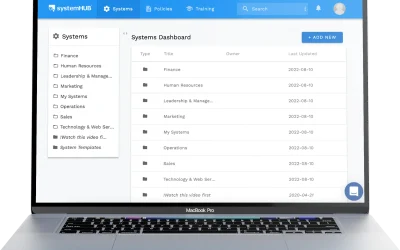
systemHUB is where thousands of business owners store, manage, and share every process, checklist, and SOP. Your onboarding checklist, role-specific training, and company policies, all in one searchable platform.
Real examples: onboarding systems that transformed businesses
Theory is useful. Seeing it work in real businesses is better. Here are two examples of how documented onboarding systems changed everything.
Den Lennie: “You can’t just hire specialists and let them figure it out”
Den Lennie runs a business coaching program for video production companies. For years, his approach to new hires was simple: find a specialist and let them work it out. “The biggest problem I had in my business was actually me,” he says.
The result? Too much room for interpretation. New hires would do what they thought needed to be done, not what actually needed to be done. Everything fell on Den’s shoulders because there was no framework guiding anyone.
When he implemented SYSTEMology, he built documented systems and onboarding processes. He gave a virtual assistant the task of building out his systems. The grey areas disappeared. “All new hires need guidance,” Den learned. And documented onboarding checklists provided exactly that.
The result? Den found liberation in six months, plus more revenue. His clients followed the same approach. One completely removed themselves from day-to-day operations in only three months.
Scaling with documented training: from 3 clients a month to 30
A digital marketing agency started with a comfortable pace of 3-4 new clients per month. As they grew, that number spiked to 30. The first couple of times it happened, they found themselves backed up by several months. Advertising had to be paused because they couldn’t handle the volume. “We would be losing business just because we couldn’t handle the customers properly.”
The breakthrough came when they documented their Critical Client Flow and used it to train new hires. For the first time, they were able to keep advertising running for an entire year. No starting and stopping. No letting down clients. No value surges or dips.
When the team had time to be creative instead of buried in onboarding and firefighting, they grew ten times faster. Documented onboarding turned hiring from a bottleneck into a growth lever. If you’re looking to hire and retain A-players, it starts with a strong onboarding system.
Common mistakes with employee onboarding checklists
Before you build your onboarding checklist, watch out for these traps. I’ve seen each of them derail otherwise well-intentioned onboarding efforts.
Relying on “shadow someone for a week.” This is the most common approach and the least effective. The new hire’s experience depends entirely on who they shadow, what mood that person is in, and whether they remember to cover everything. It’s not onboarding. It’s winging it.
Making the checklist too detailed. If your day-one checklist has 40 items, nobody will follow it and the new hire will feel overwhelmed. Focus on the key milestones and link to full procedures for anyone who needs more depth. You can always add detail later.
Not updating when processes change. A checklist that references software you replaced six months ago does more harm than good. Build a review cadence into your process. Every time you onboard someone new, check the checklist is still current. For more on keeping your onboarding best practices fresh, revisit quarterly.
Skipping the culture and values piece. Practical setup is important, but culture is what determines whether someone stays and thrives. Include a founder’s welcome video, an explanation of company values, and an honest conversation about “this is how we work here.” The SYSTEMology book recommends this as one of the first items in any onboarding process.
Having the owner run every onboarding personally. If you’re the person doing every onboarding, you’ve created a single-person dependency that limits your growth. Delegate it. Document it. Let your team own it. That’s the whole point of building systems: freedom. If delegation feels hard, start with your onboarding checklist. It’s one of the easiest systems to hand off.
Frequently asked questions
What should be included in an employee onboarding checklist?
A thorough onboarding checklist covers four phases: pre-arrival (equipment, accounts, paperwork), day one (welcome, introductions, IT setup, company values), week one (tool training, role-specific systems, key contacts), and month one (independent tasks, performance review, system feedback). Each item should have a clear owner and deadline.
How long should the employee onboarding process take?
Most effective onboarding programs run for at least 30 days, with many extending to 90 days for complex roles. The first week should cover essentials and orientation. Weeks two through four focus on role-specific training and guided independence. After 30 days, the new hire should be completing core tasks independently, with ongoing support as needed.
What is the difference between onboarding and orientation?
Orientation is typically a one-day event covering logistics: where things are, how to use the systems, who’s who. Onboarding is the full process of integrating a new employee into your team and culture over weeks or months. Think of orientation as day one of your onboarding checklist. The rest of the checklist covers the deeper work of getting someone truly productive and engaged.
Who should be responsible for onboarding new employees?
Not the business owner. Ideally, assign a Systems Champion or HR lead to own the process, with the direct manager handling role-specific training and an assigned buddy for day-to-day questions. The key is having one person accountable for making sure the checklist gets completed, even if multiple people contribute to different steps.
How do you onboard a remote employee?
The same phases apply, but with adjustments. Ship equipment in advance. Replace the office tour with a virtual walkthrough of your digital workspace. Use video calls for introductions and a recorded founder welcome. Make sure all your standard operating procedures are accessible online (not in a filing cabinet). Schedule more frequent check-ins during week one, since remote hires can’t just lean over and ask a question.
What are the biggest onboarding mistakes small businesses make?
The most common mistake is having no documented process at all, relying on “show them around and hope for the best.” Other frequent errors include dumping too much information on day one, skipping the culture conversation, not assigning a clear onboarding owner, and never updating the checklist after the first version. Start simple, document what works, and improve with every hire.
How do you measure onboarding success?
Track three things: time-to-productivity (how quickly a new hire can complete core tasks independently), 90-day retention (are people staying past the initial period?), and new hire feedback (ask every new team member what worked, what was confusing, and what was missing). Use those insights to improve the checklist for the next hire. The best onboarding systems get better every time they’re used.
Your onboarding checklist is the first system every new hire experiences. Make it count.
Start with one phase. Document your pre-arrival steps. Get them out of your head and into a checklist anyone on your team can follow. Then add day one, week one, and month one. Each hire gets a better experience than the last. Each hire takes less of your time. And before long, you’ve built a system that grows your team without growing your workload.
Ready to build your onboarding checklist in a platform designed for exactly this? See how systemHUB works.