You didn’t start your business so you could spend your days chasing invoices, answering the same questions, and putting out fires.
You started it because you loved something. Maybe you loved the craft. The problem-solving. The thrill of building something from nothing. Whatever it was, it lit you up.
Then somewhere along the way, the business grew. And with that growth came complexity. More staff. More clients. More admin. More of everything except the work you actually enjoyed. Before you knew it, you were spending 80% of your time on tasks you never signed up for and only 20% on the work that made you start in the first place.
I know this because I’ve lived it. I built a digital agency called Melbourne SEO Services because I loved helping businesses grow online. Ten years later, I was working 60 to 70 hours a week, trapped on a hamster wheel of operations, client management, and firefighting. The passion was gone. But the solution wasn’t to quit. It was to systemise the business so I could get back to the work I actually loved.
This article is about how to do exactly that. Not motivational fluff about “following your passion.” A practical, systems-based approach to removing yourself from the work that drains you so you can spend more time doing the work that energises you.
In this guide:
- Why business owners lose the love
- What “loving what you do” actually means
- The five things that kill your passion
- How systems give you back the work you love
- What to systemise first (the stuff you hate)
- Getting back to your zone of genius
- Common mistakes when trying to reclaim your passion
- Frequently asked questions
Why business owners lose the love
There’s a pattern I’ve seen play out hundreds of times. A business owner starts a company because they’re great at something and they enjoy doing it. A builder who loves designing homes. An accountant who loves helping clients plan their finances. A marketing consultant who loves crafting campaigns.
The early days are exciting. You’re doing the work, winning clients, and building something real. Then success arrives. More clients. More revenue. More people to manage. And slowly, without anyone noticing, the nature of your work changes.
You go from doing the work you love to managing the people who do the work. Then from managing people to managing problems. Then from managing problems to simply surviving the day.
I call this the passion trap. The better you get at your craft, the more the business grows. The more the business grows, the further you get from the craft that started it all.
The paradox: Your success at the work you love is the very thing that pulls you away from it. Growth rewards you with more responsibility, not more of the work that got you here.
In my case, I spent a decade building Melbourne SEO Services. I loved the strategy side of digital marketing. Helping business owners figure out their online presence, testing new channels, seeing the results come in. That was my thing.
But by year ten, I wasn’t doing any of that. I was reviewing timesheets. Chasing clients for approvals. Sitting in meetings about meetings. Managing cash flow. Handling HR issues. The agency was successful by most measures, but I had engineered myself into a role I never wanted.
And here’s the kicker: I couldn’t just walk away. No one would buy a business that completely depended on the owner being present every day. I was stuck in a role I didn’t enjoy, in a business I couldn’t sell. That’s when I realised something had to fundamentally change.
What “loving what you do” actually means
Let’s clear something up. Loving what you do doesn’t mean every moment of every day is pure joy. That’s fantasy. Every business has unglamorous work that needs doing.
What it does mean is that the majority of your time is spent on work that energises you. Work that uses your best skills. Work that you’d choose to do even if you didn’t have to.
For me, that’s teaching. Creating content. Building new products. Having strategic conversations about where the business is headed. When I’m doing those things, I don’t watch the clock. The hours disappear.
For you, it might be something completely different. Maybe you’re a builder who loves being on site, solving design challenges, talking to clients about their vision. Maybe you’re a financial planner who loves the one-on-one advisory conversations. Maybe you’re a creative agency owner who loves the ideation phase of a new campaign.
Whatever your version of it is, that’s your zone of genius. The intersection of what you love, what you’re genuinely best at, and what creates the most value for your business.
Your zone of genius is where three things overlap.
The work you love doing. The work you’re better at than anyone else on your team. And the work that creates the highest value for your business. When you’re operating in this zone, everything feels right. The problem is that most business owners spend less than 20% of their time there.
The goal isn’t to remove yourself from the business entirely. It’s to design a role within your business that you actually want to show up for. One where your days are filled with zone-of-genius work, and the operational tasks that drain you are handled by documented systems and capable team members.
The five things that kill your passion for business
If you’ve lost the love for your work, it’s not because you picked the wrong business. It’s because the business has gradually loaded you up with tasks that were never part of the plan. Here are the five most common passion killers I see in business owners.
1. Doing work that should be someone else’s job
Bookkeeping. Scheduling. Chasing suppliers. Formatting documents. Updating the website. These tasks need doing, but they don’t need you doing them. Every hour you spend on admin work is an hour stolen from the creative, strategic work that only you can do.
The reason most owners end up doing this work isn’t because they want to. It’s because there’s no documented process for someone else to follow. So it stays on your plate by default.
2. Answering the same questions over and over
“How do we handle a refund?” “What’s the password for that account?” “Where do I find the client brief?” When your team asks you the same questions repeatedly, it means the answers live in your head instead of in a documented system. Each interruption pulls you out of focused, meaningful work. And the cumulative toll on your energy and patience is enormous.
This is one of the hidden costs of avoiding systemisation. Your time gets consumed by questions that a well-documented SOP would answer instantly.
3. Firefighting instead of creating
Your calendar says you have a block for strategic planning. Then a client issue erupts. A team member calls in sick. A supplier sends the wrong order. By noon, your strategic block is gone and you’re knee-deep in problems that someone else should be solving.
When there are no systems, everything becomes urgent. And when everything is urgent, the important work never gets done. The creative, strategic, zone-of-genius work always gets bumped because it doesn’t scream the loudest.
4. Being the bottleneck for every decision
Nothing moves without your approval. Your team waits for you to sign off on proposals, approve purchases, and green-light projects. You feel indispensable. But what you’ve actually created is a culture where nobody thinks for themselves because every decision gets funnelled through you.
Your business ego might tell you this is quality control. In reality, it’s a bottleneck that slows everything down and drains your energy on decisions that don’t need your involvement.
5. Never having time for the work you actually love
This is the final symptom and the one that hurts the most. You have ideas. Projects you want to explore. New products to develop. Relationships to build. But there’s never time because the operational machine demands all of your attention.
The cruel irony is that the work you love is usually the work that would create the most value for the business. Strategic thinking, innovation, customer relationships. These are high-leverage activities that get crowded out by low-leverage operational noise.
Is your business set up for you to do the work you love?
Take the free Systems Strength Test to find out where your biggest systemisation gaps are holding you back.
How systems give you back the work you love
Here’s what most people miss about business systems: they’re not just about efficiency or scaling. They’re about freedom. Specifically, the freedom to choose how you spend your time inside your own business.
When you document a process and hand it to a team member, you’re not just delegating a task. You’re reclaiming a piece of your day. Stack enough of those reclaimed pieces together, and you’ve rebuilt your role entirely.
This is exactly what happened in my journey. When I started systemising Melbourne SEO Services, I wasn’t thinking about selling the business or removing myself completely. I was thinking, “I just want to stop doing the stuff I hate so I can do more of the stuff I love.”
The first process I documented was client onboarding. It was eating hours of my week and I dreaded it. Once it was written down step by step, my operations manager Melissa took it over. Within three months, she was running it better than I ever did. And I had those hours back for the work I actually cared about.
That’s the beautiful thing about systems. Your team often improves on a process once it’s documented and handed over. They bring fresh perspective and dedicated attention that you, spread across a hundred responsibilities, simply can’t match.

The old way: everything runs through the owner, leaving no time for the work you love.

The SYSTEMology way: your team runs the systems, you focus on the work you love.
In SYSTEMology, I describe the four stages of business systemisation: survival, stationary, scalable, and saleable. Most business owners who’ve lost the love are stuck between survival and stationary. They have some systems, but the critical work still depends on them. Moving to scalable, where the business runs without your constant involvement, is where you get your passion back.
And it doesn’t require hundreds of documented processes. You start with your Critical Client Flow (CCF), the core sequence of steps that takes a prospect from first contact to a happy, paying customer. Systemise that, and you’ve handled the biggest chunk of operational work in one focused effort.
Key insight from SYSTEMology: You don’t need to systemise everything. You need to systemise the right things. Start with the tasks that drain your energy, not the ones you enjoy. The goal is to design a role you love, not to remove yourself entirely.
What to systemise first (the stuff you hate)
This is where most systemisation advice gets it backwards. People tell you to start with your most important processes. That sounds logical but it misses the point. If you want to love what you do again, start with the processes you hate the most.
Why? Because those are the tasks consuming your energy and crowding out the work you enjoy. Remove them first, and you’ll feel the difference immediately. That momentum will carry you forward.
Here’s a practical framework for prioritising the right systems to document first.
1. Track everything you do for one week
Before you can fix the problem, you need to see it clearly. For one full week, write down every task you touch. Don’t filter or edit. Just capture. Client calls, emails, approvals, admin tasks, creative work, meetings. All of it.
2. Circle the tasks that drain you
Go through your list and circle every task that makes you feel tired, frustrated, or bored. The ones you procrastinate on. The ones you dread when they show up on your calendar. These are your systemisation targets.
3. Map your Critical Client Flow
Your CCF is the backbone of your business. Map out the journey from first contact to happy customer. Where in that flow are you personally stuck? Where are you the bottleneck? Those intersection points, where draining tasks meet critical business processes, are where you start.
4. Extract and document those tasks first
Don’t write the SOPs yourself. Have a team member watch you perform the task, then document what they observe. This is the extraction method from SYSTEMology. It’s faster, more accurate, and it means the documentation is written from a team member’s perspective, which is exactly who needs to follow it.
5. Assign a systems champion
A systems champion is someone on your team who takes ownership of the systemisation process. They coordinate the documentation, ensure processes are followed, and drive continuous improvement. Without this person, the effort dies the moment you get busy with something else.
6. Protect the time you’ve freed up
This step is critical and most people skip it. When you delegate a task, your natural instinct is to fill that time with more operational work. Resist it. Block the freed-up time in your calendar for zone-of-genius work. Treat it as non-negotiable. Otherwise, the operational machine will reclaim every hour you liberate.
Example: A builder who got back to what he loved
A building company owner was spending 30 hours a week on quoting, invoicing, scheduling subcontractors, and following up on outstanding payments. The work he loved was on-site project management, client design consultations, and mentoring his apprentices.
He used the SYSTEMology approach to document and delegate his quoting process, invoicing workflow, and subcontractor scheduling. Within eight weeks, his office manager was handling all three processes using documented systems.
The result: 20 hours a week freed up. He now spends that time on site with clients and training his team. He says he feels like he’s running his business for the first time in years, instead of the business running him.
Getting back to your zone of genius
Once you’ve systemised the work you hate, something interesting happens. You start to see your role differently. You’re no longer the person who does everything. You’re the person who does the things that matter most.
In SYSTEMology, I talk about the distinction between the leader and the manager. The leader is the visionary. Full of drive, passion, and creativity. Great at starting things, inspiring people, and pushing the business forward. The manager is the one who gets things done. Detail-oriented, process-driven, accountable.
Most business owners are natural leaders who’ve been forced into a manager role by the demands of their own business. When you systemise effectively, you can step back into the leader role. That’s where the love comes back.
Think about it. Walt Disney had Roy Disney. Henry Ford had James Couzens. Ray Kroc had Fred Turner. The visionaries everyone remembers always had a manager partner who handled the operational side. You don’t have to do both. In fact, trying to do both is exactly what kills the passion.

When your team runs the systems, you’re free to lead, create, and focus on the work that energises you.
Your zone of genius might evolve over time. When I first systemised my digital agency, my zone of genius was client strategy. Later, it shifted to teaching and content creation. Eventually, it became building SYSTEMology itself. The point is that systems give you the flexibility to follow your passion wherever it leads, because the operational foundation doesn’t depend on you.
Here’s what your week could look like once you’ve systemised the work you don’t enjoy:
Before systems
80% of your time on operations, admin, firefighting, and answering questions. 20% (if you’re lucky) on work you actually enjoy.
After systems
20% on strategic oversight and team development. 80% on your zone of genius: the creative, strategic, high-value work you love.
Gary McMahon from Ecosystem Solutions experienced this firsthand. He was working 100 to 110 hours a week, jeopardising his health and his family relationships. After implementing SYSTEMology, his profitability increased approximately 80 per cent. But his greatest win? A three-week holiday with his family for the first time in his entire working life. As Gary put it: “It’s like I’ve lost fifty kilos. And I’ve got a life.”
That’s what getting back to your zone of genius looks like. Not just more free time. A completely different experience of running your business.
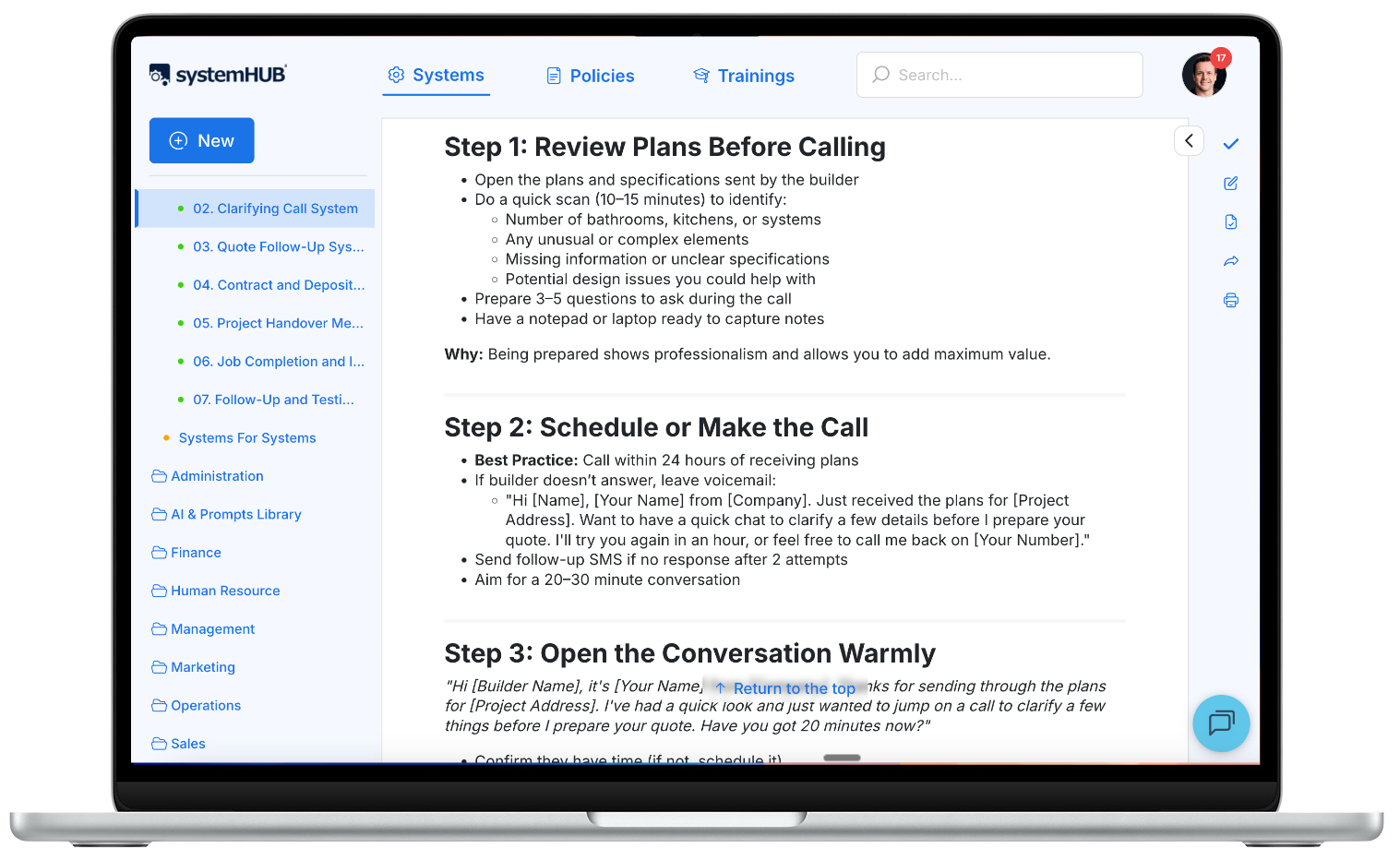
Store your documented processes in systemHUB so your team can run the business while you focus on the work you love.
Build the systems that free you to do the work you love
systemHUB gives you the platform to document your processes, delegate with confidence, and redesign your role around your zone of genius.
Common mistakes when trying to reclaim your passion
Waiting until you “have time” to build systems. You will never have time. That’s the whole problem. The operational demands expand to fill every available hour. You have to carve out time for systemisation even when it feels impossible. Start with just two hours a week. Document one process. The momentum builds from there.
Trying to systemise everything at once. Overwhelm is the enemy of progress. Don’t try to document every process in your business in one sprint. Start with the one task that drains you the most. Get it documented, delegated, and running smoothly. Then move to the next one. Two systems per week is a sustainable pace that transforms your business within months.
Delegating without documenting. Handing someone a task without a documented process is just shifting the chaos. When it goes wrong (and it will), you’ll take the task back and conclude that nobody can do it as well as you. The issue wasn’t delegation. It was the lack of a system to guide the person you delegated to. Effective delegation starts with documentation.
Confusing “stepping back” with “stepping out.” The goal isn’t to leave your business. It’s to build a better role within it. You’re not abandoning the ship. You’re moving from the engine room to the bridge. Some owners resist systemisation because they think it means becoming irrelevant. The opposite is true. Systems make you more valuable because you’re finally working on the things that actually move the business forward.
Filling freed-up time with more operational work. This is the sneakiest trap. You systemise a process and free up five hours a week. Instead of using that time for zone-of-genius work, you fill it with new operational tasks. Block the time. Guard it fiercely. If you don’t protect your creative and strategic hours, the business will consume them.
Frequently asked questions
How do I figure out what work I actually love?
Track your energy, not just your time. For one week, rate each task you do on a simple scale: energises me, neutral, or drains me. The tasks that energise you are your zone of genius. Look for patterns. Most business owners already know what they love. The challenge isn’t identifying it. It’s giving yourself permission to prioritise it.
What if I can’t afford to delegate the tasks I hate?
Consider what it’s costing you not to delegate. Every hour you spend on a task someone else could handle is an hour you’re not spending on high-value work that drives revenue and growth. The real cost isn’t the salary of the person who takes over. It’s the opportunity cost of you doing work below your pay grade. Start small. Even hiring part-time help to cover documented processes can free up enough time to make a noticeable difference.
How long does it take to systemise enough to get back to creative work?
Most business owners can systemise their Critical Client Flow within 90 days using the SYSTEMology approach. If you commit to documenting two processes per week, you’ll notice a significant shift in how you spend your time within the first month. The full transformation, where the majority of your time is zone-of-genius work, typically takes six to twelve months of consistent effort.
What is a zone of genius and how do I find mine?
Your zone of genius is the work that sits at the intersection of three things: what you love doing, what you’re better at than anyone else on your team, and what creates the most value for your business. It’s not just about enjoyment. It’s about leverage. When you’re working in your zone, your contribution is disproportionately valuable because nobody else can do it as well as you. That’s where your time belongs.
Can I systemise my business without losing quality?
Yes. Quality often improves when you systemise. A documented process delivers consistent results regardless of who executes it. Instead of quality depending on the owner’s mood, energy, or availability, it depends on a tested, verified system. Many business owners find that their team actually improves on the process once it’s documented, because they bring dedicated focus and fresh perspective.
What should I systemise first?
Start with the tasks that drain you the most and that a team member could realistically take over. Map your Critical Client Flow to see where you’re personally stuck as a bottleneck. The intersection of “I hate this task” and “this task is critical to the business” is your starting point. Common first wins include client onboarding, quoting, invoicing, and scheduling.
What if my team isn’t ready to take over the tasks I want to let go of?
Often the team is more ready than you think. The barrier isn’t their capability. It’s the lack of documented processes and clear expectations. Give them the system, the training, and the authority to execute. If genuine skill gaps exist, address them through training or strategic hiring. But don’t assume your team can’t handle it until you’ve actually given them a documented process to follow and the space to prove themselves. Getting your team to love systems starts with showing them how systems make their work clearer and more rewarding.
You didn’t build this business to spend your life doing work you dread. Systems give you back the work you love.
The passion isn’t gone. It’s buried under a mountain of operational tasks that don’t need you. Strip those away, and you’ll find the excitement, creativity, and purpose that made you start in the first place. The work you love is still there. You just need systems to clear the path back to it. Start building those systems in systemHUB.