Think SOPs are only for big corporations with 500 employees and a compliance department?
Here’s the thing most small business owners get backwards: SOPs aren’t something you “graduate” into when you’re big enough. They’re what make it possible to get big in the first place.
When you run a small business, YOU are the system. Every question, every decision, every “how do we do this again?” runs through your head. That works when it’s just you and a couple of people. But it breaks the moment you try to grow, take a holiday, or simply have a day off without your phone buzzing every ten minutes.
Standard operating procedures are the bridge between a business that depends on you and one that works without you. And for small businesses, that bridge matters more than it does for anyone else.
In this guide:
- What are SOPs (and why small businesses think they don’t need them)
- Why small businesses need SOPs more than big companies
- 7 specific benefits of SOPs for small businesses
- Real small business examples
- How to get started with SOPs (the SYSTEMology approach)
- Common objections to SOPs in small business
- Frequently asked questions
What are SOPs (and why small businesses think they don’t need them)
An SOP is simply a documented series of steps that, when followed, produces a predictable outcome. It could be how you onboard a new client. How you process an invoice. How you handle a customer complaint. How you publish a social media post.
Nothing fancy. No corporate jargon required.
As I explain in the SYSTEMology book, a system is “a series of linear steps that, when followed, produces a predictable outcome.” Whether you call it an SOP, a process, a procedure, or a workflow, the idea is the same: capture what works, write it down, and let anyone on your team follow it.
So why do so many small business owners resist the idea?
Because they associate SOPs with bureaucracy. Red tape. Endless binders collecting dust on a shelf. They’ve seen what Six Sigma looks like at a manufacturing plant and thought, “That’s not for me.”
And they’re right. That kind of systemisation wasn’t designed for small businesses. It’s complicated, costly, and time-consuming. Most methodologies around business systems were built for larger organisations. That sets small businesses up to fail from the start.
But the answer isn’t to avoid SOPs altogether. The answer is to create simple, practical SOPs that fit the way your business actually works.
Key insight: You already have SOPs in your business. They’re just trapped in your head and the heads of your best team members. The question isn’t whether you need them. It’s whether you’ll write them down before it costs you.
Why small businesses need SOPs more than big companies
This is the counterintuitive truth that changes everything: SOPs help small businesses MORE than they help large ones.
Large companies have layers of management, institutional knowledge baked into their culture, and departments designed to catch problems. If one person leaves a big company, the machine keeps running.
Small businesses have none of that. Here’s why that makes SOPs essential.
1. The owner IS the bottleneck
When every decision runs through you, your business can only move as fast as you can think. Your team waits on you. Projects stall. Growth hits a ceiling because there are only so many hours in your day.
As I’ve seen working with hundreds of businesses, the owner is quite often the bottleneck. And the hardest part? The skills that made you successful in startup mode (fast thinking, problem solving, jumping in to save the day) are the same ones keeping you stuck now. You’ve unconsciously trained your team to depend on you.
SOPs break that cycle. When the answer to “how do we handle this?” lives in a documented process instead of your brain, your team stops asking you and starts doing.
2. Knowledge lives in people’s heads
In most small businesses, your intellectual property is trapped in the brains of a few key people. Your best salesperson knows the pitch. Your operations manager knows the workflow. Your bookkeeper knows the reconciliation process.
What happens when one of them leaves? You’re back to square one. SOPs turn tribal knowledge into repeatable processes that stay with the business, no matter who walks out the door.
3. Every mistake costs more
Big companies can absorb a bad customer experience or a botched project. Small businesses can’t. One unhappy client can mean a lost referral chain. One costly error can blow your margin for the month.
SOPs reduce errors by making sure everyone follows the same proven steps. Consistency isn’t a luxury for small businesses. It’s survival.
4. Growth stalls without repeatable processes
You’ve probably experienced this: business picks up, you hire someone to help, and then you spend more time managing them than doing the work yourself. It feels faster to “just do it” than to explain how.
That’s the trap. Without SOPs, every new hire creates MORE work for you, not less. With SOPs, you can hand someone a documented process and say, “Follow this.” Suddenly, hiring actually frees your time instead of consuming it.
5. Hiring and onboarding takes too long
How long does it take to get a new person up to speed in your business? Weeks? Months? In an unsystemised small business, onboarding typically involves shadowing someone, asking a lot of questions, making preventable mistakes, and slowly piecing together how things work.
SOPs cut onboarding time dramatically. New team members follow the same process your best performers use, from day one.
6. The business has no value without you
If a buyer looked at your business today and said, “Can this run without the owner?” what would the honest answer be?
A business that depends entirely on one person isn’t really a business. It’s a job. And jobs don’t sell for premium multiples. SOPs are what transform an owner-dependent operation into a saleable asset. Even if you never plan to sell, building your business as though it’s saleable opens a world of opportunities.

The old way: everything runs through the owner.

The SYSTEMology way: your team runs the systems, you run the business.
What’s the real cost of running without SOPs?
Use the free Cost of Chaos Calculator to put a dollar figure on how much your unsystemised operations are costing your business.
7 specific benefits of SOPs for small businesses
Let’s move from “why you need them” to “what they actually do.” Here are seven concrete benefits that SOPs deliver for small businesses.
1. Consistent customer experience
When every team member follows the same process, your customers get the same quality of service every time. Not just when you’re personally overseeing things. Not just when your best person handles it. Every single time.
Most small businesses lack consistency, and that causes more issues than you realise. One great experience followed by a mediocre one is worse than two average experiences. SOPs set the floor so your worst day still meets a professional standard.
2. Faster delegation and trust-building
The biggest reason small business owners struggle to systemise their business is trust. “Nobody can do it as well as I can.” Sound familiar?
SOPs solve the trust problem. Instead of handing someone a vague instruction and hoping they figure it out, you hand them a clear, step-by-step process. You’re not asking them to read your mind. You’re asking them to follow a recipe.
Delegation stops being terrifying and starts being practical.
3. Quicker onboarding for new team members
Every week it takes to onboard a new hire costs you money and productivity. With documented SOPs, new team members can self-train on routine tasks. They follow the same process your top performers use, learn the expected standards from day one, and ramp up in weeks instead of months.
One small business owner I worked with used to spend three months training new hires. After documenting their core SOPs, onboarding dropped to three weeks. That’s not a small efficiency gain. That’s a complete transformation of their hiring capacity.
4. Reduced errors and rework
Rework is one of the most expensive hidden costs in any small business. You’re paying twice for the same output. SOPs eliminate the guesswork that causes mistakes. When steps are documented and followed, things get done right the first time.
This matters most in areas where errors are costly: financial processes, client deliverables, compliance-related tasks, and quality control.
5. Ability to scale without chaos
Scaling an unsystemised business is like trying to drive faster with a flat tyre. You can push harder, but you’ll damage the car.
SOPs are what allow you to add team members, take on more clients, and handle more volume without everything falling apart. They turn growth from a crisis into a process. One small business I worked with kept having to pause their advertising every time demand spiked because they couldn’t handle the volume. After documenting their Critical Client Flow, they were able to keep ads running for an entire year. No starting and stopping. No letting down clients.
6. Increased business value
The first areas buyers look at when valuing a business are its accounts and its systems. A business with documented SOPs, clear processes, and a team that can operate independently is worth significantly more than one where the owner IS the operation.
Even if selling isn’t on your radar today, building a business with strong SOPs gives you options. You could step back. Bring in a CEO. Franchise the model. Or simply enjoy the freedom of a business that doesn’t collapse when you go on holiday.
7. Owner freedom and quality of life
This is the one that matters most. You didn’t start a business to work 60 or 70 hours a week, miss your kids’ school events, and feel chained to your phone. You started it for freedom.
SOPs are the path back to that original vision. When your business has documented systems, you can step away. You can take the holiday. You can focus on the strategic work you love. You can stop being the firefighter and start being the architect.
Real small business examples
This isn’t theory. Here are three real businesses that transformed their operations with SOPs and the SYSTEMology framework.
Gary McMahon, Ecosystem Solutions (ecological consulting)
Gary founded Ecosystem Solutions in 2005. As demand grew, so did the chaos. Years of working 100 to 110 hours per week jeopardised his health, his family relationships, and the quality of his work.
He hired staff and tried to expand, but he was still the bottleneck. “Every tool and all the training he could find didn’t help,” Gary recalls. He knew systems were the answer but didn’t know where to start.
After discovering SYSTEMology, he mapped his Critical Client Flow and began documenting his SOPs one by one. The CCF was “a game changer” because it let his team visualise the bottlenecks. He used his documented processes to onboard new team members and create consistency across the business.
The results: Profitability increased approximately 80%. And his greatest win? A three-week holiday with his family, for the first time in his entire working life.
“Peace of mind,” Gary said when asked what it means to have a systemised business. “It’s like I’ve lost fifty kilos. And I’ve got a life.”
Oh Crap (compostable dog poop bags, garage startup)
Oh Crap started in Bruce Hultgren’s garage in 2014. Smart marketing launched sales from 200,000 bags to 6.3 million over a couple of years. But growth outpaced their capacity. When orders spiked, they had to turn off ads. Bruce’s yearly holiday brought the business to a complete halt.
Co-founder Henry Reith knew from past ventures that they needed systems. After discovering SYSTEMology, he documented their first couple of SOPs, then appointed an internal systems champion to keep everyone accountable.
The results: Their systems champion continuously records and re-evaluates essential procedures. Thanks to documented SOPs, they stay ahead of growth instead of frantically clawing to keep up. The start-and-stop chaos of their early days was replaced by a business that could handle demand without burning out its founders.
Jeanette Farren, diggiddydoggydaycare (pet services)
Jeanette ran her award-winning doggy daycare for thirteen years before deciding to sell. With a background in business management, she knew that documented systems would be critical for commanding a premium price.
Two years before the sale, she started building SOPs using the SYSTEMology framework. She mapped her Critical Client Flow and systematically documented every core process. The result was a shift from working crazy, full-time hours “in” the business to stepping out of daily operations entirely.
“The first areas corporate buyers look at when valuing a business are its accounts and systems,” says Jeanette. “The earlier people can educate themselves about systems, the better.”
The results: Jeanette exited her business and commanded a high multiple of profits. The buyer specifically valued diggiddydoggydaycare’s documented systems, and they played a huge role in the valuation. She’s now travelling Australia, planning her next venture.
Build SOPs your team will actually follow
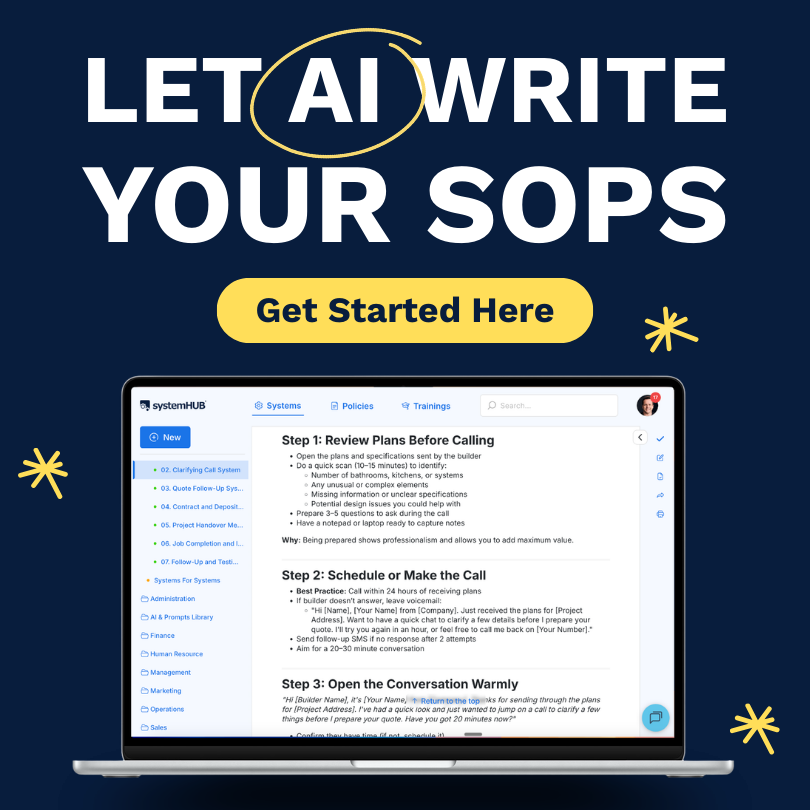
systemHUB gives you the platform, templates, and AI tools to document your small business SOPs in weeks, not months.
How to get started with SOPs in your small business
The biggest mistake is thinking you need to document everything before you see results. You don’t. The SYSTEMology approach is designed specifically for small businesses that don’t have months to spend on systemisation.
Here’s the practical path forward.
1. Map your Critical Client Flow (CCF)
Your Critical Client Flow is the journey a client takes from first contact through to delivery and follow-up. Map out the 10 to 15 mission-critical steps. This isn’t about documenting everything. It’s about identifying the systems that drive the most value using the 80/20 principle.
2. Identify your “knowers”
Here’s something most small business owners don’t expect: you’re probably the worst person to write your SOPs. Not because you don’t know how things should be done, but because you’ll either over-complicate the process or skip steps you do on autopilot.
Instead, identify the team members who do each task best. In SYSTEMology, we call them “knowers.” They already have the knowledge. Your job is to capture it.
3. Extract the process (don’t write it yourself)
Have your knower walk through the process while someone records each step. This can be a screen recording, a video, or a simple written walkthrough. The goal is to capture what is already being done well, not to engineer a perfect process from scratch.
Imperfect documentation is infinitely better than no documentation.
4. Keep it simple
You’re not a Fortune 500 company. Your SOPs don’t need to be 30-page manuals. A clear set of steps that any team member can follow is enough. You can always improve version two after version one is in use.
Tip: A good-enough SOP documented today is worth more than a perfect SOP that never gets written. Start with a simple SOP template and build from there.
5. Store everything in one central place
SOPs scattered across Google Docs, email threads, Notion pages, and sticky notes are barely better than no SOPs at all. Your team needs to know exactly where to look. A dedicated platform like systemHUB keeps everything organised, searchable, and accessible.
6. Appoint a systems champion
Every systemisation effort needs a champion. Someone (other than you, the business owner) who keeps the momentum going, makes sure SOPs get updated, and holds the team accountable for following them. Without ownership, systems go stale.
1
Define
Map your Critical Client Flow to find the SOPs that matter most
2
Document
Capture what your best people already do, not a theoretical ideal
3
Delegate
Hand off the process and let your team own it
Common objections to SOPs in small business
If you’ve been putting off creating SOPs, you’ve probably told yourself one of these stories. Let’s address them head on.
“I’m too small for SOPs.” You’re not too small. You’re too vulnerable NOT to have them. The smaller your team, the more damage a single person’s absence causes. If your best employee calls in sick tomorrow, can your business keep running? SOPs are what make that possible.
“I don’t have time to write SOPs.” You don’t have to. That’s the whole point of the SYSTEMology approach. Your team members (the “knowers”) capture the processes. And you don’t need to document everything at once. Start with one SOP. The time you invest documenting it will save you multiples in the weeks and months ahead. Consider what not systemising is already costing you.
“My team won’t follow them.” They will if they help create them. When team members are involved in building SOPs, they feel ownership rather than restriction. The key is framing SOPs as tools that give your team clarity and confidence, not as rules designed to control them.
“SOPs will make us rigid and bureaucratic.” Only if you build them that way. Good SOPs for small businesses are simple, flexible guides. Not legal documents. They capture the essence of how to do something well while leaving room for professional judgement. Think recipe, not regulation.
“I’ve tried before and it didn’t work.” Most first attempts at systemisation fail for one of two reasons: trying to document everything at once, or the business owner trying to do it all themselves. SYSTEMology solves both problems. You start with just 10 to 15 critical systems and your team does the documenting. That’s a very different approach from what probably didn’t work last time.
Frequently asked questions
How many SOPs does a small business need?
You don’t need hundreds. Most small businesses can cover their core operations with 10 to 15 SOPs mapped to their Critical Client Flow. These are the standard operating procedures that drive the most value. Start there and expand over time as needed.
What’s the difference between an SOP and a process?
In practice, very little. An SOP (standard operating procedure) is a documented process with clear steps. A “process” can be documented or undocumented. The point of creating SOPs is to take the processes that already exist in your business and write them down so anyone can follow them consistently.
How long does it take to create an SOP?
A single SOP can be documented in an afternoon. Have your “knower” walk through the process, record it, and clean up the steps. A full set of core SOPs (your Critical Client Flow) typically takes two to four weeks. Using SOP templates speeds this up significantly.
Should the business owner write the SOPs?
No. This is one of the most important principles in SYSTEMology. The business owner is typically the worst person to document processes. They either over-complicate things or skip steps they do unconsciously. Instead, identify the team member who does each task best and have them capture the process.
What’s the best format for small business SOPs?
Keep it simple. A step-by-step written checklist, a short video walkthrough, or a screen recording with annotations. The best format is the one your team will actually use. Many small businesses start with video recordings and refine them into written steps over time.
How do I get my team to actually use SOPs?
Involve them in creating the SOPs from the start. When people help build a system, they’re far more likely to follow it. Also, make SOPs easy to find by storing them in a central platform, and appoint a systems champion to maintain accountability.
Can SOPs work for service-based small businesses?
Absolutely. Service businesses often benefit the most because their value delivery depends heavily on the skills and knowledge of individual people. SOPs capture that expertise and make it transferable. Whether you’re a consulting firm, a trades business, a healthcare practice, or a creative agency, SOPs ensure consistent quality regardless of who does the work.
Do SOPs help with selling a small business?
Yes. Documented SOPs are one of the most significant factors in business valuation. Buyers want proof that the business can operate without the current owner. A complete set of SOPs demonstrates operational maturity, reduces buyer risk, and directly increases the sale price. Jeanette from diggiddydoggydaycare credits her documented systems as a key reason she commanded a premium multiple when she sold.
Your business is already running on systems. The question is whether they’re documented.
Every business has systems. You have a way you answer the phone, handle enquiries, deliver your product, and follow up with clients. The question isn’t whether systems exist. It’s whether they’re captured, consistent, and accessible to your whole team.
Gary went from 110-hour weeks to an 80% profit increase. Jeanette sold her business for a premium. Oh Crap scaled from a garage side hustle to millions of units without burning out the founders.
None of them had huge teams or massive budgets. They were small businesses, just like yours. They just decided to document how they do things.
SOPs aren’t something you need when you’re “big enough.” They’re what make getting there possible.
Ready to start building yours? Explore systemHUB plans and create your first SOP today.