You know your business needs systems. But where do you actually start?
That question stops more business owners than any other. You have dozens of processes running in your head. Staff keep asking the same questions. Things fall through the cracks every week. And everyone says you need to “document your systems” but nobody tells you which ones to document first.
The answer is simpler than you think. It is a single page. A linear map of the 7 to 12 mission-critical steps your business uses to deliver value to your clients, from the moment they first hear about you through to turning them into repeat customers.
It is called the Critical Client Flow (CCF), and it is the starting point for all business systemisation.
In this guide, you will learn exactly what a Critical Client Flow is, why it matters more than any other systemisation tool, and how to build yours step by step. Whether you run a building company, an allied health clinic, a bookkeeping firm, or any service-based business, this is where your systemisation journey begins.

systemHUB gives you a central place to store and manage every system in your business.
In this guide:
What is a Critical Client Flow?
A Critical Client Flow is a one-page map of the essential steps your business follows to deliver your core product or service. It traces the full journey from how a client first discovers you, through the sales process and delivery, all the way to repeat business or referrals.
The CCF is a core concept in SYSTEMology. It was designed to answer the question every business owner asks when they try to systemise: “Where do I begin?”
Think of it as a bird’s-eye view of your business. Not every task. Not every detail. Just the critical path your clients travel and your team follows to deliver results. Typically, a Critical Client Flow contains between 7 and 12 steps.
Important distinction: A CCF is not the same as a customer journey map. While a customer journey focuses on the client’s experience and emotions, the Critical Client Flow also captures what your business needs to do behind the scenes to deliver the product. It covers both the client-facing and operational sides in a single, linear sequence.
Every CCF follows a similar structure, built around these core stages:
- Attention – How do prospects first learn about your business?
- Enquiry – How do interested prospects reach out?
- Sales – How does a prospect become a paying client?
- Money – How do you collect payment?
- Onboarding – How do you get new clients started?
- Delivery – How is the work completed and delivered?
- Repeat or Referral – How do you turn clients into repeat buyers or referral sources?
Your business will have its own version of each stage. Some stages might combine. Others might need two steps. That is perfectly normal. The goal is to capture how your business currently operates in a simple, linear flow of no more than 12 steps.
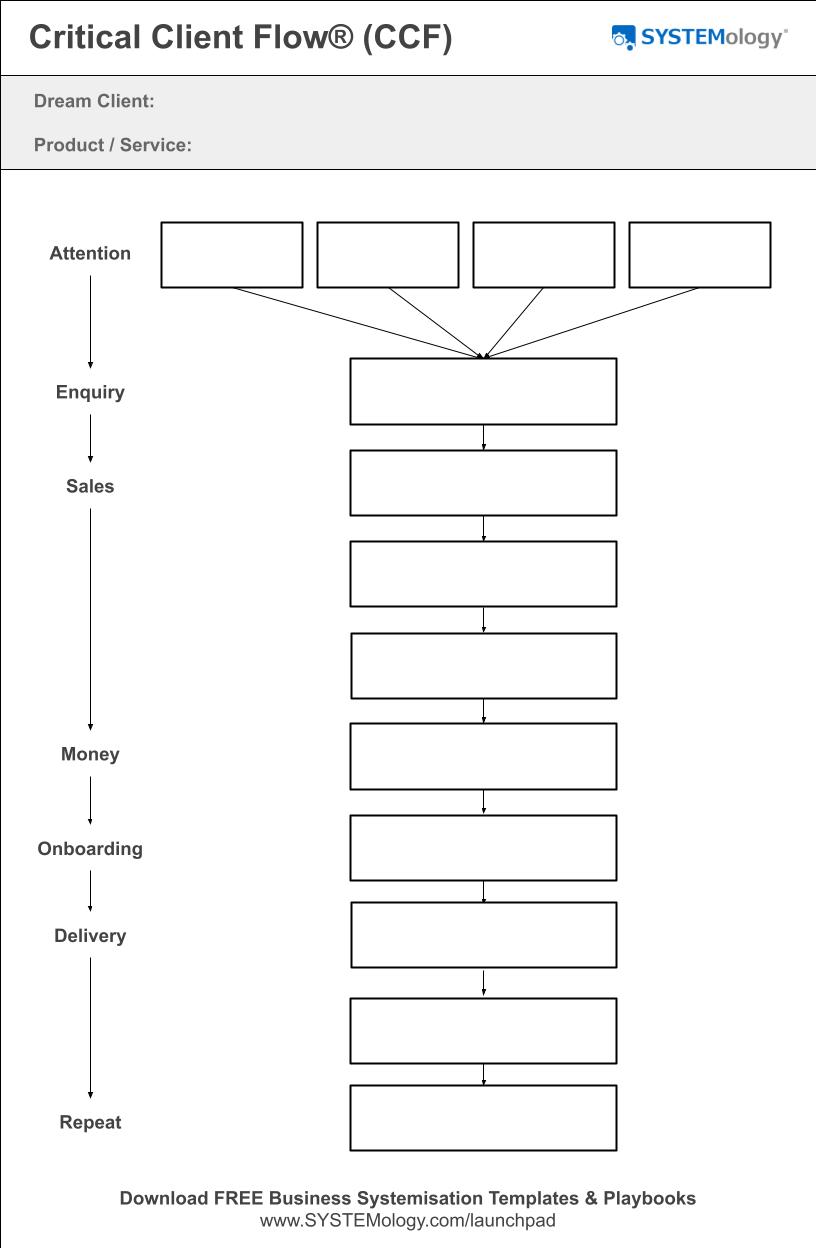
The Critical Client Flow template.
Why the Critical Client Flow is your starting point
Here is the biggest myth about systemising a business: you need hundreds of documented systems before it makes a difference.
That belief has killed more systemisation projects than anything else. Business owners sit down, look at the mountain of processes they could document, and feel overwhelmed before they even start. So they don’t. Or they start in a random corner of the business, document a handful of SOPs that nobody uses, and conclude that systemisation doesn’t work.
The Critical Client Flow solves this problem by giving you focus.
Instead of trying to document everything, you identify the 7 to 12 steps that sit at the heart of your business. These are the systems that directly generate revenue and deliver value to clients. They are the highest-priority systems in any business, regardless of industry.
When you systemise your Critical Client Flow first, three things happen:
- You remove yourself as the bottleneck. The CCF exposes exactly where you are personally involved in delivering the product. Once those steps are documented, you can delegate them.
- You spot the holes immediately. If you have cash flow problems, the CCF will reveal a weak invoicing step. If leads are inconsistent, it will show gaps in your attention stage. The CCF is diagnostic.
- You build momentum fast. Documenting 7 to 12 systems is achievable. Documenting 200 is not. The CCF gives you quick wins that prove the value of systemisation to you and your team.
Case study: Ecosystem Solutions
Gary McMahon founded Ecosystem Solutions, a specialist ecological consulting firm, in 2005. The business grew quickly, but Gary paid a steep price. He was working 100 to 110 hours per week. His health suffered. His family relationships were strained. Every tool and training he tried failed to fix the problem.
“This is my only hope,” he said when he discovered SYSTEMology. He started by documenting his Critical Client Flow, and it became a “game changer.” The CCF allowed Gary and his team to visualise bottlenecks they had never seen clearly before. He used the CCF to onboard new team members and create a cohesive brand identity across the business.
The result? Profitability increased approximately 80 per cent. And for the first time in his entire working life, Gary took a three-week holiday with his family. When asked what having a systemised business means to him, Gary said: “Peace of mind.”
Gary’s story is not unusual. Over years of helping hundreds of businesses create their CCF, the pattern is the same. The Critical Client Flow is always the starting point. It is always where the biggest wins come first.
You will get to the other systems. The HR processes, the popular business systems that every company needs, the management routines. But the CCF comes first because it strikes at the heart of your revenue engine.
How much is a lack of systems really costing your business?
Use our free Cost of Chaos Calculator to find out the hidden cost of inconsistent processes, missed steps, and owner dependency.
How to build your Critical Client Flow (step by step)
Building your CCF is not complicated. You can complete a solid first draft in 30 to 60 minutes. Grab a pen and paper, a whiteboard, or a simple document. Here is the process.
1. Identify ONE target client and ONE core product
Before you map your Critical Client Flow, you need to narrow your focus. Pick one target client and one primary product or service you sell to that client.
This feels counterintuitive. You might serve multiple client types and sell several products. But trying to map all of them at once creates confusion. The CCF works because it forces simplicity.
Ask yourself: Who is your ideal client? And what is the best first purchase for that client, the one that opens the door to a long-term relationship?
Some examples:
- If you are a bookkeeper, your target client might be farmers and your primary service is an initial financial audit.
- If you are a digital agency, you might serve franchisors and your primary service is building them a new website.
- If you run a physiotherapy clinic, your target client might be adults recovering from sports injuries and your primary service is an initial assessment and treatment plan.
Write these down at the top of your page. One client. One product. That is your starting point.
2. Map the CCF stages from attention to repeat
Now work through each stage of the Critical Client Flow. For each one, write down what currently happens in your business. Not what you wish happened. Not what you plan to do. What actually happens right now.
Attention: How do people learn about your business? Search engine traffic? Referrals? Social media? Pay-per-click ads? Speaking engagements? List your primary methods.
Enquiry: When someone is ready to enquire, how do they do it? Inbound call? Web form? Email? Walk-in?
Sales: Your prospect has shown interest. What happens next? Do you issue a proposal? Do they book a consultation? Is there a quote process?
Money: How do you collect payment? Card at the counter? Invoice before work begins? Deposit up front, balance on completion?
Onboarding: How do you get new clients started? This could be as simple as putting goods in a bag, or as detailed as sending a welcome pack, setting up a project in your management software, and assigning an account manager.
Delivery: How is the work completed? For a service business, this covers the actual delivery of your core service. For a product business, it covers picking, packing, and shipping.
Repeat or Referral: How do you encourage clients to come back or send new business your way? Do you have a follow-up sequence? A loyalty programme? A referral incentive?
Write each step in simple language. Two or three words per step is ideal. “Phone enquiry.” “Send proposal.” “Welcome email.” You are labelling steps, not writing standard operating procedures yet.
3. Keep it to 7-12 steps total
Your finished Critical Client Flow should have between 7 and 12 steps. This is a hard rule.
If you end up with fewer than 7, you have probably combined too many things. Break some stages apart. For example, “Sales” might actually be two steps: “Send proposal” and “Follow-up call.”
If you end up with more than 12, you have gone too deep. Step back and combine steps that are handled by the same person or department. For instance, if you listed five delivery sub-steps, merge them into one or two labels.
The CCF is a high-level overview. It should explain how your business works from start to finish in terms anyone could understand. You will capture the detailed processes and procedures later when you document each step as a full system.
4. Label each step clearly in 2-3 words
Each step in your Critical Client Flow should be labelled with just two or three words. Think of them as sticky notes on a whiteboard. Clear. Short. Obvious.
Good labels:
- “Google Ads”
- “Phone enquiry”
- “Site quote”
- “Invoice client”
- “Welcome pack”
- “Project kickoff”
- “Feedback survey”
If you need a full sentence to describe a step, you are going into too much detail. Pull back. The CCF is a map, not a manual.
5. Test it with an outsider
Once your Critical Client Flow is complete, show it to someone outside of your business. Pick a friend, a spouse, or a peer who roughly knows what your business does but is not directly involved in the day-to-day work.
If they can look at your CCF and understand how your business operates without you talking them through every step, you are in good shape. If they find it confusing or too complex, simplify further.
This test matters because the CCF is not just for you. It will become a training tool for new hires, a reference point for your team, and the foundation for all your repeatable processes. It needs to be simple enough that anyone can understand it at a glance.
Ready to document your Critical Client Flow?
systemHUB gives you a central place to build, store, and manage every system in your business. Start with your CCF and expand from there.
Critical Client Flow example: allied health clinic
To make this concrete, here is what a Critical Client Flow looks like for a physiotherapy clinic. The target client is an adult recovering from a sports injury, and the core service is an initial assessment and treatment plan.
CCF: Peak Performance Physiotherapy
Target client: Adults (25-55) recovering from sports injuries
Core service: Initial assessment and 6-week treatment plan
- Google search / GP referral (Attention) – Client finds the clinic through local search or a doctor’s referral.
- Online booking (Enquiry) – Client books an initial assessment through the website booking system.
- Confirmation call (Sales) – Receptionist calls to confirm the appointment, collects basic health history, and sets expectations.
- Payment at reception (Money) – Client pays at the front desk before the session. Health fund claims processed on the spot.
- Initial assessment (Onboarding) – Physio conducts a 45-minute assessment. Explains findings and recommends a treatment plan.
- Treatment sessions (Delivery) – Client attends weekly sessions over 6 weeks. Progress notes updated after each session.
- Discharge and review (Delivery) – Final session includes a progress review, home exercise programme, and discharge summary.
- Follow-up email (Repeat/Referral) – Two weeks after discharge, client receives a check-in email with a link to rebook if needed and a referral card to share.
Result: 8 steps, clearly labelled, easy for any team member to understand. Each step can now be documented as a full system with its own standard operating procedure.
Notice how the CCF does not try to capture every detail. It does not list every question the receptionist asks or every technique the physio uses. Those details belong in the individual SOPs you will create later. The CCF just gives you the roadmap.
This approach works the same way for a building company, a bookkeeping firm, a digital agency, or a retail store. The stages might look slightly different, but every business has a Critical Client Flow. In years of helping hundreds of businesses build their CCF, there has never been a business where this exercise did not work.
Common Critical Client Flow mistakes to avoid
The CCF is deliberately simple. But there are a few traps that catch business owners on their first attempt. Watch out for these.
Overthinking it. The CCF is meant to take 30 to 60 minutes. If you have been staring at it for half a day, you are going too deep. Write down what comes to mind, keep it rough, and refine later. Done is better than perfect here.
Too many steps. If your CCF has 15 or 20 steps, you have turned it into an operating manual. Pull back. Combine steps that are handled by the same person. The limit is 12 steps, and most businesses land between 8 and 10.
Listing aspirational activities. The CCF captures what you are currently doing, not what you plan to do. If you want to run Facebook ads but you currently only get clients through referrals, your attention stage should say “Referrals” not “Facebook ads.” This is about documenting reality so you can improve it systematically.
Skipping the outsider test. It is tempting to finish your CCF and move straight to documenting systems. But showing it to someone outside the business is a critical quality check. If they cannot understand it, your team will struggle with it too.
Trying to document everything at once. The CCF is your starting point, not your entire systemisation project. Once you have the CCF, the next step is to pick the most critical system within it and document that first. Do not try to write SOPs for all 10 steps at the same time. Work through them one by one. Read our guide to systemising for more on sequencing your documentation work.
From your Critical Client Flow to full systemisation
Your CCF is complete. You now have a one-page map of the most important systems in your business. So what comes next?
In the SYSTEMology framework, the CCF is the first step in the “Define” phase. After defining your Critical Client Flow, you move through these stages:
- Assign: For each step in your CCF, identify the person on your team who currently does it best. This is your “knowledgeable worker” for that system. They are the ones who will help you document it.
- Extract: Record the knowledgeable worker performing the task. This can be as simple as a screen recording or a quick video walkthrough. The goal is to get the knowledge out of their head and into a format you can work with.
- Organise: Turn that recording into a written, step-by-step system. Store it in a central location where your team can access it. This is where a platform like systemHUB comes in, giving you a single source of truth for all your business systems.
- Integrate: Roll the new system out to your team. Train them on it. Build it into your onboarding process. Make it part of how the business runs.
You do not need to rush through these stages. Start with the most impactful step in your CCF and work through the process for that one system. Then move to the next. Over a 90-day period, most businesses can document and implement the core systems across their entire Critical Client Flow.
The beauty of starting with the CCF is that every system you document directly supports your revenue engine. You are not wasting time on low-impact processes. You are systemising your business where it matters most.
Quick self-check: Not sure how strong your current systems are? Take the free Systems Strength Test to see where your business sits on the systemisation spectrum.
Frequently asked questions
How many steps should a Critical Client Flow have?
Between 7 and 12. Fewer than 7 usually means you have combined too many stages. More than 12 means you have gone too deep into the detail. The sweet spot for most businesses is 8 to 10 steps. If you are over 12, try combining steps that are handled by the same person or department.
Can I have more than one Critical Client Flow?
Eventually, yes. But start with one. Focus on your primary client and your core product or service. Once you have systemised that flow, you can create additional CCFs for other product lines or client segments. Trying to map multiple flows at once creates complexity that will slow you down.
What if my business is too complex for a linear flow?
Every business owner thinks this at first. But after helping hundreds of businesses across dozens of industries create their CCF, a linear flow has worked every time. The trick is narrowing your focus to one client and one product. Even highly customised service businesses like ecological consulting firms and custom home builders have successfully mapped their CCF as a linear sequence. If your flow feels non-linear, you are probably trying to include too many product lines or client types at once.
How long does it take to create a Critical Client Flow?
Most business owners can complete a solid first draft in 30 to 60 minutes. It does not need to be perfect. Get it down on paper, test it with an outsider, and refine from there. Do not spend more than a couple of hours on your first CCF.
Do I need special software to build a CCF?
No. A pen and paper, a whiteboard, or a simple document is all you need for the initial mapping. Once your CCF is complete and you start documenting individual systems, a platform like systemHUB helps you store, organise, and share those systems with your team. But the CCF itself is just a one-page overview.
What is the difference between a CCF and a customer journey map?
A customer journey map focuses on the client’s experience, emotions, and touchpoints. A Critical Client Flow covers both the client-facing steps and the internal business operations needed to deliver the product. The CCF is also simpler and more action-oriented. It is designed to be the foundation for systemisation, not a marketing analysis tool. If you already have a customer journey map, it will help you complete the CCF, but they serve different purposes.
Who should be involved in creating the CCF?
Start by drafting it yourself as the business owner. You have the broadest view of how the business operates end to end. Then share it with your key team members for their input. They will often spot steps you take for granted or identify gaps you have overlooked. The final version should be something your entire team agrees represents how the business actually works.
What do I do after completing my CCF?
Pick the most critical system in your CCF and document it first. Look for the step that causes the most problems, depends most heavily on one person, or would deliver the biggest improvement if it ran consistently. Document that system, train your team on it, and then move to the next one. The full SYSTEMology framework walks you through this process step by step. You can learn more in the SYSTEMology book.
Start with the Critical Client Flow
You do not need to document hundreds of systems to transform your business. You need to start with the right one.
The Critical Client Flow gives you a single page that captures the essence of how your business works. It shows you where the bottlenecks are, where the opportunities lie, and which systems will deliver the biggest return when you document them.
Every systemised business started here. Yours can too.
Grab a pen. Map your CCF. Test it with a friend. Then start documenting, one system at a time. If you want a central place to store and manage those systems as you build them, explore systemHUB.
Your business already has a Critical Client Flow. It is just waiting for you to write it down.