Your systems are documented. So why does everything still feel chaotic?
You did the hard work. You sat down, documented your processes, maybe even invested in software. And yet your team still asks you the same questions. Processes get skipped. Quality drifts. New hires take forever to find the right instructions.
Here’s the uncomfortable truth: documenting your systems is only half the job. The other half is managing them. And that’s the part most business owners skip entirely.
Process management is the ongoing practice of organising your systems, integrating them into daily work, keeping them updated, and making sure your team actually follows them. It’s the difference between a dusty binder on a shelf and a living, breathing operations manual that runs your business.
In this guide, I’ll walk you through the dos and don’ts of process management so your systems actually deliver the results they were designed to produce.
In this guide:
What is process management?
Process management is the ongoing discipline of organising, maintaining, and improving the documented systems in your business. It covers everything that happens after you’ve created a process: where you store it, how your team accesses it, who keeps it current, and how you measure whether it’s working.
Think of it this way. Creating a system is like writing a recipe. Process management is running the kitchen. It’s making sure every cook knows where the recipe book is, that the recipes stay current as ingredients change, and that someone checks the quality of the meals coming out of the oven.
This is different from business process management systems, which focuses on the software and tools used to support this work. Process management is the practice itself. It’s the daily, weekly, and monthly habits that keep your systems alive and relevant.
Process management in plain English:
It’s the care and feeding of your business systems. You’ve documented how things get done. Process management is how you organise those documents, get your team to follow them, hold people accountable, and continuously improve them over time.
In SYSTEMology, this falls across two critical stages: Organise and Integrate. The Organise stage is about getting your systems stored in the right place with the right tools. The Integrate stage is about embedding systems into your team’s daily workflow so they become “just how we do things here.”
Most business owners invest heavily in the creation stage and then wonder why nothing sticks. The answer is almost always that process management was never treated as a priority.
Why process management matters more than process creation
Creating systems feels productive. You can point to a finished document and say, “We’ve got a process for that.” But if nobody uses it, updates it, or even knows where to find it, you’ve just created expensive shelf decoration.
Here are five reasons why managing your processes deserves more attention than creating them.
1. Systems decay without active management
Your business changes constantly. You add new products, hire new people, update your tools, adjust your pricing. Every one of those changes can make an existing process outdated. If nobody is actively reviewing and updating your systems, they drift further from reality with each passing month. Eventually, your team stops trusting them and goes back to doing things their own way.
2. Team compliance depends on accessibility and accountability
Having a documented process is meaningless if your team can’t find it when they need it. And even if they can find it, they need a reason to follow it. Process management creates both: a central, organised location where systems live and an accountability structure that ensures people actually use them. Without those two pieces, you’re relying on goodwill alone.
3. Unmanaged processes create a false sense of security
This one is dangerous. You think you’re covered because you have SOPs. But if those standard operating procedures haven’t been reviewed in six months, they might be leading your team in the wrong direction. Outdated processes are worse than no processes because they give you confidence that isn’t earned.
4. Your business value depends on living, current systems
Systems-run businesses are always worth more. That’s a fact. But a potential buyer or investor isn’t going to be impressed by a folder full of outdated documents. They want to see systems that are actively used, recently updated, and embedded in how your team works. Process management is what makes that possible. It’s what turns documentation into a genuine business asset.
5. Growth demands systems that evolve with you
What worked when you had eight employees won’t work when you have twenty. As your team grows, your processes need to grow with them. New roles get created. Responsibilities shift. The way you onboard, deliver, and manage clients changes. If your systems aren’t actively managed, they become a bottleneck rather than a growth engine. Improving your business processes is an ongoing activity, not a one-time project.

The old way: everything runs through the owner.

The SYSTEMology way: your team runs the systems, you run the business.
How well are your processes actually managed?
Take a free 2-minute assessment to find out where your systems stand and what needs attention first.
The dos of process management
Now let’s get practical. These are the habits and decisions that separate businesses where systems actually work from those where they quietly gather dust.
1. DO appoint a systems champion
This is the single most important move you can make. A systems champion is someone on your team who takes ownership of the documentation process. They schedule extractions, keep systems organised, follow up on updates, and hold the team accountable.
You don’t need to hire someone new for this. Look for the person on your team who’s naturally detail-oriented and organised. They’re the one who creates to-do lists for fun, who gets satisfaction from seeing things run smoothly. They don’t need special training. The right person will just “get it.” I’ll go deeper on this role in a moment.
2. DO organise systems by department
Your systems need a logical home. Create folders in your systems management software for each business department: sales, marketing, operations, finance, human resources, and management. Then use sub-folders to further organise within each department.
This sounds basic, but you’d be surprised how many businesses have their processes scattered across shared drives, someone’s desktop, random Dropbox folders, and Google Docs with cryptic titles. If your systems are everywhere, they’re effectively nowhere. When everything is prioritised and organised by department, your team always knows exactly where to look.
3. DO separate systems management from project management
This is a distinction many business owners miss. You need two tools, not one. Systems management software is where your documented processes live. It’s the “how-to manual” for everything in your business. Project management software is where you assign tasks, set deadlines, and track accountability. It answers the question, “who does what, by when?”
Combining the two creates unnecessary complexity. Keep them separate and link them together. Post the link to the relevant system directly inside the task when you assign it. That way, instructions are always right where your team needs them.
4. DO link systems to tasks at the point of work
This is where the magic happens. When you assign a task in your project management software, include a direct link to the documented system. Your team member opens their task, sees what needs to be done, and clicks straight through to the step-by-step instructions.
This removes excuses. It removes the “I didn’t know” problem. And it means that even when someone is new to a task, they have everything they need to complete it to the required standard. Over time, experienced team members may not read the full system every time, but they can still check off key milestones as they go, which keeps accountability intact.
5. DO create a regular review cadence
Systems aren’t set-and-forget. You need a rhythm for reviewing them. I recommend a monthly meeting where your systems champion reviews the “problems list,” a running log of system-related issues your team records as they encounter them. This meeting is where you prioritise what needs updating, assign the work, and track improvements.
On a quarterly basis, zoom out and audit your systems library. Are there gaps? Are there systems that haven’t been reviewed in over six months? Are there new repeatable processes that need documenting? Building this cadence is what turns process management from an occasional project into a permanent part of how you operate.
6. DO measure system performance with a dashboard
You can’t improve what you don’t measure. Create a simple dashboard that tracks 5 to 7 key metrics aligned to your Critical Client Flow. These might include website visitors, proposals issued, sales made, average sale price, profit margin, and repeat client rate.
Assign someone (not you) to populate this dashboard on a regular basis, ideally monthly. Then review the numbers in your management meeting. When a metric dips, look at the system behind it. The dashboard connects your process management to real business outcomes.
7. DO make systems the first port of call for questions
When someone on your team comes to you with a question, resist the urge to just answer it. Instead, open your systems management software together and look for the answer there. If the answer exists, you’ve just trained them to check the system first next time. If it doesn’t, you’ve just identified a gap that needs filling.
This habit is one of the most powerful things you can do for your culture. It teaches your team to be self-sufficient. It reinforces that systems are the authority. And it continuously improves your documentation because every unanswered question becomes a prompt to create or update a system.
The don’ts of process management
For every good habit, there’s a trap that derails business owners. These are the most common ones I see.
1. DON’T try to perfect systems before using them
This is the McDonald’s trap. You see a perfectly systemised franchise and think your systems need to be at that level before you roll them out. They don’t. McDonald’s has had six decades of optimisation. You’re just getting started. Capture what you’re currently doing, get it documented, and start using it. You can optimise later. A good-enough system that your team follows is infinitely better than a perfect system that sits in draft mode forever.
2. DON’T scatter systems across multiple platforms
This is one of the most common problems I see. Systems stored in Word documents, Google Docs, Dropbox folders, shared drives, email attachments, and sticky notes. When your processes are spread across five different platforms, your team will never develop the habit of checking them. You need one central location. A dedicated systems management platform where everything lives, organised by department, accessible to the people who need it.
3. DON’T let the business owner drive the process alone
If you’re the one creating, updating, and managing all the systems, you’ve just created another bottleneck. The whole point of systemising your business is to reduce owner dependency, not increase it. Get a systems champion involved early. Let them drive the documentation. Let them own the review cadence. Your role is to set the vision and remove obstacles, not to be the person doing all the work.
4. DON’T skip the integration stage
Many businesses document their systems, load them into software, and then expect the team to magically start following them. That’s not how it works. You need a deliberate integration plan. Introduce systems to your team with their benefits framed around each individual’s situation. Show them how systems make their job easier, not just the company more efficient. People support what they help create, so involve them in refining the documentation.
5. DON’T automate before you’ve mastered the manual process
Automation is tempting. Who wouldn’t want the robots doing the work? But before you set up automated triggers and Zapier integrations, master the process manually first. Think like Google. They test every hypothesis with human oversight before automating it. Do it manually first, perfect it, then automate it. There’s no point automating something until you’re sure it’s worth automating.
6. DON’T ignore resistance from team members
Some people will push back on systemisation. That’s normal. Some fear being replaced. Others worry it will expose how little they actually do. Still others are simply set in their ways. Don’t wait for the resistance to appear and surprise you. Plan for it. Decide in advance how you’ll handle it. Start with a conversation. Link compliance to performance reviews. And make it clear that opting out isn’t on the table. Most resistance dissolves when people see the personal benefits of better systems.
The systems champion: your secret weapon for ongoing process management
If there’s one concept from SYSTEMology that transforms process management more than any other, it’s the systems champion.
A systems champion is the person on your team who takes ownership of your documentation and drives the systemisation effort forward. They’re the one who schedules the extractions, organises the systems library, follows up on reviews, and keeps everyone honest.
Here’s the critical insight: creating systems should always be a two-person job. One person shares their knowledge (the knowledgeable worker) and another person documents it (the systems champion). If you try to get one person to do both, you’ll hit resistance every time. But split the job in two, and it gets done.
Profile of a systems champion
Natural traits: Detail-oriented, organised, enjoys creating order from chaos. They’re the kind of person who makes to-do lists and gets genuine satisfaction from checking items off.
Key responsibilities:
- Schedule and conduct system extractions with knowledgeable workers
- Organise documented systems by department in your systems management software
- Create step-by-step documentation from recorded processes
- Coordinate testing of new systems with team members
- Maintain the problems list and prioritise system updates
- Run monthly system review meetings
Important: You don’t need to hire externally. The right person is often already on your team. They might not even realise they’re a natural systems champion until you put them in the role.
I recall a great example from a company called Portavac, which cleans residential and commercial roofing gutters. One of the first things they did was identify their systems champion before we even started working together. Kane was a curious, give-anything-a-go twenty-year-old who worked in their head office. Over a few months, he worked closely with the team, extracting and documenting their core systems. No special qualifications. No formal training. Just the right mindset.

Your systems champion leads the charge, but process management is a team effort.
Once you identify your systems champion, this is the perfect time for the business owner to step back. Let the systems champion drive things. Let them own the cadence. Let them be the person your team goes to when there’s a process question. Your job is to support them, not to micromanage the process.
Tip: If you don’t have the right person on your team yet, consider hiring a part-time virtual assistant or contractor to fill the role. It could easily start as a 10 to 15 hour per week job over a 3 to 6 month period. If they prove to be a good fit, offer them a more permanent position later.
Building a process management cadence
The difference between businesses that succeed with systems and those that don’t often comes down to cadence. Not how many systems they’ve documented, but how consistently they manage them.
Here’s a simple three-tier rhythm you can adopt straight away.
1
Weekly
Quick check-ins. Are tasks being completed to the standard outlined in the system? Any new items for the problems list?
2
Monthly
Review the problems list. Prioritise by urgency and impact. Assign system updates. Check dashboard metrics for dips.
3
Quarterly
Full systems audit. Are there gaps? Outdated systems? New processes to document? Review dashboard trends and adjust.
The key is consistency. It doesn’t matter if your weekly check-in takes five minutes. What matters is that it happens every week. Over time, this rhythm becomes second nature, and your team starts to expect it. That expectation alone drives compliance.
Sample: Monthly process review agenda
Duration: 30 to 45 minutes
- Review dashboard metrics. Any significant changes from last month?
- Walk through the problems list. Categorise by department.
- Prioritise the top 3 to 5 items by urgency and business impact.
- Assign system updates or new extractions to the systems champion.
- Review progress on last month’s assigned updates.
- Identify any systems that haven’t been reviewed in 6+ months.
- Note any upcoming changes (new hires, product changes, tool updates) that will affect existing systems.
Owner: Systems champion leads, department heads contribute, business owner attends as needed.
Building a business process improvement rhythm like this ensures that your systems don’t just exist. They evolve. They get better every month. And the gap between how your business operates and how your systems describe it never gets too wide.
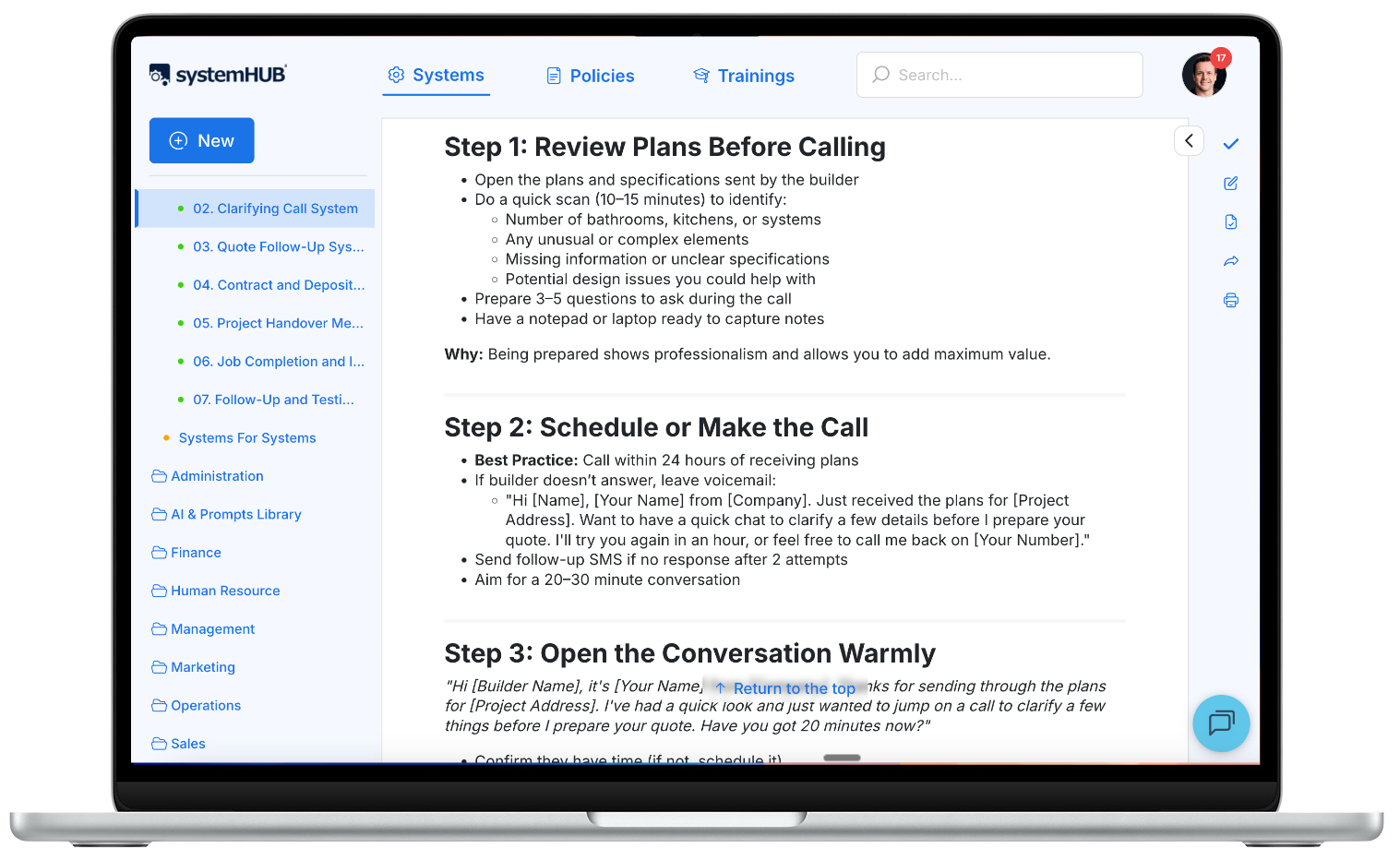
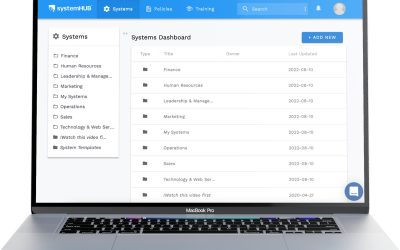
A dedicated systems management platform keeps everything organised and accessible.
Give your systems a home your team will actually use
systemHUB is purpose-built systems management software that keeps your processes organised, accessible, and up to date.
Common mistakes with process management
Even with the best intentions, business owners fall into predictable traps. Here are the ones I see most often.
Treating documentation as a one-time project. You create a batch of systems, feel accomplished, and move on. Six months later, half of them are out of date and nobody references them. Process management is an ongoing discipline, not a project with a finish line. Build it into your operations permanently.
Overcomplicating the software. You don’t need enterprise BPM platforms with BPMN flowcharting and process mining. You need a simple, intuitive place to store your systems and a way to assign tasks with accountability. If your software requires an administrator or weeks of training, it’s too complex. Unneeded features create friction, and friction lowers adoption.
Failing to build accountability into daily workflows. Having systems available is not the same as having systems followed. You need to connect your documented processes to your daily task management. Link systems to assigned tasks. Create milestones that team members check off as they complete key steps. This is how you move from “we have processes” to “we follow processes.”
Not involving the team in system creation and updates. People support what they help create. If you hand your team a finished system and say “follow this,” expect pushback. Instead, involve knowledgeable workers in the extraction, let them review and refine the documentation, and ask for their feedback. The more ownership they feel, the more likely they are to follow the system and flag improvements.
Blaming people instead of systems when things go wrong. When a mistake happens, the first question should always be: “Is there a system for this, and was it followed?” If the system was followed and the outcome was wrong, the system needs fixing. If the system wasn’t followed, that’s a training and accountability issue. Either way, the focus stays on improving the process, not punishing the person. This creates a culture where team members feel safe flagging problems rather than hiding them.
Frequently asked questions
What is process management in simple terms?
Process management is the ongoing practice of organising, maintaining, and improving the documented systems in your business. It covers how you store your processes, how your team accesses them, who keeps them updated, and how you measure whether they’re working. Think of it as the care and feeding of your business systems after they’ve been created.
What is the difference between process management and project management?
Process management is about how recurring work gets done. It focuses on the documented systems and procedures that govern repetitive tasks. Project management is about who does what, by when. It focuses on assigning tasks, tracking deadlines, and managing one-off or time-bound work. You need both, and they work best as separate tools that link together. Your systems management software holds the “how,” and your project management software handles the “who and when.”
Who should be responsible for managing processes in a small business?
Ideally, you appoint a systems champion. This is someone on your team who is naturally detail-oriented and organised, someone who enjoys creating order and gets satisfaction from seeing things run smoothly. They take ownership of the documentation effort, maintain the systems library, and hold the team accountable. The business owner sets the vision, but the systems champion drives the day-to-day process management.
How often should business processes be reviewed and updated?
At minimum, review your systems monthly. Use a “problems list” where your team logs system-related issues as they encounter them, then review and prioritise that list in a monthly meeting. On a quarterly basis, do a broader audit of your entire systems library to catch gaps, outdated documentation, and new processes that need creating. Any time your business makes a significant change (new software, new hire, new product), review the affected systems immediately.
What tools do I need for process management?
You need two core tools. First, systems management software: a central platform where all your documented processes are stored, organised by department, and accessible to your team. Second, project management software: a tool for assigning tasks, setting deadlines, and tracking completion. The key is linking the two by posting system links inside task assignments. Avoid combining them into one platform, as this typically introduces unnecessary complexity. For systems management, look for something purpose-built, intuitive, and easy for your whole team to use.
How do I get my team to actually follow documented processes?
Three things make the difference. First, accessibility: put the system link right inside the task where work is assigned. Make it impossible to miss. Second, accountability: when a team member marks a task as complete, they’re confirming it was done to the standard in the system. Third, culture: get your team to embrace systems by framing the benefits around them personally. Show how it makes their job easier, reduces stress, and creates opportunities for growth. People support what they help create, so involve them in building and refining the systems.
What is a systems champion?
A systems champion is a team member who takes ownership of your business documentation. They schedule and conduct system extractions with knowledgeable workers, create step-by-step documentation, organise systems by department, coordinate testing, maintain the problems list, and run regular review meetings. They don’t need special qualifications. They just need to be detail-oriented, organised, and committed to making systems work. In SYSTEMology, the systems champion is the key role that makes ongoing process management sustainable without the business owner being involved in every step.
Your systems don’t manage themselves. But with the right person, the right cadence, and the right tools, they won’t need you to manage them either.
Process management is the bridge between documented systems and a business that actually runs on them. It’s not glamorous work. It doesn’t make headlines. But it’s what separates businesses that grow from businesses that stay stuck.
If you’re ready to give your systems a proper home and build the management habits that make them stick, explore systemHUB and see how it can work for your business.