You know you should be delegating more. But every time you try, something goes wrong.
The task comes back half-done. Your team member asks twelve questions you thought were obvious. Or worse, you end up redoing the whole thing yourself, wondering why you bothered in the first place.
Here’s what I’ve learned after years of helping business owners escape their own operations: the problem isn’t usually HOW you delegate. It’s knowing when to delegate. Which tasks are ready to hand off? Which ones still need you? And how do you tell the difference before things fall apart?
Most delegation advice skips straight to the mechanics. But the decision of what to delegate (and what to keep) is where most business owners get stuck. Get this wrong, and delegation becomes a revolving door of frustration. Get it right, and you start building a business that runs without your constant involvement.
I’m a self-described recovering micromanager. Building the SYSTEMology framework was my way of learning to let go of the right things at the right time. In this guide, I’ll share the decision framework that makes it clear.
In this guide:
What “when to delegate” actually means
Delegation isn’t an all-or-nothing decision. You don’t wake up one morning and hand everything to your team. You also can’t keep doing everything yourself and expect the business to grow.
The real skill is knowing which tasks are safe to hand off and which ones still need you. This is a different question from how to delegate (the mechanics of handing off work) or delegation of authority (transferring decision-making power). This article is about the when. The decision framework that tells you which tasks are ready to leave your plate today.
Think of it this way. Every task in your business falls into one of two categories:
Delegate: Repeatable tasks
Tasks that happen regularly, follow a predictable pattern, and can be documented. These are the systems that keep your business running. They don’t need your unique skills. They need a clear process and a capable person to follow it.
Keep: Irreplaceable tasks
Tasks that require your unique vision, key relationships, or strategic thinking. These are the things only you can do because they depend on who you are, not what you do. No system can replace them.
The goal is to move as many tasks as possible from the first category off your plate, so you have the time and headspace for the second. That’s what SYSTEMology is built to do.
6 signs it’s time to delegate
Most business owners wait too long to delegate. They tell themselves they’ll get to it when things calm down. But things never calm down when you’re the bottleneck. Here are the clearest signals that it’s time to start handing things off.
1. You’re the bottleneck and you know it
Tasks are piling up. Your team is waiting on you for approvals, answers, or decisions before they can move forward. If removing yourself from the chain would speed things up, that’s a sign those tasks are ready to delegate.
In the SYSTEMology framework, we talk about the business owner being the biggest bottleneck. Not because you’re doing a bad job, but because everything flows through you. Every question, every decision, every approval. Your business can only move as fast as your calendar allows.
2. The same tasks keep pulling you away from strategy
You planned to spend this morning on growth strategy. Instead, you answered supplier emails, approved an invoice, and walked a team member through a process for the third time this month. Sound familiar?
If repeatable tasks keep hijacking your strategic time, they’re candidates for delegation. You should be working on the business, not trapped inside it doing work that someone else could do just as well.
3. Your team is capable but waiting on you
This one stings. You’ve hired good people. They have the skills. But they’re idle or underperforming because they need your sign-off on everything. When you hire and retain A-players, the worst thing you can do is make them wait around for permission.
If your team could handle the task with a clear process and documented guidelines, it’s time to delegate.
4. Quality drops when you’re stretched too thin
When you try to do everything, nothing gets done well. Client calls get rushed. Proposals go out with errors. Follow-ups slip through the cracks. This is your business telling you that you’re holding too much.
Counterintuitively, delegating improves quality. When you hand off repeatable work to a team member with a documented system, they can give it their full attention. You get better output because the task has a dedicated owner, not a stretched-thin founder.
5. You’ve documented the process (or easily could)
If you can describe a task in a series of steps, it’s a delegation candidate. And in SYSTEMology, you don’t even have to write those steps yourself. You find the knowledgeable worker (the person who already does the task well) and have someone else document it by watching them work.
If a task follows a repeatable process, it can be captured, stored, and handed off.
6. A key person leaving would expose a gap
If only one person (including you) knows how to do a critical task, that’s a vulnerability, not a delegation decision. It’s a business risk. Documenting and delegating that process isn’t optional. It’s protection against the day when that person is unavailable, on leave, or moves on.
Key point: If you recognised yourself in three or more of these signs, delegation isn’t something to “get around to.” It’s the most urgent thing on your list.
How owner-dependent is your business?
Take the free Systems Strength Test and find out where your delegation, documentation, and team systems stand right now.
What to delegate first (use your Critical Client Flow)
This is where most delegation advice falls short. It tells you to “delegate more” without telling you where to start. SYSTEMology gives you a clear answer: start with your Critical Client Flow.
The CCF is a map of the 7 to 12 key systems your business uses to deliver its core product or service. It covers the journey from getting a client’s attention through to delivering the result and getting paid. Every business has one, whether you’ve documented it or not.
Here’s why the CCF is your delegation roadmap. These are the tasks that:
- Happen repeatedly (they’re part of every client journey)
- Directly drive revenue (they’re how you make money)
- Are already being done by someone (often by you, but not always)
- Can be documented by watching the current best performer
When you map your CCF, you’re identifying the exact tasks that are prime delegation candidates. Not random tasks. Not the easy stuff. The critical, revenue-driving work that currently depends on you but shouldn’t.
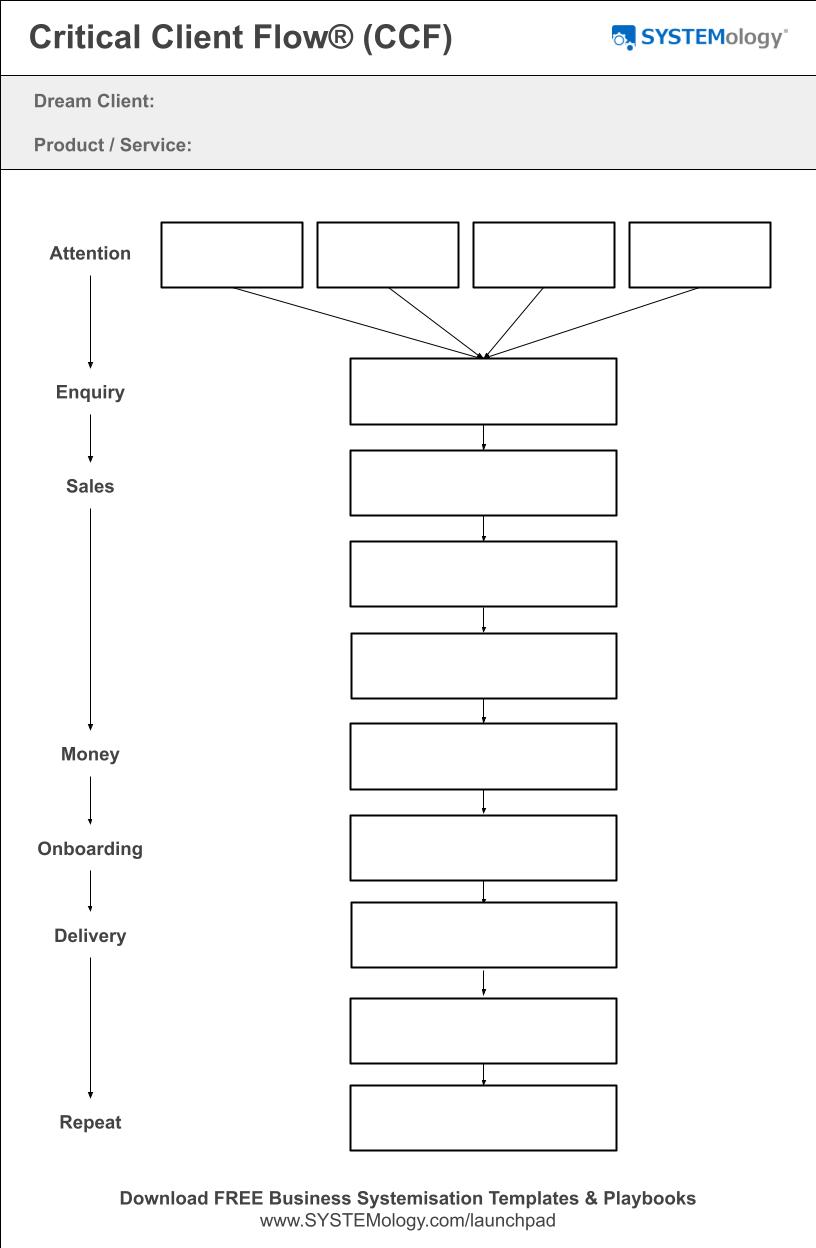
The Critical Client Flow maps your 7-12 core business systems, showing exactly where to focus your delegation efforts.
Once you have your CCF, pair it with the DRTC (Departments, Responsibilities & Team Chart). The CCF tells you WHAT to delegate. The DRTC tells you WHO should own it. Together, they give you a delegation action plan that’s specific, clear, and tied to the work that matters most.
Example: Delegating from a CCF
Imagine you run a building company. Your CCF might include systems like: handling incoming enquiries, quoting jobs, scheduling site visits, managing subcontractors, invoicing, and collecting client feedback.
Right now, you’re personally handling enquiries, writing every quote, and checking in with every subcontractor. That’s three CCF systems that are bottlenecked on you.
Using the DRTC, you assign: enquiries to your admin person (the knowledgeable worker who already answers the phone). Quoting to your senior estimator. Subcontractor management to your site foreman.
Each of these tasks is repeatable, documentable, and already being done well by someone in the business. They just need a system and clear ownership to run without you.
What NOT to delegate (what only you can do)
Knowing when to delegate is just as much about knowing when NOT to delegate. Some tasks should stay with you, not because you’re the only one capable, but because they require something that can’t be systematised.
1. Vision and strategic direction
Where is the business going? What markets will you enter? What products will you build next? These are founder decisions. They require your unique understanding of the market, your ambition, and the long-term picture only you hold. This is the work of a leader, not a manager.
In the SYSTEMology framework, we distinguish between the leader (often the founder) and the manager (the person who runs operations). Walt Disney had Roy. Henry Ford had James Couzens. Ray Kroc had Fred Turner. The leader sets the direction. The manager makes it happen. You don’t delegate the direction.
2. Key relationships
Your top clients, strategic partners, and industry connections often have a relationship with you specifically. They chose your business because of you. These high-value relationships need your personal attention, your responsiveness, and your judgment. You can delegate the follow-up admin around them, but the relationship itself stays with you.
3. Culture and values decisions
How your team treats each other. What you tolerate and what you don’t. The standard you hold for client experience. These are the cultural pillars that make your business yours. A system can reinforce culture, but someone has to define it. That’s you.
4. Final say on critical commitments
Signing a major contract. Making a significant hire. Entering a partnership. These irreversible or high-stakes decisions benefit from your experience and instinct. You can delegate the research, the shortlisting, and the analysis. But reserve the final call for yourself.
The rule of thumb: Delegate the repeatable. Keep the irreplaceable. If a task depends on who you are rather than what you do, it stays with you. Everything else is a candidate for a system and a capable team member.

The old way: the owner holds every task, every decision, every process.

The SYSTEMology way: repeatable tasks are delegated through systems, freeing the owner for strategic work.
The delegation decision framework
If you’re unsure whether a specific task is ready to hand off, run it through these four questions. This framework cuts through the uncertainty and gives you a clear answer.
The 4-question delegation test
1. Is this task repeatable? Does it happen more than once? Weekly, monthly, or with every client? If yes, it’s a delegation candidate.
2. Can it be documented? Could you (or someone else) write down the steps in a way that a competent person could follow? If yes, it’s ready for a standard operating procedure.
3. Does it require my unique knowledge or relationships? Not “can I do it better” but “does it genuinely require ME?” If the answer is honestly no, it’s a delegation candidate.
4. Would someone else do it 70% as well (or better)? You don’t need perfection. You need competence. If a team member could handle it at 70% of your standard with a good system behind them, delegate it. They’ll improve with practice. The system will improve with feedback.
Quick test: If you answered “yes” to questions 1 and 2, and “no” to question 3, that task is ready to delegate today. Don’t wait for the perfect moment. The perfect moment was six months ago.
The hardest part of this framework is question 3. Most business owners believe more tasks require their unique involvement than actually do. This is the business ego at work. The belief that “no one does it like me” is natural, but it’s also the single biggest barrier to growth.
Challenge yourself on this one. For every task you think only you can do, ask: “If I were on holiday for three months, what would happen to this task?” If the answer is “someone else would figure it out,” then it doesn’t actually require you.
Ready to delegate with confidence?
systemHUB gives you a central place to document your systems, assign ownership, and make delegation stick.
How to make delegation stick with systems
Deciding what to delegate is only half the battle. The other half is making sure it actually works. This is where most delegation attempts fail. The task gets handed off, quality drops, the owner takes it back, and nothing changes.
The fix isn’t better people. It’s better systems. When delegation is backed by documented processes, it sticks. Here’s how.
1
Identify
Use your CCF to find the repeatable tasks that are bottlenecked on you.
2
Document
Extract the system from the knowledgeable worker. Don’t write it yourself.
3
Assign & verify
Use the DRTC to assign clear ownership. Verify outcomes, not steps.
Step 1: Identify the delegation candidates
Start with your Critical Client Flow. Look at every system on it and ask yourself: “Am I still personally doing this?” If yes, it’s a delegation candidate. Prioritise the systems that cause the biggest bottleneck or consume the most of your time.
You don’t need to delegate everything at once. Pick one or two systems to start. Small wins build confidence for both you and your team.
Step 2: Document the process
This is the part most business owners get wrong. They try to write the SOP themselves. In SYSTEMology, documenting a system is always a two-person job. One person (the knowledgeable worker) demonstrates the process. Another person (the systems champion) documents it.
Why? Because the person doing the task is usually too close to it. They skip steps they consider “obvious.” A fresh pair of eyes catches everything. And most people would rather review and edit a draft than write something from scratch.
Once the system is documented, store it somewhere your team can actually find it. Scattered Google Docs and email attachments don’t count. You need a central hub where every system lives, is searchable, and stays current.
Step 3: Assign ownership and verify outcomes
A documented system without an owner is just a document. Use your DRTC to assign clear responsibility. Who owns this department? Who owns this specific process? Who is accountable when the outcome doesn’t meet the standard?
Once ownership is clear, your job shifts from doing the work to verifying the result. You’re checking outcomes, not hovering over someone’s shoulder watching them follow steps. That’s the difference between leadership and micromanagement.
In my old digital agency, I learned this the hard way. My manager Melissa eventually posted a message in our project management software telling the team to ignore my “urgent” messages. It was embarrassing. But she was right. I was undermining the systems we’d built by jumping in and doing things myself. The system held the standard. My job was to trust it.
Common mistakes with when to delegate decisions
Delegating everything at once. You get excited about the idea of delegation and try to hand off ten things in one week. Your team drowns. Quality crashes. You end up taking it all back and concluding that “delegation doesn’t work.” Start with one or two CCF systems. Build the muscle gradually.
Keeping tasks because “no one does it like me.” This is the most common trap. You confuse “different” with “worse.” Your team member handles the task differently from how you would, so you assume it’s not good enough. But often, 70% of your standard with a documented system beats 100% of your standard with you as the bottleneck. The system will improve. Your bandwidth will not.
Delegating without documenting first. Handing off a task without a written process is delegation by hope. Without standard operating procedures, your team has to guess what “good” looks like. The system is the safety net that makes delegation work.
Delegating the wrong things. Vision, culture, key relationships, and high-stakes strategy decisions are not delegation candidates. If you hand off your most important client relationship to someone who doesn’t understand the nuance, you’ll damage it. Know the line between repeatable and irreplaceable.
Taking tasks back at the first sign of imperfection. Your team member makes a mistake. Your instinct screams: take it back. But every time you reclaim a task, you’re training your team that trying isn’t worth the risk. Instead of taking the task back, ask: “What’s missing from the system?” Fix the process, not the person.
Frequently asked questions
When is the right time to start delegating?
The moment you have at least a few team members and find yourself doing repeatable tasks that pull you away from strategic work. If you’re spending more than half your day on tasks someone else could handle with a clear process, you’re overdue. Don’t wait until you’re burnt out. Start by delegating one system from your Critical Client Flow and build from there.
What tasks should a business owner never delegate?
Vision and strategic direction, culture-defining decisions, critical stakeholder relationships, and final-call decisions on irreversible commitments. These tasks depend on who you are as the founder, not on a process. Everything else, especially repeatable operational tasks, is a delegation candidate once it has a documented system behind it.
How do I know if a task is ready to be delegated?
Run it through the 4-question test. Is it repeatable? Can it be documented? Does it genuinely require your unique knowledge or relationships? Would someone else do it at 70% or better? If the first two are “yes” and the third is “no,” the task is ready. You don’t need to wait until you find the perfect person or the perfect process. Start with version one and improve from there.
What if my team can’t do the task as well as me?
They probably won’t do it as well as you at first. That’s normal. The question isn’t whether they match your standard on day one. The question is whether the system gives them a path to get there. Document the process, assign ownership, and give them room to improve. Most business owners find that within a few weeks, the team member does the task differently but equally well, sometimes even better, because they can give it their full focus.
Should I delegate tasks I enjoy doing?
If the task is repeatable and someone else can do it, yes. Enjoying a task doesn’t mean it’s the highest and best use of your time. Many business owners hold onto tasks they enjoy (like client calls or product design) while neglecting the strategic work only they can do. Delegate the enjoyable but repeatable tasks so you can focus on the work that actually moves the business forward.
How does the Critical Client Flow help with delegation?
The CCF maps the 7-12 key systems your business uses to deliver its core product or service. It gives you a concrete list of repeatable processes to evaluate for delegation. Instead of guessing where to start, you can look at your CCF and ask: “Which of these am I still personally doing?” Those are your first delegation candidates. Pair it with the DRTC to identify who should own each one.
What’s the difference between delegating tasks and delegating authority?
Delegating tasks means handing off the work. Delegating authority means handing off the decision-making power that goes with it. When you delegate a task without authority, your team member still comes back to you for every decision. When you delegate authority, you give them the system, the guidelines, and the permission to make calls within that framework. Both are important, but delegation of authority is what truly frees you from the day-to-day.
The freedom you’re looking for is on the other side of letting go.
You don’t need to delegate everything. You need to delegate the right things at the right time, backed by the right systems. Start with your CCF. Use the 4-question test. Document before you hand off. And trust that a team member with a good system will get the job done.
When you systemise your business, delegation stops being a leap of faith. It becomes a predictable, repeatable process that builds your team’s capability and gives you back the time to do the work that only you can do. Ready to start? See how systemHUB can help.