Repeatable Processes: What They Are and How to Build Them
A repeatable process is a task that happens more than once and gets the same result every time it is done the same way. Here is how to spot yours, which to document first and four worked examples.
What are repeatable processes?
A repeatable process is any task or sequence of steps that happens more than once in your business and produces a consistent result when it is followed the same way each time.
Sending invoices, answering enquiries, onboarding clients, posting on social media and running payroll are all repeatable processes, whether you have documented them or not.
Three parts make a process repeatable
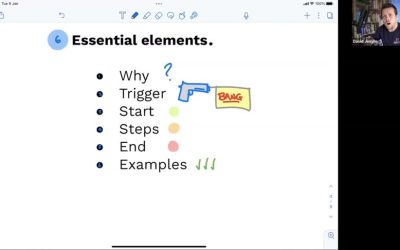
- 1TriggerWhat kicks the process off
- 2StepsThe method, in order
- 3EndpointHow you know it is done
Document those three things, test them with someone who has not done the task before and refine from their feedback. You now have a process anyone on the team can follow.
A project (one-off)
- Redesigning your website once every three years
- Moving to a new office
- Launching a new product line
A repeatable process
- Handling the ten new enquiries you get every week
- Sending the weekly invoices
- Onboarding every new client
The simple test: if a task happens more than once and more than one person could do it, it is a repeatable process and it deserves a documented system, even a simple one. The goal is consistency, not perfection. As I explain in SYSTEMology, we aren’t creating anything new at this stage. We are uncovering what you already do and capturing it so anyone can follow along.
Most businesses already run on repeatable processes. The trouble is that they live inside individual heads, unwritten and inconsistent. One person onboards a client one way and another does it differently so the owner steps in to fix it. The gap between “we do this task regularly” and “we have a documented way to do it” is where most operational problems come from.
Why repeatable processes matter for your business
“We’re doing fine without formal documentation.” I hear that a lot and it is usually true right up until a key person leaves, a mistake costs you a client or growth stalls because you can’t onboard people fast enough.
1. Consistency builds client trust
When every team member follows the same process, clients get the same quality every time. No more one person handling a task brilliantly and another dropping the ball. In SYSTEMology I call this the “best known way”: find who does the task best, capture their approach and get everyone to follow it. You are spreading what already works.
2. You stop being the bottleneck
If your team can’t complete a task without asking you, that task has no repeatable process. Every question in your inbox is a symptom of a missing or broken system. When the steps are documented your team can follow them without you supervising.
3. Onboarding becomes fast
With documented processes a new hire has clear steps and knows what “good” looks like. They can be productive in days instead of weeks. See onboarding best practices.
4. Quality goes up for free
Documenting a process forces you to define what “done right” means. That creates a standard your team can meet, measure and improve. It is the cycle of process improvement: document, delegate, optimise, repeat.
5. Your business can scale
Growth without repeatable processes is chaos. Every new client or hire adds complexity and without documented systems that complexity lands on your desk. Processes let revenue grow without growing your problems.
6. You build a sellable asset
A business that depends on its owner is a job with overhead. The first thing a buyer wants to see is that the operation runs without you. Documented, repeatable processes are how you prove it.
How strong are your business systems?
Take the free Systems Strength Test to find out where your repeatable processes are solid and where the gaps are costing you time and money.
Take the free testHow to identify your repeatable processes
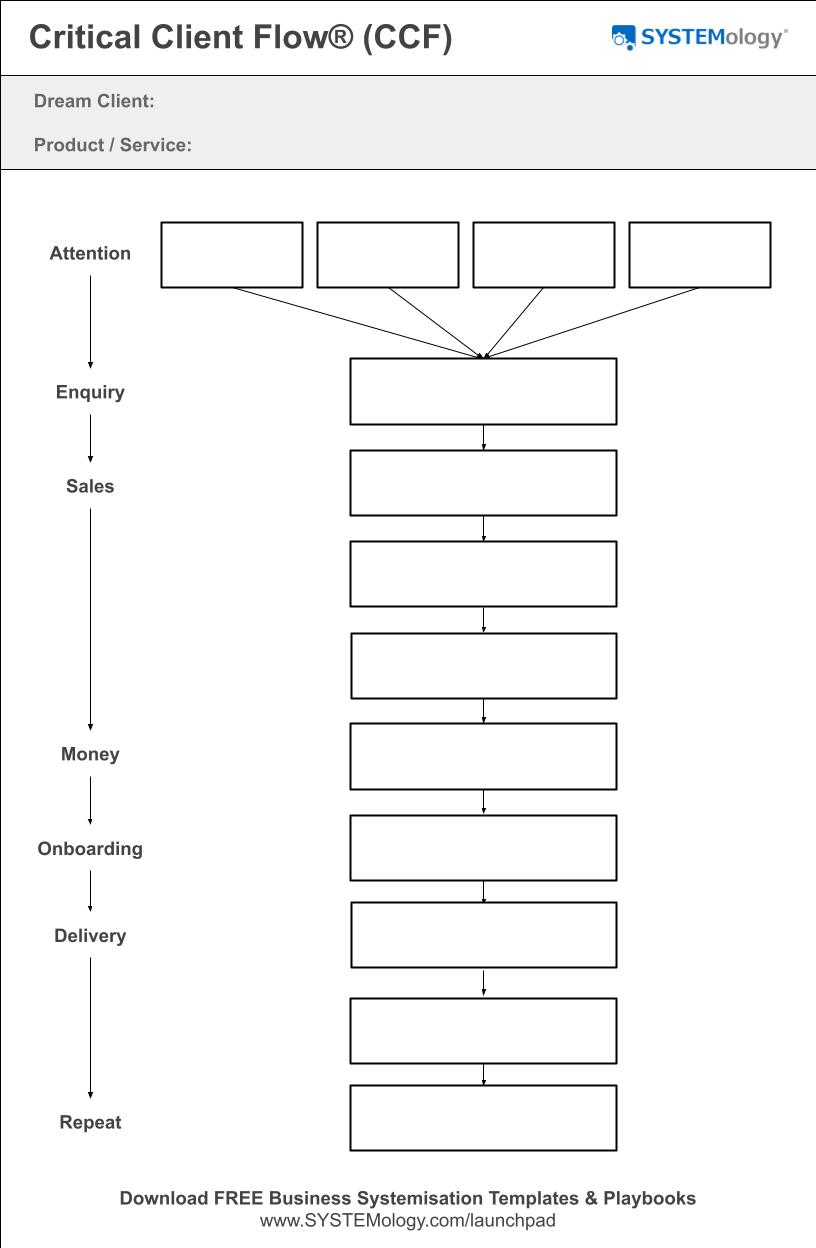
“Where do I start?” is the question I hear most. That is why I created the Critical Client Flow (CCF): a simple tool that takes about twenty minutes and shows the 10 to 15 most critical repeatable processes in your business. No guesswork and no overwhelm.
It works by mapping the journey your client takes from first hearing about you to becoming a repeat customer. Every step on that journey is a repeatable process that needs a system.
- 1DefinePick one target client and one core product, then map their journey
- 2AssignFind who on your team already does each step well
- 3ExtractRecord them at work and turn it into a documented process
- Pick one client and one productDon’t try to map every client type and service. Start with your dream client and the product that best serves them. As I wrote in SYSTEMology: “one client, one product, one journey.”
- Map the Critical Client FlowTrace how that client moves through your business: Attention, Enquiry, Sales, Money, Onboarding, Delivery and Repeat or Referral. Write two or three words per stage on what actually happens, not what you wish happened. Gaps show up fast: weak leads in Attention, clients slipping through in Onboarding or Delivery. The CCF finds your repeatable processes and also shows where the broken ones are.
- Break each stage into tasksUnder each stage list the specific tasks. Under Sales you might have: send proposal, follow up after three days, schedule discovery call. Each of those is a repeatable process.
- Spot the tasks that recurHighlight every task that happens daily, weekly or monthly. Those are your repeatable processes. One-off and rare tasks can wait.
- Prioritise with the 80/20 ruleAbout 20% of your systems produce 80% of your gains. Start with the ones that affect client delivery and revenue or that depend on you personally. See prioritising the right systems.
The Critical Client Flow in one page
Keep it to 7 to 12 steps. If you have more, combine the steps handled by the same person or department. You should be able to explain how your business works on the back of a napkin.
Get the free CCF templateRepeatable beats world class.
How to document a repeatable process
You have identified your critical processes. Now get them out of people’s heads and into a format anyone can follow. Most owners stall here because they assume it means writing a manual from scratch. It doesn’t. Find someone who already does the task well and capture what they do as the baseline.
- Define the resultBe clear what “done well” looks like. For invoicing: “invoice sent within 24 hours of project completion, with correct amounts and payment terms.”
- Find your knowledgeable workerThe owner is usually the worst person to document systems: too busy, too close to the detail and rarely the one doing the task. Pick the team member who already does it to a high standard. That is your “knower”.
- Record them doing itAsking someone to write down what they do creates resistance. Recording them doesn’t. Use screen recording for desk work, a phone or GoPro for physical tasks and a voice recorder for calls.
- Have your systems champion write it upCreating systems is a two-person job. The knower shares the knowledge and the systems champion turns the recording into a clear SOP. Most people hate writing documentation but don’t mind editing something that exists.
- Test it with a newcomerThe real test: someone who has never done the task follows the document and gets an acceptable result. If they get stuck, that shows exactly where it needs work.
Key principle: your first version of any process will be the worst it ever is and that is fine. You want a usable baseline your team can follow and improve, not a perfect document. For the whole method, with the roles and the capture tools, read process documentation.
Repeatable process examples across departments
Repeatable processes exist in every department. Here are four that show what a documented one looks like. Each has a clear trigger, a defined sequence of steps and a measurable endpoint.
Weekly email newsletter
Trigger: Every Monday morning at 9:00 AM.
- Review the content calendar for this week’s topic and approved copy.
- Build the email in the marketing platform from the standard template.
- Add the subject line, preview text and call-to-action link.
- Send a test to the review group.
- Make final edits from the test feedback.
- Schedule the send at the approved time.
- Log the send date, subject line and open rate in the tracking sheet.
Endpoint: Email sent and metrics logged within 24 hours.
Handling an incoming enquiry
Trigger: A new enquiry arrives by phone, email or web form.
- Respond within two business hours with the standard acknowledgement template.
- Log it in the CRM with contact details, source and first notes.
- Qualify the lead with the standard checklist.
- If qualified, book a discovery call within 48 hours.
- If not, send the “not a fit” template and close it.
- Update the CRM status and assign follow-up tasks.
Endpoint: Lead qualified and either booked or closed out within 48 hours.
Client onboarding sequence
Trigger: A new client signs the agreement and pays the first invoice.
- Send the welcome email with login details and next steps.
- Create the client project in the project management tool.
- Send the onboarding questionnaire.
- Book the kickoff call within five business days.
- Assign the account manager and introduce them to the client.
- Run the kickoff: set expectations and confirm deliverables.
Endpoint: Client onboarded, expectations set and first deliverable scheduled within one week of payment.
Weekly invoicing cycle
Trigger: Every Friday afternoon.
- Review completed work for the week against active client projects.
- Generate invoices in the accounting software from the standard templates.
- Cross-check amounts against agreed pricing and approved change orders.
- Email the invoices with the standard payment terms.
- Log each invoice in the accounts receivable tracker.
- Follow up on anything overdue by more than seven days.
Endpoint: All invoices for the week sent and logged with overdue ones flagged for follow-up.
The pattern works for any process: define the trigger, list the steps and set the endpoint. It holds whether you are writing everyday procedures for a receptionist or a complex delivery workflow for an operations team.
Ready to document your repeatable processes?
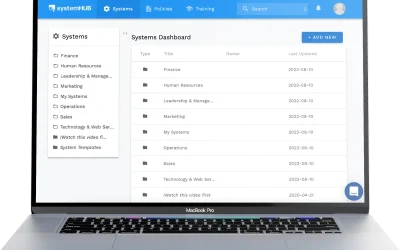
systemHUB gives you the tools and templates to capture, organise and share your systems with your whole team.
See plans and pricingMcDonald’s wins on consistency.
The McDonald’s lesson (and why you shouldn’t copy them)
“You need to systemise like McDonald’s.” I hear it constantly and it is one of the most damaging myths in business. McDonald’s is the gold standard of repeatable processes. But its current form is the result of six decades of development.
When Ray Kroc arrived the McDonald brothers had a restaurant that already worked like a well-oiled machine, yet they had tried and failed to franchise it. The system was far from perfect and it took years of optimisation to get close. Think of McDonald’s as an elite athlete at Olympic level in business systemisation. Trying to copy their level of detail on day one is like a couch potato following an Olympic training program. You will burn out before you see results.
I have seen owners catch the systemisation bug and try to build Olympic-level detail for every process, split-testing tiny variables before they have a baseline. That makes sense for McDonald’s. It doesn’t for a business that has not yet documented its core processes.
The real lesson: McDonald’s didn’t start with perfect processes. It documented what was already working and improved from there. Capture your processes as they are today, get your team following them consistently and optimise over time. Document first. Optimise later. A rough process your team follows beats a “perfect” one that never gets written.
Common mistakes when building repeatable processes
After working with hundreds of business owners I see the same mistakes again and again. These five derail the most progress.
Documenting everything at once
The number one killer. The owner gets motivated, lists 150 processes and feels so overwhelmed they don’t start one. Use the CCF to pick the 10 to 15 critical ones and begin there.
Waiting for the “perfect” process
Perfectionism disguised as quality control. If you wait until a process is flawless to write it down, you never will. Document what happens now, even if it is messy.
Making the owner write it all
The owner is rarely the person who does the task every day. Use the extraction method: the knowledgeable worker demonstrates and the systems champion documents.
Going to McDonald’s-level detail
Your processes don’t need to rival a Fortune 500 company on day one. A process document should be short enough to read in five minutes and start executing. Add detail as you delegate and refine.
Failing to assign ownership
A documented process with no owner gathers dust. Every repeatable process needs a person who makes sure it is followed and keeps it updated. No owner, no accountability, no results.
Frequently asked questions
What is a repeatable process?
A repeatable process is any task or sequence of steps that happens more than once in your business and can be documented so that different team members get a consistent result. Examples include sending invoices, onboarding clients, answering enquiries and processing payroll. If a task recurs and has defined steps it qualifies.
How do you make a process repeatable?
A process becomes repeatable when it has three things: a clear trigger that starts it, a defined sequence of steps and a measurable endpoint that shows it is done. Document those three, test the document with someone who has not done the task before and refine it from their feedback.
What is a repeatable sales process?
It is your sales steps written down so every enquiry is handled the same way: a trigger such as a new enquiry, steps such as responding within two hours, logging it in the CRM, qualifying the lead and booking a discovery call and an endpoint such as “qualified and booked or closed out within 48 hours”. See the sales example above.
What is the difference between a process and a procedure?
A process describes the overall flow of work from start to finish. A procedure is a detailed, step-by-step instruction for completing one task within that process. The process is the map and the procedure is the turn-by-turn directions. See how to write an SOP.
How many repeatable processes does a small business need?
You don’t need hundreds. The Critical Client Flow usually identifies 10 to 15 core repeatable processes that drive the business. Start there and expand into finance, HR and management once they run smoothly. About 20% of your processes deliver 80% of your operational gains.
What is the Critical Client Flow (CCF)?
The CCF is a SYSTEMology tool that maps the journey your client takes through your business, from first hearing about you to becoming a repeat customer. It shows 7 to 12 stages such as Attention, Enquiry, Sales, Onboarding, Delivery and Repeat and it reveals the core repeatable processes your business depends on. It takes about twenty minutes. See business process diagrams.
Who should document repeatable processes?
Not the business owner. The SYSTEMology extraction method uses two people: the knowledgeable worker, who does the task best and is recorded and the systems champion, who turns the recording into written documentation. The knowledgeable worker then reviews and refines it. See process documentation.
How often should repeatable processes be reviewed?
Review your core processes every 90 days. That doesn’t mean rewriting them. Check that the documented steps still match how the work is done and look for obvious improvements. Some need updating sooner if the business is growing fast or you have changed tools.
Can repeatable processes work for creative businesses?
Yes. Systemising doesn’t remove creativity. It removes the repetitive administrative tasks around the creative work. A design agency still produces unique work for every client but the way it briefs the project, manages revisions, delivers files and invoices can all be repeatable processes. The system handles the structure so the creative team can focus on the work that matters.
Every business already runs on repeatable processes. The question is whether yours are written down.
You don’t need to overhaul your operation. Start with one process: the one that causes the most headaches or takes the most of your time. Document it with the extraction method, hand it to someone else and move on to the next. That is how you build a business that runs without you, one repeatable process at a time. Added up they make your business brain, the one place that explains how your business runs.
Keep reading
Give every process a home your team will use
systemHUB keeps your SOPs, checklists and training in one place so how you work is never stuck in someone’s head.
14-day free trial. No credit card required.