What if your biggest growth problem isn’t your product, your marketing, or your sales process… but your people systems?
You know the feeling. You finally find someone who seems like a great fit, bring them on board, and two months later they’re gone. Or worse, they stay but never quite perform the way you hoped.
For most small business owners, human resources management feels like something big companies worry about. You don’t have an HR department. You don’t have a dedicated recruiter. Half the time, “onboarding” means handing someone a laptop and saying, “Ask Sarah if you have questions.”
Here’s what I’ve learned after helping thousands of business owners systemise their operations: your people problems are almost always systems problems. Bad hires, high turnover, inconsistent performance, team members who “just don’t get it” … these aren’t signs of a bad team. They’re signs of missing HR systems.
The good news? You don’t need a corporate HR department to fix this. You need a handful of documented, repeatable processes that bring consistency to how you hire, onboard, train, review, and manage your team. And in this guide, I’ll show you exactly how to build them.
In this guide:
What is human resources management?
Human resources management is how your business attracts, hires, develops, and retains the right people. For small businesses, it covers every system that touches your team, from the moment you write a job ad to the day someone moves on.
Now, if the phrase “human resources management” makes you think of corporate bureaucracy, thick policy manuals, and soul-crushing compliance training, I understand. That’s not what we’re talking about here.
For a business with 10 to 50 employees, HR management is really about answering five practical questions:
- How do we find and hire the right people?
- How do we get new team members up to speed quickly?
- How do we develop and train our people over time?
- How do we know if someone is performing well (or not)?
- How do we handle it when someone leaves?
In SYSTEMology, I teach that every business can be divided into six core departments: Marketing, Sales, Operations, Finance, Human Resources, and Management. Each department has its own set of repeatable systems that, once documented, allow the business to run without depending on any single person.
HR is one of the most neglected of those six departments. Most business owners have at least some marketing and sales systems in place. But when it comes to hiring, onboarding, and managing their team? They’re winging it. Every single time.
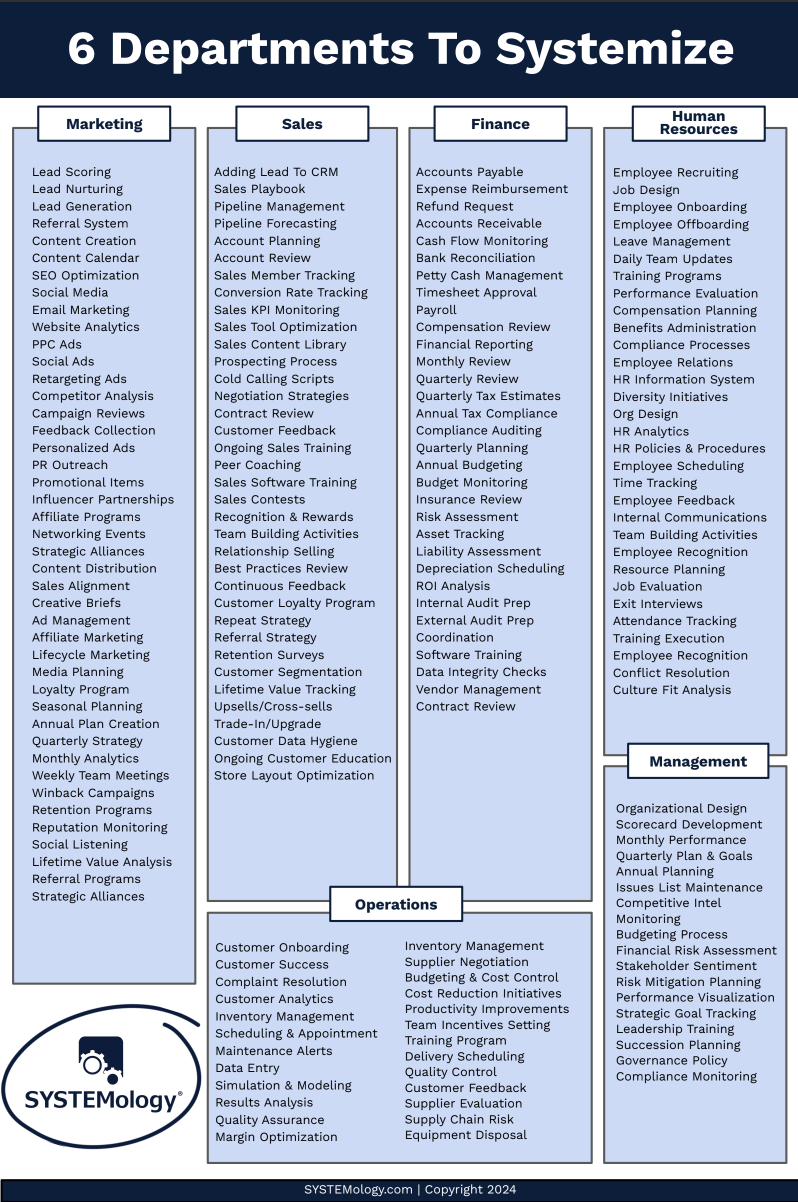
The six departments every business needs to systemise. HR is the one most small businesses skip.
The SYSTEMology approach uses a tool called the Departments, Responsibilities & Team Chart (DRTC) to map out each department, assign responsibilities, and identify where the knowledge already lives within your team. For the HR department specifically, this means identifying who currently handles hiring, who does the onboarding, and who manages performance. Once you know where the knowledge sits, you can begin documenting it.
Why human resources management matters for small businesses
I hear it all the time: “We’re too small for HR.” But here’s the truth. If you have employees, you have HR responsibilities. The question is whether those responsibilities are handled by a system or handled by luck.
Here’s why getting your HR systems right is one of the highest-leverage moves you can make.
1. Bad hires are expensive
Without a documented hiring process, every recruitment round is different. Different questions, different criteria, different gut feelings. The result? Inconsistent hiring and costly mistakes. Some studies estimate the cost of a bad hire at 30% of that person’s first-year salary. For a $70,000 role, that’s $21,000 in wasted time, training, and disruption.
A systematic recruitment process removes the guesswork. When every candidate goes through the same steps, the same questionnaire, and the same trial task, you make better decisions. Consistently.
2. Your best people leave when expectations are unclear
As I write in SYSTEMology: “A-players love to know what’s expected of them and how they can succeed in a role.” Top performers don’t want ambiguity. They want clarity on what great looks like and how to get there.
When you don’t have documented systems, expectations live in your head. Your team is left guessing. And your best people, the ones with options, will eventually leave for somewhere that offers the structure they crave.
3. You become the training bottleneck
If every new hire has to shadow you for their first two weeks, you’ve created a dependency that doesn’t scale. You can only personally onboard so many people before your own work suffers. This is especially painful during growth phases when you need to hire quickly.
Documented onboarding systems let your team train new members without you. That’s freedom. That’s what it means to systemise your business.
4. Compliance risk grows with your headcount
Employment law isn’t optional. As your team grows, so do your obligations around fair work practices, leave entitlements, workplace safety, and termination procedures. Without documented policies, you’re exposed. A simple, well-maintained employee handbook protects both your team and your business.
5. Business value depends on your team systems
Imagine you want to sell your business or bring in an investor. The first thing they’ll look at (beyond revenue) is whether the business can run without you. If all the people-knowledge lives in your head, your business is worth less. Documented HR systems, from hiring to performance reviews, signal a mature, transferable operation. (Not sure where you stand? Take our free Systems Strength Test to find out.)

The old way: hiring on gut feel, onboarding by osmosis, and hoping people figure it out.

The SYSTEMology way: documented HR systems that anyone on your team can follow.
Want ready-made templates to start building your HR systems?
Our free SOP templates give you a head start on documenting hiring, onboarding, and other critical processes.
The 5 HR processes every small business must systemise
In SYSTEMology, I recommend identifying 5 to 8 core systems for your HR department. You don’t need dozens of policies. You need a small collection of repeatable processes that cover the full employee lifecycle.
Here are the five that matter most.
1. Hiring and recruitment
This is the most important HR system you can build. As I write in the book: “Average team members like to sneak in under the radar; A-players love a system where they can demonstrate their skills and stand out from the crowd.”
A solid recruitment system follows a consistent path: write and post the job ad, create an applicant questionnaire, shortlist candidates, assign a trial task, conduct interviews, check references, and make a formal offer. Every candidate goes through the same steps. No exceptions.
The trial task is a game-changer most small businesses skip. Instead of relying on CVs and interview charm, you give shortlisted candidates a real task that mirrors the work they’ll actually do. It reveals skill level, work ethic, and communication style far better than any question you could ask in an interview.
Example: Small business recruitment system
Trigger: A new role is approved for hiring.
- Write the position description and person required
- Write the job advertisement and create an applicant questionnaire
- Post the ad on relevant recruitment sites
- Shortlist applicants based on questionnaire responses
- Send a trial task to gauge skill level
- Review trial task submissions and shortlist again
- Request CVs and cover letters from remaining candidates
- Conduct one-on-one interviews using standardised questions
- Contact referees and complete reference checks
- Select the successful candidate and make a formal offer
Endpoint: Successful candidate accepts offer and start date is confirmed. Unsuccessful finalists are notified.
2. Employee onboarding
The second system I always advise business owners to build is employee onboarding. This is the process that transforms a new hire into a confident, productive team member. It sets the tone for their entire experience with your company.
A strong onboarding system covers several key areas. Start with a welcome video from the founder that shares company history, values, and vision. Then move into training on your core tools and software (email, project management, systems management). Show them your Critical Client Flow (CCF) so they understand where their role fits within the broader business. Walk through the standard operating procedures specific to their role. Share the daily routine and expectations. Complete any necessary forms and compliance requirements.
As I tell every business owner I work with: establish, right from the start, “This is the way we do things here.” When new team members understand the systems from day one, they buy in. They don’t push back. They contribute.
Tip: View every new hire as an opportunity to review and improve your systems. Fresh eyes will often reveal gaps, unclear steps, and opportunities to streamline. Ask new team members to flag anything that confused them during onboarding, then use that feedback to refine the process.
3. Training and development
Onboarding gets someone started. Training keeps them growing. Without a system for ongoing development, your team plateaus. Skills stagnate. And your best people start looking for growth elsewhere.
You don’t need a complex learning management system. Start simple. Create a quarterly skills review for each role. Identify the two or three skills that would make the biggest difference. Then build a development plan around those skills, whether that’s shadowing a senior team member, completing an online course, or working through a set of documented procedures.
Cross-training is another powerful strategy most small businesses overlook. When team members can cover for each other, you eliminate single-person dependencies. If your accounts person goes on leave, someone else can step in because the system is documented and they’ve been trained on it.
4. Performance reviews
Most small business owners dread performance reviews. So they don’t do them. Or they do them once a year, awkwardly, covering twelve months of vague memories and uncomfortable feedback.
Here’s a better approach: make reviews frequent, short, and system-driven. A 15-minute monthly check-in using a simple template beats a two-hour annual review every time. Cover three things: what’s working well, what needs improvement, and what the priorities are for the next month.
Quarterly, go a little deeper. Review goals, discuss career development, and talk about how the team member fits within the broader business. The key is consistency. When reviews happen on a predictable schedule using a documented format, they stop being scary and start being useful.
Example: First-week onboarding checklist for a new team member
Trigger: New team member’s confirmed start date.
- Send welcome email with first-day instructions and company handbook
- Set up accounts: email, project management tool, systems management software
- Day 1: Welcome meeting with founder/manager and team introductions
- Day 1: Watch the founder’s welcome video covering company history and values
- Day 2: Training on core tools and software
- Day 2: Review the Critical Client Flow (CCF) and where their role fits
- Day 3-4: Walk through the documented SOPs for their specific role
- Day 5: Complete compliance forms and discuss daily routine expectations
- End of week 1: Check-in meeting to answer questions and gather feedback
Endpoint: New team member has access to all tools, understands company systems, and has a clear picture of their first 30 days.
5. Offboarding and termination
Nobody likes thinking about team members leaving. But it happens. And without a system, departures create chaos. Knowledge walks out the door. Accounts stay active. Clients fall through the cracks.
An offboarding system covers the practical steps: revoking access to tools and systems, transferring ongoing work, conducting a knowledge transfer session, collecting company property, and completing the final pay and compliance requirements. It also includes an exit interview, which is one of the most underused tools in small business. Former team members will often share insights about your business they’d never mention while employed.
Build this system before you need it. The worst time to figure out offboarding is when someone hands in their resignation on a Friday afternoon.
How to build an employee handbook (even if you have 5 employees)
An employee handbook isn’t a 200-page legal document. It’s your “this is how we do things here” guide. It sets expectations, communicates values, and gives your team a single reference point for policies and procedures.
You don’t need to build it all at once. Start with the essentials and add to it over time.
1
Start with essentials
Company values, code of conduct, leave policies, workplace safety, and anti-discrimination.
2
Document expectations
Working hours, communication norms, dress code, remote work policy, and performance standards.
3
Make it living
Store it centrally, review quarterly, update as policies change, and share with every new hire on day one.
The most important thing about a handbook? It’s not about rules. It’s about clarity. When your team knows what’s expected (and where to find the answers), they stop guessing and start performing.
Your handbook should cover the basics: company overview and values, employment policies (leave, hours, benefits), code of conduct and workplace behaviour, health and safety, communication guidelines, and the systems-centred culture you’re building. If you’re running a best-practice onboarding process, the handbook is what every new team member reads on day one.
SYSTEMology tip: Consider adding “systems-thinking” as a core value in your handbook. When you bake it into the culture from the start, your team understands that documenting and following processes isn’t optional. It’s “the way we do things here.”
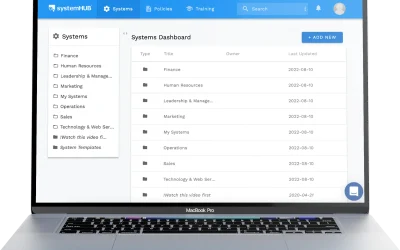
Store every HR system, SOP, and policy in one place
systemHUB gives your team a single, searchable home for every process, from hiring checklists to your employee handbook. No more scattered documents or forgotten folders.
How to use SOPs to create HR consistency
Standard operating procedures aren’t just for operations and delivery. They’re the backbone of every reliable HR function. When your hiring process is documented step by step, when your onboarding checklist is written down and tested, when your review template is the same every quarter, you get consistency. And consistency is what separates businesses that scale from businesses that stall.
The SYSTEMology approach to building HR SOPs follows the same extraction method you’d use for any business system. Here’s how it works.
First, identify the knowledgeable worker. This is the person in your team who currently handles the task best. For hiring, it might be your office manager who screens candidates. For onboarding, it might be a senior team member who always does a great job welcoming new hires. The knowledge already lives somewhere in your business.
Next, pair that knowledgeable worker with a systems champion. This is the person who records and documents the process. It’s a two-person job. The knowledgeable worker walks through how they do it. The systems champion captures it as a step-by-step procedure. This is what I call the “System for Creating Systems.”
Then, test the documented system with the next person who needs to use it. If you’ve just documented your hiring process, test it with the next recruitment round. If you’ve documented onboarding, test it with the next new hire. Gather feedback. Refine. Repeat.
Here’s the key insight from SYSTEMology: you’re not trying to create the perfect system on the first attempt. You’re trying to capture what’s already working and make it consistent. The first version is almost always the worst it will ever be. Every iteration improves it.
If you’re not sure how to write a procedure, start simple. Use a checklist format. Include the trigger (what starts the process), the steps (in order), and the endpoint (how you know it’s done). That’s enough to create massive improvement over having nothing at all.

When your team has clear systems to follow, meetings shift from firefighting to forward planning.
Common HR management mistakes
Most small businesses don’t fail at HR because they’re careless. They fail because they’ve never been shown a better way. Here are the mistakes I see most often.
No documented hiring process. Every recruitment round is different. Different questions, different criteria, different outcomes. Without a system, you’re relying on gut feel, and gut feel doesn’t scale. Build a repeatable recruitment process once, then use it every time.
The owner does all the training. If every new hire has to learn from you personally, you’ve created a bottleneck. Document your training process so anyone on your team can onboard a new person using your systems, not their memory.
Throwing new hires into the deep end. “Just figure it out” isn’t an onboarding strategy. It’s a retention risk. New team members who feel lost in their first weeks are far more likely to leave. A structured onboarding checklist changes everything.
Skipping performance reviews entirely. When you avoid giving feedback, small issues become big problems. A simple monthly check-in (even 15 minutes) prevents most performance crises before they start.
Policies that live in your head. If your team can’t find the rules, the rules don’t exist. Every expectation, from leave policies to communication norms, needs to be written down and stored where your team can access it. This is why an employee handbook matters, even at five employees.
Frequently asked questions
What is human resources management?
Human resources management is the set of processes a business uses to attract, hire, onboard, develop, and retain its team. For small businesses, it means having documented, repeatable systems for how you bring people in, train them, review their performance, and manage departures. It doesn’t require a dedicated HR department. It requires clear systems that anyone on your team can follow.
Do small businesses need HR systems?
Yes. If you have employees, you have HR responsibilities. The difference between businesses that grow smoothly and those that struggle with constant people problems is almost always the quality of their HR systems. You don’t need complex software or corporate policies. You need documented processes for hiring, onboarding, and managing your team that create consistency regardless of who’s involved.
What HR processes should be documented first?
Start with hiring and onboarding. These two processes have the biggest impact on everything that follows. A poor hire costs time, money, and morale. A poor onboarding experience leads to early turnover. In SYSTEMology, these are the only two HR systems where I recommend building something new rather than just documenting what you already do. Get these right and the rest becomes much easier.
How do you create a hiring system for a small business?
Start by mapping out every step from “we need someone” to “they accept the offer.” A strong small business hiring system typically includes writing a position description, creating a job ad with an applicant questionnaire, shortlisting candidates, assigning a trial task, conducting structured interviews, checking references, and making a formal offer. The trial task is critical because it tests real skills rather than interview performance. Document each step, then use the same process every time you hire.
What should an employee handbook include?
At minimum, cover these areas: company overview and values, employment policies (working hours, leave, benefits), code of conduct and workplace behaviour, health and safety, communication guidelines, and performance expectations. You don’t need to write everything at once. Start with the essentials, store it centrally (in a tool like systemHUB), and add to it over time. The most important thing is that it’s accessible to every team member.
How do SOPs improve HR management?
Standard operating procedures bring consistency to every HR function. When your hiring process is documented step by step, every candidate gets the same fair evaluation. When onboarding follows a checklist, every new hire gets up to speed the same way. When performance reviews use a standard template, feedback is consistent and actionable. SOPs eliminate the variability that causes most HR problems in small businesses.
When should a small business start formalising HR?
The moment you hire your first employee. In practice, most business owners don’t think about HR systems until they’ve been burned by a bad hire or lost a good team member. But the earlier you start, the easier it is. Even a simple hiring checklist and a one-page onboarding guide is better than nothing. As your team grows to 10, 20, 50 people, you’ll be glad you built the foundation early. If you want to hire and retain A-players, the systems need to be in place before they walk through the door.
Your team is only as good as the systems behind them.
Human resources management isn’t about bureaucracy. It’s about building repeatable processes that attract the right people, set them up to succeed, and keep them performing at their best. Start with hiring and onboarding. Add a simple employee handbook. Then build out your training, reviews, and offboarding systems over time.
You don’t need a corporate HR department. You need documented systems your team can follow, stored in a place everyone can access. See how systemHUB helps you build and manage your HR systems.