What would happen to your business if you disappeared for a month?
Not retired. Not sold. Just gone. No phone calls, no emails, no “quick questions” from the team.
If the honest answer is “everything would fall apart,” you have a process problem. And the fix is simpler than you think.
Most business owners I work with are not short on talent or effort. They are short on repeatable processes. The tasks that keep the business running happen every day, but they live inside people’s heads. When that person is sick, on holiday, or walks out the door, the knowledge goes with them.
The good news? You do not need to document hundreds of systems overnight. You just need to start identifying the tasks that happen more than once and capture how your best people do them. That is the core of the SYSTEMology framework, and it is the approach I have used to help hundreds of business owners build operations that run without their constant involvement.
In this guide, I will walk you through what makes a process repeatable, why it matters, how to find the right ones to document first, and how to get them out of your team’s heads and into a system anyone can follow.
In this guide:
- What are repeatable processes?
- Why repeatable processes matter for your business
- How to identify your repeatable processes (the CCF framework)
- How to document a repeatable process
- Repeatable process examples across departments
- The McDonald’s lesson (and why you should not copy them)
- Common mistakes when building repeatable processes
- Frequently asked questions
What are repeatable processes?
A repeatable process is any task or sequence of steps that happens more than once in your business and produces a consistent result when followed the same way each time.
Think about the tasks your team does every week. Sending invoices. Responding to enquiries. Onboarding new clients. Posting on social media. Running payroll. Every one of those is a repeatable process, whether you have documented it or not.
The distinction matters because one-off tasks do not need systems. If you are redesigning your website once every three years, that is a project. But if your team handles ten new client enquiries every week, that is a repeatable process, and it should be documented.
The simple test:
If a task happens more than once and more than one person could potentially do it, it is a repeatable process. It deserves a documented system, even a simple one. The goal is not perfection. It is consistency. As I explain in SYSTEMology, we are not creating anything new at this stage. We are simply uncovering what you are already doing and capturing it so anyone can follow along.
Most businesses are already running on repeatable processes. The problem is that those processes live inside individual team members’ heads. They are unwritten, inconsistent, and invisible. One person handles client onboarding one way, another handles it differently, and the business owner ends up stepping in to fix things when the result is not what they expected.
That invisible gap between “we do this task regularly” and “we have a documented way to do this task” is where most operational problems come from. Bridging that gap is what building repeatable processes is all about. It connects directly to the broader work of establishing strong processes and procedures across every area of your business.
Why repeatable processes matter for your business
You might be thinking, “I know processes are important, but we are doing fine without formal documentation.” I hear that a lot. And it is usually true right up until the moment it is not. A key team member leaves. A mistake costs you a client. Growth stalls because you cannot onboard new people fast enough.
Here is why investing in repeatable processes now pays off at every stage of your business.
1. Consistency builds client trust
When every team member follows the same repeatable process, your clients get the same quality experience every time. No more situations where one person handles a task brilliantly and another drops the ball. That consistency is what separates a professional operation from a business that feels like it is constantly winging it.
In SYSTEMology, I call this finding the “best known way.” You identify who on your team does a particular task best, capture their approach, and then get everyone else to follow that same method. You are not reinventing the wheel. You are spreading what already works.
2. You stop being the bottleneck
If your team cannot complete a task without asking you, that task has no repeatable process. Every question that lands in your inbox is a symptom of a missing or broken system.
The core promise of systemising your business is building an operation that does not depend on you for every decision. Repeatable processes are how you get there. When the steps are documented, your team can follow them without needing you to supervise.

The old way: everything runs through the owner.

The SYSTEMology way: your team runs the systems, you run the business.
3. Onboarding becomes fast and predictable
When your processes are documented, bringing on a new team member goes from a months-long headache to a structured experience. They have clear steps to follow. They know what “good” looks like. They can get productive in days instead of weeks. That is the foundation of solid onboarding best practices.
4. Quality improves without extra effort
Here is the counterintuitive part. When you document a repeatable process, quality goes up even though you are not spending more time on it. Why? Because the documentation forces you to define what “done right” actually looks like. It creates a standard. And once a standard exists, your team can meet it, measure against it, and improve on it over time.
This is the cycle of business process improvement: document, delegate, optimise, repeat.
5. Your business becomes scalable
Growth without repeatable processes is chaos. Every new client or team member adds complexity, and without documented systems, that complexity lands on your desk. Repeatable processes are what make it possible to grow your revenue without proportionally growing your problems.
6. You build a sellable asset
A business that depends on its owner is not really a business. It is a job with overhead. When a potential buyer looks at your company, the first thing they want to see is that the operation can run without you. Documented, repeatable processes are how you prove that. They turn your business from an owner-dependent operation into a genuine asset.
How strong are your business systems?
Take the free Systems Strength Test to find out where your repeatable processes are solid and where the gaps are costing you time and money.
How to identify your repeatable processes (the CCF framework)
One of the most common questions I get from business owners is, “Where do I start?” They know they need better systems, but the idea of documenting everything feels overwhelming.
That is exactly why I created the Critical Client Flow (CCF). It is a simple tool that takes about twenty minutes to complete and identifies the 10 to 15 most critical repeatable processes in your business. No guesswork. No overwhelm. Just a clear starting point.
The CCF works by mapping the journey your client takes from first hearing about your business through to becoming a repeat customer. Every step along that journey is a repeatable process that needs a system.
Here is how to build yours.
1
Define
Pick one target client and one core product. Map the client journey from attention to repeat purchase.
2
Assign
Identify who on your team already knows how to do each step. Find your knowledgeable workers.
3
Extract
Record those people doing the task and turn the recording into a documented, repeatable process.
Let me walk you through the detail.
1. Pick one client and one product
Do not try to map every client type and every service. Start with your dream client and the product or service that best serves them. This keeps the exercise focused and manageable. As I wrote in SYSTEMology: “one client, one product, one journey.”
2. Map the Critical Client Flow
Using the CCF template, trace how that client moves through your business. The typical stages are: Attention, Enquiry, Sales, Money, Onboarding, Delivery, and Repeat/Referral. For each stage, write two or three words describing what actually happens. Not what you wish happened. What you are currently doing.
This is where the insights come. Gaps become immediately visible. If you are struggling to generate consistent leads, you will see it in the Attention stage. If clients are falling through the cracks, it will show up in Onboarding or Delivery. The CCF does not just identify your repeatable processes. It highlights where the broken ones are.
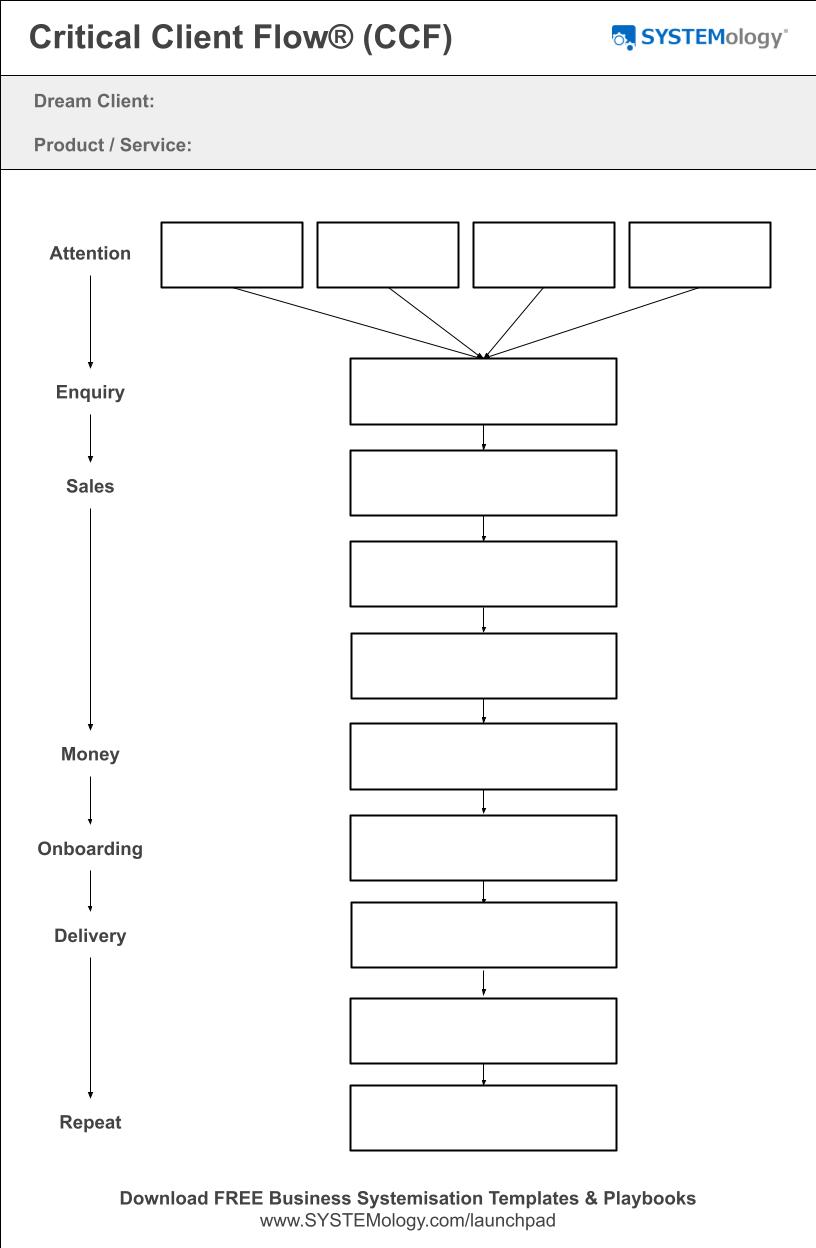
The Critical Client Flow (CCF) maps your core repeatable processes from first contact through to repeat business.
3. Break down each stage into tasks
Under each stage of the CCF, list the specific tasks that happen. For example, under “Sales” you might have: send proposal, follow up after three days, schedule discovery call. Each of those is a repeatable process.
4. Spot the tasks that happen more than once
Go through your list and highlight every task that happens on a recurring basis, whether daily, weekly, or monthly. These are your repeatable processes. The one-off or rare tasks can wait.
5. Prioritise using the 80/20 rule
Not all repeatable processes are equally important. Apply the 80/20 principle: 20% of your systems will produce 80% of your efficiency wins. Focus on the ones that directly impact client delivery, revenue, or the tasks that currently depend on you personally. This is the art of prioritising the right systems.
Tip: Your CCF should have no more than 7 to 12 steps. If you end up with more, simplify by combining steps that are handled by the same person or department. The goal is to explain how your business works on the back of a napkin.
How to document a repeatable process
You have identified your critical repeatable processes. Now it is time to get them out of people’s heads and into a format anyone can follow. This is where most business owners stall, because they assume documentation means sitting down and writing a detailed manual from scratch.
It does not. The SYSTEMology extraction method is designed to make this as painless as possible. Here is the step-by-step approach.
1. Identify the result the process should produce
Before you record anything, be clear about the outcome. What does “done well” look like? For an invoicing process, the result might be: “Invoice sent to client within 24 hours of project completion, with correct amounts and payment terms.” That clarity guides everything that follows.
2. Find your knowledgeable worker
This is one of the most important principles in SYSTEMology. The business owner is typically the worst person to document systems. Why? Because you are too busy, too close to the detail, and probably not the person who actually does the task day to day.
Instead, identify the team member who already does this task to a high standard. That is your “knower,” the knowledgeable worker. They are the one whose method you want to capture and clone across the team.
3. Record them doing the task
Here is where the extraction method really shines. Instead of asking someone to write down what they do (which creates resistance), you simply record them doing it. For desk-based work, use screen-recording software. For physical tasks, use a phone camera or GoPro. For conversations or sales calls, use a voice recorder.
The knowledgeable worker just does their job. No extra effort required. The recording captures the process naturally.
4. Have your systems champion turn it into documentation
Creating systems is a two-person job. One person shares the knowledge (the knowledgeable worker) and another person documents it (your systems champion). The systems champion watches the recording and turns it into a clear, step-by-step standard operating procedure.
This small shift is what makes the SYSTEMology method actually work. Most people hate writing documentation. But most people do not mind editing something that already exists. Get version one done by your systems champion, then let the knowledgeable worker review and refine it.
5. Test with a new team member
The real test of any repeatable process is whether someone who has never done the task before can follow the documentation and produce an acceptable result. Hand it to a new hire, a colleague from a different department, or anyone who was not involved in creating it. If they get stuck, that tells you exactly where the documentation needs improvement.
Key principle: Your first version of any documented process will be the worst it will ever be. And that is completely fine. The goal is not a perfect document. It is a usable baseline that your team can follow and improve over time. Every iteration makes the process better. That is why understanding the importance of documentation is the first step.
Repeatable process examples across departments
Repeatable processes exist in every department of your business. Here are four examples to show what a documented repeatable process looks like in practice. Notice how each one has a clear trigger, a defined sequence of steps, and a measurable endpoint.
Marketing: Weekly email newsletter send
Trigger: Every Monday morning at 9:00 AM.
- Review content calendar for this week’s topic and approved copy.
- Build the email in the marketing platform using the standard template.
- Add subject line, preview text, and CTA link.
- Send a test email to the review group.
- Make any final edits based on test feedback.
- Schedule the email for the approved send time.
- Log send date, subject line, and open rate in the tracking spreadsheet.
Endpoint: Email sent and metrics logged within 24 hours.
Sales: Handling an incoming enquiry
Trigger: New enquiry received via phone, email, or web form.
- Respond within two business hours with the standard acknowledgement template.
- Log the enquiry in the CRM with contact details, source, and initial notes.
- Qualify the lead using the standard qualification checklist.
- If qualified, schedule a discovery call within 48 hours.
- If not qualified, send the appropriate “not a fit” template and close the enquiry.
- Update the CRM status and assign follow-up tasks.
Endpoint: Lead qualified and either booked for a discovery call or closed out within 48 hours.
Operations: Client onboarding sequence
Trigger: New client signs the agreement and pays the first invoice.
- Send the welcome email with login credentials and next steps.
- Create the client project in the project management tool.
- Send the onboarding questionnaire.
- Schedule the kickoff call within five business days.
- Assign the account manager and introduce them to the client.
- Complete the kickoff call, set expectations, and confirm deliverables.
Endpoint: Client onboarded, expectations set, and first deliverable scheduled within one week of payment.
Finance: Weekly invoicing cycle
Trigger: Every Friday afternoon.
- Review completed work for the week against active client projects.
- Generate invoices in accounting software using standard templates.
- Cross-check amounts against agreed pricing and any approved change orders.
- Send invoices to clients via email with standard payment terms.
- Log each invoice in the accounts receivable tracker.
- Follow up on any invoices overdue by more than seven days.
Endpoint: All invoices for the week sent and logged. Overdue invoices flagged for follow-up.
These examples follow a pattern you can apply to any repeatable process. Define the trigger, list the steps, and specify the endpoint. That structure works whether you are creating everyday procedures for your receptionist or building a complex delivery workflow for your operations team.
Ready to document your repeatable processes?
systemHUB gives you the tools and templates to capture, organise, and share your systems with your entire team.
The McDonald’s lesson (and why you should not copy them)
“You need to systemise like McDonald’s.” I hear this constantly. And it is one of the most damaging myths in business.
Yes, McDonald’s is the gold standard of repeatable processes. They turned a hamburger restaurant into the most successful franchise of all time. Ray Kroc took what the McDonald brothers had built, an operation that already functioned as a well-oiled machine, and scaled it across the globe with relentless consistency.
But here is what people miss. McDonald’s in its current form is the result of six decades of development. When Ray Kroc first arrived on the scene, the McDonald brothers had already tried and failed to franchise their restaurant. The system was far from perfect. It took years of optimisation to reach near perfection.
Think of McDonald’s as an elite athlete competing at Olympic level in the sport of business systemisation. They have been training their whole life. Comparing your business to theirs and trying to replicate their level of detail from day one is like a couch potato trying to follow an Olympic training program. It will not work, and you will burn out before you see any results.
The real lesson: McDonald’s did not start with perfect processes. They started by documenting what was already working, then improved from there. That is exactly what you should do. Capture your repeatable processes as they are today. Get your team following them consistently. Then optimise over time. Start where you are, not where you would like to be.
I have seen business owners get bitten by the systemisation bug and immediately try to create Olympic-level detail for every process. They start split-testing tiny variables before they even have a baseline in place. That level of optimisation makes sense for McDonald’s. It does not make sense for a business that has not yet documented its core repeatable processes.
The practical takeaway? Document first. Optimise later. Your first version of every repeatable process will be rough. And that is exactly right. A rough process that your team actually follows beats a “perfect” process that never gets created. That is the foundation of improving your business processes over time.
Common mistakes when building repeatable processes
After working with hundreds of business owners through the SYSTEMology framework, I see the same mistakes come up again and again. Here are the five that derail the most progress.
Trying to document everything at once. This is the number one killer. The business owner gets motivated, creates a list of 150 processes, and then feels so overwhelmed they do not start a single one. Use the CCF to identify just 10 to 15 critical repeatable processes. Start there. You can always expand later.
Waiting for the “perfect” process before documenting. Perfectionism disguised as quality control. If you wait until a process is flawless before you write it down, you will never write it down. Document what is currently happening, even if it is messy. A documented imperfect process beats an undocumented “perfect” one every day.
Making the business owner write all the documentation. The business owner is typically the worst person to be documenting systems. They are too busy, and they are rarely the person who does the task every day. Use the extraction method: the knowledgeable worker demonstrates, the systems champion documents. Two-person job.
Overcomplicating systems to McDonald’s-level detail. Your processes do not need to rival a Fortune 500 company on day one. Keep them simple. A repeatable process document should be short enough that someone can read it in five minutes and start executing. You can add detail later as you delegate and refine.
Failing to assign ownership. A documented process with no owner is a document that gathers dust. Every repeatable process needs a person responsible for making sure it is followed and keeping it updated. No owner, no accountability, no results.
Frequently asked questions
What is a repeatable process?
A repeatable process is any task or sequence of steps that happens more than once in your business and can be documented so that different team members can produce a consistent result. Examples include sending invoices, onboarding clients, responding to enquiries, and processing payroll. If a task recurs on a regular basis and involves defined steps, it qualifies as a repeatable process.
What is the difference between a process and a procedure?
A process describes the overall flow of work from start to finish, covering what needs to happen and in what order. A procedure is a more detailed, step-by-step instruction for how to complete a specific task within that process. Think of the process as the map and the procedure as the turn-by-turn directions. Both matter for building a systemised business. You can learn more in our guide to processes and procedures.
How many repeatable processes does a small business need?
You do not need hundreds. The Critical Client Flow (CCF) typically identifies 10 to 15 core repeatable processes that drive your business. Start there. As those are documented and running smoothly, you can expand into supporting departments like finance, HR, and management. In my experience, just 20% of your processes will deliver 80% of your operational improvements.
How do you make a process repeatable?
A process becomes repeatable when it has three things: a clear trigger (what kicks it off), a defined sequence of steps (the method), and a measurable endpoint (how you know it is done). Document these three elements, test the documentation with someone who has not done the task before, and refine based on their feedback. That gives you a repeatable process anyone on the team can follow.
What is the Critical Client Flow (CCF)?
The CCF is a SYSTEMology tool that maps the journey your client takes through your business, from first hearing about you to becoming a repeat customer. It identifies 7 to 12 key stages (such as Attention, Enquiry, Sales, Onboarding, Delivery, and Repeat) and reveals the core repeatable processes your business depends on. It takes about twenty minutes to complete and provides a clear starting point for your systemisation efforts.
Who should document repeatable processes?
Not the business owner. The SYSTEMology extraction method uses two people: the knowledgeable worker (the person who does the task best) demonstrates or is recorded, and the systems champion (an organised, detail-oriented team member) turns that recording into written documentation. The knowledgeable worker then reviews and refines the draft. This two-person approach removes the biggest barrier to getting systems documented.
How often should repeatable processes be reviewed?
As a general rule, review your core repeatable processes every 90 days. This does not mean rewriting them from scratch. It means checking whether the documented steps still match how the work is actually being done and whether there are obvious improvements to make. Some processes will need updating more frequently, especially if your business is growing quickly or you have recently changed tools.
Can repeatable processes work for creative businesses?
Absolutely. This is one of the most common objections I hear, and it comes from a misunderstanding of what a repeatable process actually is. Systemising your business does not remove creativity. It removes the repetitive, administrative tasks that surround the creative work. A graphic design agency, for example, still produces unique creative output for every client. But the way they brief the project, manage revisions, deliver files, and invoice the client can all be repeatable processes. The system handles the structure so the creative team can focus entirely on the work that matters.
Every business is already running on repeatable processes. The only question is whether yours are documented or stuck inside someone’s head.
You do not need to overhaul your entire operation. Start with one process. The one that causes you the most headaches or takes up the most of your time. Document it using the extraction method. Hand it to someone else. Then move on to the next one.
That is how you build a business that runs without you. One repeatable process at a time. If you are ready to get started, explore systemHUB and see how it can help you capture, organise, and share your systems with your team.